Presented By: Vertex
Dr. Stacy Johnson
Nephrologist
Clinical Development Director
Vertex
Alonzo Mourning
Disease Advocate
Vertex
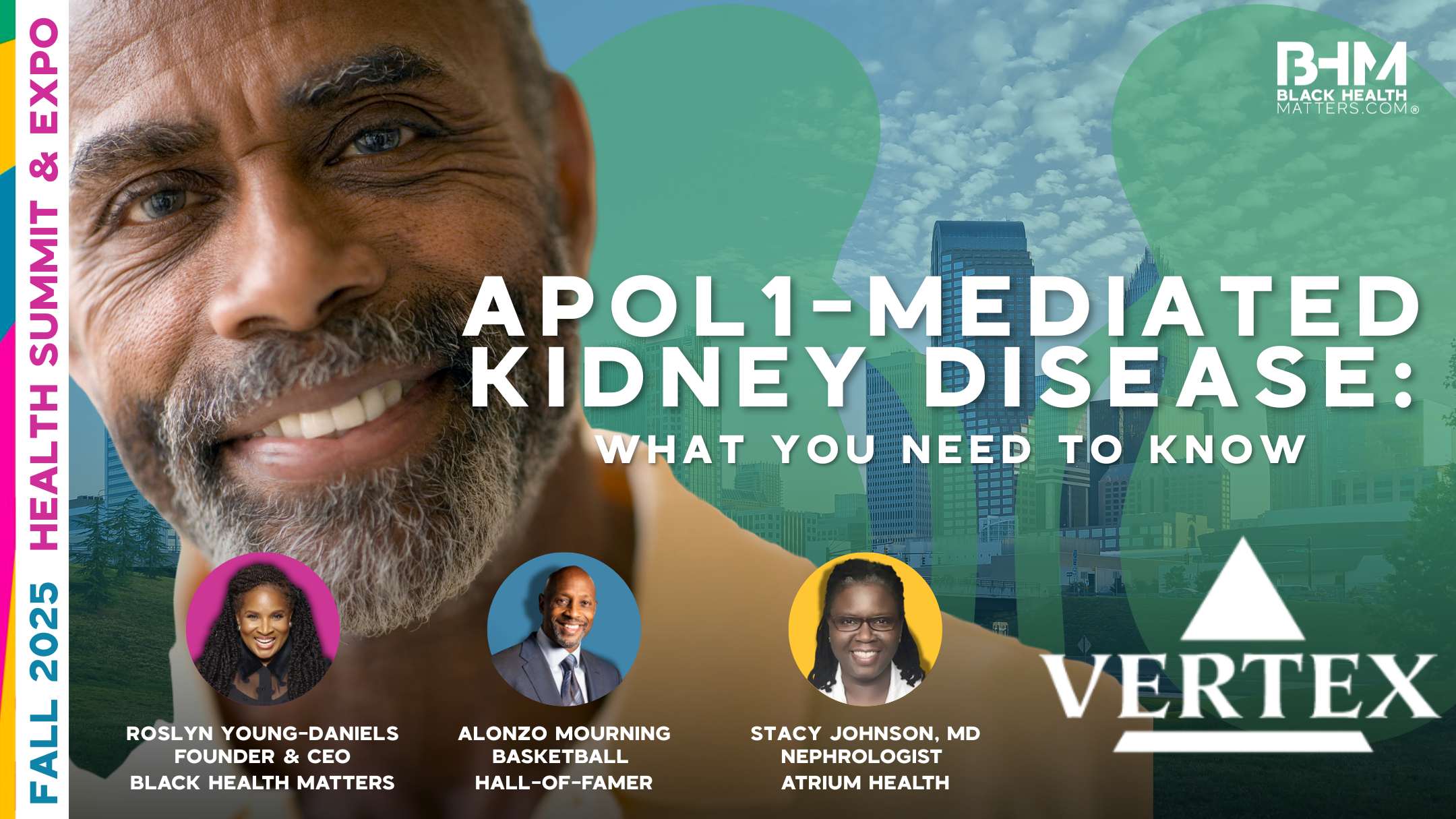
Kidney diseases can show up anywhere, including NBA locker rooms. Athletic legend and disease advocate Alonzo Mourning shared his experience discovering and cheating with APOL1-Mediated Kidney Disease at the Black Health Matters 2025 Health Summit & Expo.
He was joined by Black Health Matters Founder Roslyn Daniels and Dr. Stacy Johnson, Nephrologist, Clinical Development Director at Vertex.
Johnson highlighted the deep racial disparities in the diagnosis of kidney diseases. “Although African-Americans make up about 14% of the US population, they represent about 30% of the cases of kidney failure,” she said. The research has deepened into the genetic components of kidney disease in recent years.
“We have known for a long time that African-Americans have a higher chance of developing kidney disease, ending up on dialysis, or needing a kidney transplant. And it wasn’t until about 2010 when scientists were able to actually identify that there is a genetic cause,” Johnson continued.
A 2025 review of the Journal of Kidney Medicine reports that “6 million African Americans have a high-risk genotype,” which puts them at risk of kidney disease.
Johnson clarified that this risk can persist despite adopting doctor recommendations. “I think a lot of times before that people thought oh maybe your kidney disease isn’t getting better because your blood pressure isn’t under control, because you’re just not doing the right things,” she said. “But what we know is that no, there’s nothing that someone is doing wrong. You could do everything that you need to do to take care of your health, and sometimes the kidney disease continues to progress. But having that knowledge means now we can put a name to it. When you can name something, then you can start to deal.”
“The United States doesn’t really believe in investing in preventative care for its citizens,” said Daniels. “We bear this burden of disease; it’s not our fault.”
“We’re not getting the care that we deserve along the way, and by the time we’re diagnosed, it’s advanced,” Daniels added. “There’s no stigma here. There’s no pointing fingers.”
Heart disease is dubbed “the silent killer,” but kidney disease is just as sneaky. Its ability to be confused for other issues makes it extremely dangerous. That casual discomfort you’re dealing with might be a symptom of it creeping into your life undetected.
“The CDC estimates maybe one out of nine US Americans has kidney disease, and most of them don’t know it,” said Johnson.
“So that means there are a lot of there are like hundreds of thousands if not millions of people walking around with that are they’re losing kidney function slowly and steadily. Often, they may not have any symptoms. Sometimes they may have pretty mild symptoms like a little bit of fatigue. Maybe they might see some swelling in their feet that comes and goes, maybe they might see foamy urine, and they think, ‘Oh, I wonder if that means anything.’ But then they don’t, you know? No one follows up.”
That lack of follow-up has severe consequences for many people. Their lives and schedules change. “Unfortunately, by the time it gets to the more advanced stages often people are basically headed towards either needing dialysis or a kidney transplant,” said Johnson.
Mourning was fresh off the heels of an Olympic win at a point in his life where symptoms of kidney issues became unignorable. His victory lap was cut short.
“I had just witnessed the birth of my daughter,” he said. “I was defensive player of the year. I had just finished winning the gold medal. I mean, I was at the the top of the world,” he said.
Mourning noticed a few symptoms, but they did not jump out at him right away. “I was just tired. I had a lot of lethargy,” he said. “My legs were swelling a little bit and initially I kind of attributed
it to the intense physical training and the travel and flying over to Sydney, Australia.”
He was referred to a nephrologist, a medical doctor specializing in the health of the kidneys. “At that time when I was 30 years old I didn’t know what a nephrologist was,” he added. “They diagnosed me with FSGS, focal segmental glomerulosclerosis. It’s a disease that slowly scars the filters in the kidney, and I had the aggressive form.”
The first opinion was quite drastic. The doctor predicted that Mourning would be on dialysis and the transplant list within 365 days. Evaluations of kidney disease can be subjective. In some cases, it is wise to consult another voice.
Mourning refused to accept the course of treatment without seeking a second opinion.
“I was able to find another doctor. And that doctor took a different approach. He said, “Look, let’s try to slow the progression of the disease down with some medication, oral medication,” he said.
They participated in shared decision making (SDM), a practice advocated for in a 2023 article from the Clinical Kidney Journal. This shifts away from a paternalistic viewpoint and empowers the patient.
The less aggressive strategy worked out. “I was never on dialysis, and I didn’t need a transplant until three years later.”
Mourning participated in clinical research to further efforts to gain knowledge about his condition. “My nephrologist informed me about a research study that was designed to better understand the type of kidney disease that I had, and after discussing all of this with him, I had to trust that he was doing the right thing for me,” he said. Genetic testing and other studies can greatly benefit the outcomes of patients. He suggested that attendees talk with their family members to find out if they have been impacted by kidney disease in the past, so that they can share that information with their doctors.
“We’ve got to know our family history. We’ve got to have dialogue,” Mourning added.
Daniels explained how coming together as a community can spark dialogue. “You all are the beginning. You’re laying the foundation,” she told attendees. “You all will share with your friends and family the importance of the knowledge shared here.”
Johnson pointed out the importance of proactivity in healthcare. “I think this conversation is really important,” added Johnson. “We may see some of these symptoms and hope that things are going to change, but hope is not a strategy. We need to ask questions and have these things checked out.”
Mourning advised the room to learn from his mishaps. “Don’t ignore the signs and the
symptoms, okay? Don’t just brush it off, okay? That was something that I did.”

















