• Twenty47HealthNews
  • Health & Wellness
  • Disclaimer
    • Terms of Use
    • Privacy Policy
    • DMCA Notice
  • Twenty47HealthNews
  • Health & Wellness
  • Disclaimer
    • Terms of Use
    • Privacy Policy
    • DMCA Notice
24/7 Health News
No Result
View All Result
Home Article

Are people born with good balance? A physical therapist explains the systems that help keep you on your toes

October 9, 2023
in Article
Are people born with good balance? A physical therapist explains the systems that help keep you on your toes
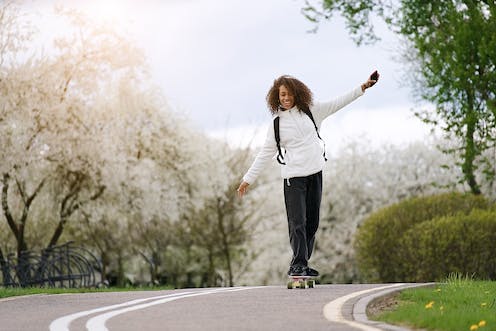
People learn balance as they grow – and can usually improve their balance with practice. uzhursky/iStock via Getty Images

Curious Kids is a series for children of all ages. If you have a question you’d like an expert to answer, send it to curiouskidsus@theconversation.com.


Are people born with good balance? – Sebastian L., age 15, Skanderborg, Denmark


No one is born with the ability to ride a skateboard, surf or even stand on their tiptoes. Unlike other mammals, human beings have no balance at birth – virtually no capacity to walk or even stand. Before that can happen, their vision, hearing, muscles, bones and brain must develop. This takes months, and for some activities, even years.

Infants typically begin rolling over when they’re 6 months old. They generally start to crawl by 9 months, and stand around a year old. By 18 months old, most can walk alone and go up steps. By age 2, toddlers can perform more complex tasks, such as kicking a ball. By 3 years old, most children run well and can walk up and down stairs with one foot on each stair. Some children reach these milestones faster, and some are slower, and that’s normal.

It’s all about practice, practice, practice.

Table of Contents

  • Balance is a skill
  • Becoming unbalanced
  • Learning better balance

Balance is a skill

As you get older, you may notice that some people are really good at keeping their balance. They can dance well, jump rope and do somersaults. But they were not born with this ability. Instead, it took practice. Balance is a skill – the more you practice any skill, the better you become, though some people may be more naturally adept at it.

As a physical therapist for over 15 years, I’ve seen patients of all ages who struggle with balance, and I’ve learned that it takes three of the body’s systems working together to keep a person in good balance: the visual, somatosensory and vestibular systems.

The visual system includes the eyes, the optic nerves that connect the eyes to the brain, and the brain’s visual cortex. Babies are born nearsighted, able to see only about 10 to 12 inches away. As their visual system develops, their brain learns how to process visual information, so they get better at moving and balancing.

The somatosensory system registers sensations detected by the muscles, joints, skin and the body tissues that connect them, called the fascia. These perceptions of touch, pressure, pain, temperature, position, movement and vibration travel via pathways in the spinal cord, brain stem and thalamus – a small, egg-shaped structure in the middle of the human brain – where they are integrated and analyzed.

For example, when a baby tries to stand, their brain processes the feelings coming from their feet, legs and hands to help them balance.

The vestibular system, which is the body’s system of hearing as well as balance, consists of five distinct organs in the ear. Inside these organs there is fluid, which moves when the body and head move. As this fluid moves, it sends signals to the brain, which in turn makes a person aware of their position and helps them balance.

The central nervous system uses the information coming from these three systems and generates signals that are sent back to appropriate muscles in the body to help maintain good balance.

Healthy individuals rely roughly 70% on somatosensory information, 20% on vestibular system information and 10% on vision to maintain balance on firm surfaces.

Abnormality in any one of these three systems may result in balance problems. But when one system is affected, the other two can be trained to compensate.

Ananth Vijendren, a physical therapist, explains how he assesses patients who see him for balance problems.

Becoming unbalanced

There are many ways to lose one’s balance. Standing on slippery ice, the sensory receptors in the feet are unable to send appropriate signals to the brain quickly enough for the brain to activate muscles to maintain balance.

For many people, walking in the dark means risking a fall because the brain is receiving so little visual information about the environment. People with poor or no eyesight learn to rely more on the other two sensory systems to maintain balance.

When something knocks a person off balance, such as being bumped while walking or running, it can cause something called a “vestibulospinal reflex.” The vestibular and somatosensory systems send signals to the brain, which in turn activates the appropriate muscles to save the person from falling.

As people get older, their balance often declines due to age-related changes to their muscle strength and vision, as well as other causes. This increases their risk of falling. In fact, falls are a leading cause of physical injuries for adults 65 years and older. Older adults can work on balance, strength and flexibility exercises as a way to prevent falls.

People can also have trouble with balance due to neurological problems, arthritis and joint injuries.

Woman gymnast balancing on one bent leg on a balance beam with the other leg extended straight behind her.
Gymnast Misaki Masui of Japan demonstrated her athletic skills on the balance beam during a June 2023 national competition in Tokyo.
Kiyoshi Ota/Getty Images AsiaPac via Getty Images

Learning better balance

All of this explains why it’s necessary to practice if you want to improve your balance. For example, gymnasts who practice walking on narrow beams continuously challenge their somatosensory and vestibular systems. This trains their brains to respond to very subtle changes, which means they get better and better at staying on their toes.


Read more:
What Olympic gymnasts can teach us about improving our balance


.

People are sometimes born with disorders or developmental problems, such as cerebral palsy, that affect the visual, vestibular or somatosensory systems. Infants with such issues ideally start physical therapy very early, which allows them to achieve developmental milestones – from holding their heads up to standing and moving independently.

When I treat people with balance problems, I begin by evaluating whether their somatosensory system is working properly, and I ask about injuries to muscles or bones. Depending on what the problem is, we may do simple exercises such as standing or marching in one place, and progress to more difficult exercises such as walking fast or walking while talking.


Hello, curious kids! Do you have a question you’d like an expert to answer? Ask an adult to send your question to CuriousKidsUS@theconversation.com. Please tell us your name, age and the city where you live.

And since curiosity has no age limit – adults, let us know what you’re wondering, too. We won’t be able to answer every question, but we will do our best.

The Conversation

Gurpreet Singh does not work for, consult, own shares in or receive funding from any company or organization that would benefit from this article, and has disclosed no relevant affiliations beyond their academic appointment.


ShareTweetSharePin
Next Post
How employers can tackle misconceptions about disabled people in the workplace

How employers can tackle misconceptions about disabled people in the workplace

Most Read

What causes stuttering? A speech pathology researcher explains the science and the misconceptions around this speech disorder

What causes stuttering? A speech pathology researcher explains the science and the misconceptions around this speech disorder

December 15, 2022
morning back pain

Morning Again Ache Trigger Is Not the Mattress

October 11, 2021

Why Circadian Rhythms Matter for Your Health

July 30, 2024
lower back pain relief exercises

5 decrease again ache aid workouts

October 11, 2021

4 steps to building a healthier relationship with your phone

January 28, 2025
Nasal vaccines promise to stop the COVID-19 virus before it gets to the lungs – an immunologist explains how they work

Nasal vaccines promise to stop the COVID-19 virus before it gets to the lungs – an immunologist explains how they work

December 14, 2022
3 years after legalization, we have shockingly little information about how it changed cannabis use and health harms

3 years after legalization, we have shockingly little information about how it changed cannabis use and health harms

October 15, 2021
bleeding in gum

When The Bleeding in gum Is Severe ?

October 11, 2021
Good Night Sleep

6 Causes of Good Evening Sleep

October 11, 2021
Kick up your heels – ballroom dancing offers benefits to the aging brain and could help stave off dementia

Kick up your heels – ballroom dancing offers benefits to the aging brain and could help stave off dementia

January 3, 2023
3 women stroke prevention

Silent Stroke Symptoms in Women: What You Might Be Overlooking

February 27, 2026
Ten small changes you can make today to prevent weight gain

Ten small changes you can make today to prevent weight gain

October 12, 2021
Biden is getting prostate cancer treatment, but that’s not the best choice for all men − a cancer researcher describes how she helped her father decide

Biden is getting prostate cancer treatment, but that’s not the best choice for all men − a cancer researcher describes how she helped her father decide

May 20, 2025

COVID vaccines: how one can pace up rollout in poorer international locations

October 5, 2021

This Simple Hygiene Habit Could Cut Your Risk of Stroke, New Research Reveals

February 1, 2025
Five ways to avoid pain and injury when starting a new exercise regime

Five ways to avoid pain and injury when starting a new exercise regime

December 30, 2022
Support and collaboration with health-care providers can help people make health decisions

Support and collaboration with health-care providers can help people make health decisions

December 16, 2021
Greece to make COVID vaccines mandatory for over-60s, but do vaccine mandates work?

Greece to make COVID vaccines mandatory for over-60s, but do vaccine mandates work?

December 1, 2021

Multiple sclerosis: the link with earlier infection just got stronger – new study

October 12, 2021
woman covered with white blanket

Exploring the Impact of Sleep Patterns on Mental Health

August 4, 2024

Maximize Your Performance – Sync with Your Circadian Rhythms

August 9, 2024
Backlash to transgender health care isn’t new − but the faulty science used to justify it has changed to meet the times

Backlash to transgender health care isn’t new − but the faulty science used to justify it has changed to meet the times

January 30, 2024
Nurses’ attitudes toward COVID-19 vaccination for their children are highly influenced by partisanship, a new study finds

Nurses’ attitudes toward COVID-19 vaccination for their children are highly influenced by partisanship, a new study finds

December 2, 2022
GPs don’t give useful weight-loss advice – new study

GPs don’t give useful weight-loss advice – new study

December 16, 2022
As viral infections skyrocket, masks are still a tried-and-true way to help keep yourself and others safe

As viral infections skyrocket, masks are still a tried-and-true way to help keep yourself and others safe

December 14, 2022
Four ways to avoid gaining weight over the festive period – but also why you shouldn’t fret about it too much

Four ways to avoid gaining weight over the festive period – but also why you shouldn’t fret about it too much

December 22, 2022
Why are some people faster than others? 2 exercise scientists explain the secrets of running speed

Why are some people faster than others? 2 exercise scientists explain the secrets of running speed

April 29, 2024
Nutrition advice is rife with misinformation − a medical education specialist explains how to tell valid health information from pseudoscience

Nutrition advice is rife with misinformation − a medical education specialist explains how to tell valid health information from pseudoscience

January 28, 2025
News of war can impact your mental health — here’s how to cope

Binge-eating disorder is more common than many realise, yet it’s rarely discussed – here’s what you need to know

December 2, 2022
The promise of repairing bones and tendons with human-made materials

The promise of repairing bones and tendons with human-made materials

January 4, 2022
  • Twenty47HealthNews
  • Health & Wellness
  • Disclaimer

© 2020 DAILY HEALTH NEWS

  • Twenty47HealthNews
  • Health & Wellness
  • Disclaimer
    • Terms of Use
    • Privacy Policy
    • DMCA Notice

© 2020 DAILY HEALTH NEWS










