
Medically Reviewed
Dr. Jose Rossello, MD, PhD, MHCM
Preventive Medicine & Public Health Specialist
Last Reviewed: January 17, 2026
Table of Contents
Quick Interpretation Guide
Normal Range: <0.50 µg/mL (500 ng/mL) FEU for adults under 50 years; Age-adjusted cutoff = (Age × 10) ng/mL for adults over 50 years
Slightly Elevated (500-1000 ng/mL): May indicate mild infection, early pregnancy, minor surgery, or small thromboses. Often requires clinical context and further evaluation[1]
Significantly Abnormal (>5000 ng/mL): Strong indicator of serious disease including massive pulmonary embolism, disseminated intravascular coagulation (DIC), sepsis, or advanced malignancy. Requires immediate medical attention
Next Steps: If abnormal with low clinical probability, proceed to imaging studies (ultrasound for DVT, CT pulmonary angiography for PE). If high clinical probability, proceed directly to imaging without D-dimer testing
Understanding the Test
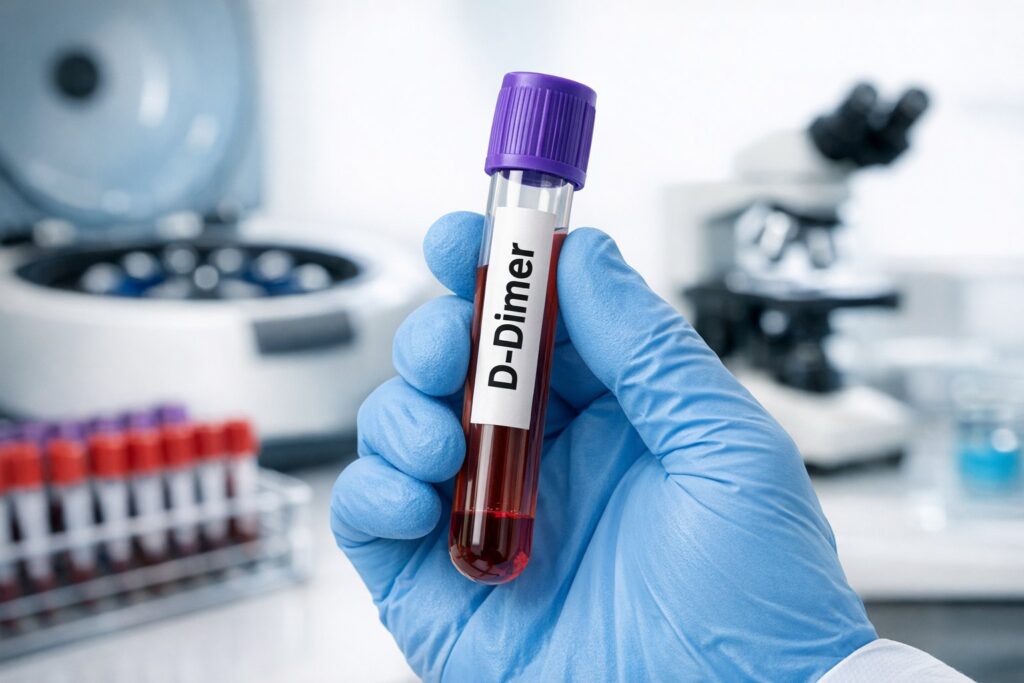
D-dimer is a fibrin degradation product that forms when blood clots break down in the body. The test measures the concentration of these protein fragments in plasma, serving as a biomarker for both thrombosis formation and fibrinolysis activity. D-dimer testing has become a cornerstone of modern emergency medicine and thrombosis evaluation due to its exceptional negative predictive value—approaching 99% when combined with low clinical probability assessment.
Clinicians primarily order D-dimer testing to exclude venous thromboembolism (VTE), which encompasses deep vein thrombosis (DVT) and pulmonary embolism (PE). The test’s high sensitivity (≥95%) makes it excellent for ruling out these life-threatening conditions in appropriately selected patients. When D-dimer levels fall below the established cutoff in patients with low or intermediate pretest probability, VTE can be safely excluded without expensive or invasive imaging studies.
Beyond VTE evaluation, D-dimer assists in diagnosing disseminated intravascular coagulation (DIC), monitoring snake venom poisoning, evaluating acute aortic dissection, and assessing thrombotic risk in certain patient populations. The test also plays a role in guiding anticoagulation duration decisions after an initial VTE event, with persistently elevated levels after treatment completion indicating higher recurrence risk.
However, D-dimer has significant limitations that clinicians must understand. Its low specificity means elevated levels occur in numerous non-thrombotic conditions including pregnancy, recent surgery, trauma, infection, malignancy, and advanced age. This poor specificity renders D-dimer unsuitable as a standalone diagnostic test or screening tool in unselected populations. The test should never be ordered in patients with high pretest probability of VTE, as a negative result cannot reliably exclude thrombosis in this group. Additionally, D-dimer cannot localize clots, distinguish between acute and chronic thrombosis, or differentiate thrombotic from inflammatory causes of elevation.
Normal Results & Reference Ranges
Standard Reference Ranges
The conventional D-dimer cutoff for adults under 50 years is <0.50 µg/mL or <500 ng/mL when reported in fibrinogen equivalent units (FEU). However, laboratories may use different assay methodologies and report results in either FEU or D-dimer units (DDU), which are not directly interchangeable. DDU values approximate FEU by multiplying by two (1 µg/mL D-dimer = 2 µg/mL FEU).
| Population | Normal Range (ng/mL FEU) |
|---|---|
| Adults <50 years | <500 |
| Adults 50-60 years | <600 (age-adjusted) |
| Adults 60-70 years | <700 (age-adjusted) |
| Adults 70-80 years | <800 (age-adjusted) |
| Adults >80 years | <900 (age-adjusted) |
| First trimester pregnancy | 50-950 |
| Second trimester pregnancy | 320-1290 |
| Third trimester pregnancy | 130-1700 |
Age-adjusted D-dimer cutoffs significantly improve specificity in older adults without compromising safety. Studies demonstrate that using the formula (age × 10 ng/mL) for patients over 50 years increases the proportion of elderly patients in whom VTE can be excluded from 28% to 47% in those over 70 years. This approach reduces unnecessary imaging procedures while maintaining negative predictive values above 99%.
Optimal vs Normal
While laboratories typically report D-dimer as positive or negative based on the standard cutoff, the degree of elevation carries prognostic significance. Patients with D-dimer levels between 250-500 ng/mL occupy a gray zone where clinical probability assessment becomes particularly important. After anticoagulation completion for unprovoked VTE, patients with D-dimer <250 ng/mL have a remarkably low 2-year recurrence risk of 3.7%, compared to 11.5% in those with higher levels. This “optimal” threshold below 250 ng/mL may guide decisions about anticoagulation duration in selected patients.
Common Causes of Abnormal Results (Ranked by Frequency)
Most Frequent Causes of Elevation
- Infection and Sepsis (15.6-41.2% of elevated D-dimers) – Systemic inflammation drives coagulation activation, with D-dimer levels correlating with disease severity. Sepsis represents one of the three most common diagnoses in patients with extremely elevated D-dimer (>5000 µg/L), accounting for approximately 24% of cases.
- Venous Thromboembolism (12.1-40% of elevated D-dimers) – Pulmonary embolism is the single most common cause of extremely elevated D-dimer (>5000 µg/L), representing 32% of such cases. Deep vein thrombosis accounts for an additional 13% of markedly elevated levels.
- Pregnancy (physiologic elevation) – D-dimer increases progressively during normal pregnancy, with median third-trimester values of 1700 ng/mL (range 130-1700). This physiologic elevation occurs due to increased coagulation factor production and does not necessarily indicate pathology.
- Recent Surgery or Trauma (8.2-24.4% of elevated D-dimers) – Tissue injury activates coagulation cascades, with over two-thirds of postoperative patients demonstrating positive D-dimer. Surgery increases D-dimer positivity odds by approximately 60%.
- Active Malignancy (5.8-29% of elevated D-dimers) – Cancer promotes a hypercoagulable state through multiple mechanisms. Malignancy is particularly prevalent in patients with extremely elevated D-dimer, with levels >8000 ng/mL independently associated with occult cancer.
Most Frequent Non-Thrombotic Causes
- Advanced Age – D-dimer increases physiologically with aging due to enhanced coagulation activation and reduced clearance. In patients over 80 years, up to 20% have elevated D-dimer without thrombosis.
- Chronic Inflammatory Conditions – Rheumatoid arthritis, spondyloarthritis, and other autoimmune diseases generate elevated D-dimer through inflammation-driven coagulation activation. D-dimer correlates with disease activity markers including ESR and CRP.
- Heart Failure and Cardiovascular Disease – Cardiac dysfunction and atrial fibrillation produce elevated D-dimer through endothelial dysfunction and reduced flow states.
- Liver Disease – Hepatic dysfunction impairs D-dimer clearance and alters coagulation factor synthesis.[2]
- Renal Insufficiency – End-stage renal disease associates with 45% higher risk of positive D-dimer independent of thrombosis.[3]
Less Common Causes
Rare but important causes of elevated D-dimer include acute aortic dissection (sensitivity 94-100% when measured within 24 hours), sickle cell disease (particularly during vaso-occlusive crises with odds ratio of 24.17), connective tissue disorders, COVID-19 infection and post-acute COVID syndrome, and disseminated intravascular coagulation.
Severity Classification
Mild Abnormality (500-1000 ng/mL)
Mild elevations typically indicate low-grade coagulation activation from minor infections, early pregnancy, small thromboses, or recent minor procedures. These levels carry limited specificity and require careful clinical correlation. In patients with low pretest probability of VTE, mild elevations often reflect non-thrombotic etiologies.
Moderate Abnormality (1000-5000 ng/mL)
Moderate elevations suggest more substantial thrombotic or inflammatory processes including deep vein thrombosis, pulmonary embolism, serious infections, or active malignancy. This range warrants systematic evaluation with imaging studies when VTE is clinically suspected. Approximately 15% of emergency department patients presenting with symptoms fall into this category.
Severe Abnormality (>5000 ng/mL)
Extreme elevations signal severe systemic disease requiring urgent evaluation. In one large study, 89% of patients with D-dimer >5000 µg/L had venous thromboembolism, sepsis, and/or cancer. Massive pulmonary embolism, disseminated intravascular coagulation, severe sepsis, and advanced malignancy represent the most common diagnoses. D-dimer levels 3-4 times above normal (>1500-2000 ng/mL) warrant serious consideration for hospital admission even without severe symptoms, as they signify substantial thrombin generation and associate with increased mortality. In COVID-19 patients, D-dimer >5000 ng/mL carries a 50% positive predictive value for thrombotic complications.
Associated Symptoms & Clinical Patterns
Deep Vein Thrombosis Presentation
DVT classically manifests with unilateral leg pain, swelling, warmth, erythema, and tenderness. Calf pain on foot dorsiflexion (Homans sign) may be present but lacks specificity. Pitting edema and dilated superficial veins appear in more severe cases. Approximately 70% of patients presenting with DVT symptoms do not actually have the condition, underscoring the importance of objective testing.
Pulmonary Embolism Presentation
PE symptoms include sudden-onset dyspnea (most common), pleuritic chest pain, hemoptysis, tachycardia, tachypnea, and low-grade fever. Syncope occurs in 10-15% of cases and indicates more severe disease with right ventricular dysfunction. Massive PE may present with hemodynamic instability, hypotension, and cardiovascular collapse. The triad of dyspnea, chest pain, and hypoxemia strongly suggests PE but appears in only a minority of cases.
Disseminated Intravascular Coagulation
DIC presents with simultaneous bleeding and thrombosis due to consumption of coagulation factors. Laboratory findings include thrombocytopenia, prolonged PT/aPTT, low fibrinogen, and markedly elevated D-dimer (typically >5000 ng/mL). Clinical manifestations range from subtle laboratory abnormalities to catastrophic bleeding and organ failure.
Recommended Diagnostic Workup
D-dimer testing should never stand alone but rather integrate into validated clinical decision algorithms. The Wells score, revised Geneva score, and PERC rule represent evidence-based tools for pretest probability assessment.
For Suspected Pulmonary Embolism
Low Pretest Probability Meeting PERC Criteria: No D-dimer testing or imaging required
Low/Intermediate Pretest Probability Not Meeting PERC:
- Obtain high-sensitivity D-dimer
- If D-dimer negative (<age-adjusted cutoff): No further testing
- If D-dimer positive: Proceed to CT pulmonary angiography (CTPA) or V/Q scan
High Pretest Probability: Proceed directly to CTPA without D-dimer testing
For Suspected Deep Vein Thrombosis
Low Pretest Probability:
- D-dimer testing first-line
- If negative: DVT excluded
- If positive: Proximal compression ultrasonography
Moderate/High Pretest Probability: Proceed directly to ultrasonography
Additional Testing
When D-dimer is elevated without clear thrombotic etiology, consider:
- Complete blood count (assess for thrombocytopenia suggesting DIC)
- Prothrombin time, aPTT, fibrinogen (evaluate coagulation cascade)[4]
- C-reactive protein, erythrocyte sedimentation rate (inflammatory markers)
- Cancer screening in patients >50 years with unexplained persistent elevation
- Chest imaging if symptoms suggest infection or malignancy[5]
- Echocardiography if heart failure suspected
Age & Gender Differences
D-dimer levels increase progressively with age due to enhanced basal coagulation activation, reduced fibrinolytic capacity, and accumulated comorbidities. Without age adjustment, D-dimer specificity drops dramatically in older adults—only 10-20% of elderly patients with low pretest probability have negative results using the conventional 500 ng/mL cutoff. Age-adjusted thresholds (age × 10 ng/mL for patients >50 years) restore diagnostic utility by increasing specificity from approximately 35% to 60% in septuagenarians while maintaining sensitivity above 97%.
Gender differences in D-dimer remain less pronounced outside pregnancy, though some studies suggest slightly higher baseline levels in women using combined hormonal contraception. Pregnancy induces dramatic physiologic increases, with D-dimer rising from 50-950 ng/mL in the first trimester to 130-1700 ng/mL in the third trimester. Despite these elevated baselines, negative D-dimer still effectively excludes PE in pregnant women when combined with appropriate clinical probability assessment. Twin pregnancies demonstrate even higher D-dimer levels than singleton gestations.
Medications Affecting Results
Anticoagulants
Vitamin K Antagonists (VKAs): Therapeutic anticoagulation with warfarin lowers D-dimer levels. Median D-dimer in VKA users is approximately 0.20 mg/L.
Direct Oral Anticoagulants (DOACs): Paradoxically, DOACs including rivaroxaban, apixaban, and dabigatran produce higher D-dimer levels than VKAs despite effective anticoagulation. Median levels range from 0.24-0.31 mg/L, with 15-30% of patients exceeding normal reference ranges during treatment. This effect likely reflects DOAC-mediated facilitation of fibrin clot lysis.
Heparin/LMWH: Low molecular weight heparin reduces D-dimer levels during acute treatment. In COVID-19 studies, D-dimer decreased following LMWH initiation while remaining elevated compared to non-DVT patients.[6]
Statins
HMG-CoA reductase inhibitors (statins) modestly decrease D-dimer levels by approximately 15% through reduced tissue factor activity and thrombin generation. However, this effect is inconsistent across studies and does not warrant adjusting D-dimer cutoffs for statin users.[7]
Antiplatelet Agents
Aspirin and other antiplatelet drugs show no significant effect on D-dimer levels in most studies. P2Y12 inhibitors (clopidogrel, ticagrelor) may paradoxically associate with higher D-dimer in some populations.
Hormonal Contraceptives
Combined oral contraceptives significantly elevate D-dimer through estrogen-mediated increases in coagulation factors and decreased anticoagulant protein levels. Third- and fourth-generation progestins (desogestrel, drospirenone) carry higher VTE risk than second-generation formulations. D-dimer may remain elevated 1-3 months after COVID-19 in contraceptive users before normalizing.
Other Medications
Thrombolytic therapy dramatically increases D-dimer through accelerated clot breakdown. Some biologic DMARDs used in rheumatoid arthritis may influence D-dimer through anti-inflammatory effects, though data remain limited.
Treatment & Management
Initial Management
For Confirmed Venous Thromboembolism: Initiate anticoagulation immediately with LMWH, fondaparinux, or DOAC per current guidelines. Duration of therapy depends on whether VTE was provoked (3-6 months) or unprovoked (indefinite or guided by D-dimer after initial course).
For Elevated D-Dimer Without Confirmed Thrombosis: Management focuses on the underlying cause. Treat infections with appropriate antimicrobials, optimize heart failure management, address inflammatory conditions, or initiate cancer-directed therapy as indicated.
Monitoring Frequency
During active anticoagulation for VTE, routine D-dimer monitoring is not recommended. However, D-dimer plays a role in determining anticoagulation duration after the initial 3-6 month treatment period.
Post-Anticoagulation Monitoring Protocol:
- First D-dimer measurement: 15-30 days after stopping anticoagulation
- If negative (<250 ng/mL): Repeat every 2 months for 1 year
- If positive or becomes positive: Consider resuming or extending anticoagulation
In patients with unprovoked VTE and persistently negative D-dimer (<250 ng/mL), the 2-year recurrence risk is only 3.7%. Conversely, positive D-dimer after anticoagulation completion associates with 2-fold higher recurrence risk.
When Specialist Referral Needed
Refer to appropriate specialists for:
- Hematology: Recurrent VTE, family history suggesting thrombophilia, unexplained D-dimer >5000 ng/mL
- Pulmonology: PE with right heart strain, suspected chronic thromboembolic pulmonary hypertension[8]
- Vascular Surgery: Extensive DVT, phlegmasia cerulea dolens, consideration for catheter-directed thrombolysis[9]
- Oncology: Elevated D-dimer with concern for occult malignancy
- Rheumatology: Elevated D-dimer with suspected autoimmune etiology
Timeline to Improvement
D-dimer normalization kinetics vary substantially based on the underlying condition:
Acute Venous Thromboembolism: D-dimer peaks at baseline and typically trends downward over 1-2 weeks after anticoagulation initiation. However, a transient increase may occur 7-10 days into treatment as clot fragmentation accelerates—this paradoxical rise actually predicts better thrombolysis and is not a treatment failure. Complete thrombus dissolution occurs in approximately 68% of PE patients by 30 days and virtually all by 90 days with appropriate anticoagulation.
Post-Anticoagulation: After stopping anticoagulation for VTE, D-dimer reaches its peak positivity rate at 15 days (20.8%), with overall positivity of 48.8% by 90 days. Patients with negative D-dimer at 15-30 days have excellent prognosis with minimal risk of recurrence.
COVID-19 Infection: In post-acute COVID-19 syndrome, D-dimer may remain elevated for 2-4 months after clinical recovery. Approximately 25% of COVID-19 patients demonstrate persistent elevation at 80 days post-infection. With prophylactic anticoagulation, elevated D-dimers typically normalize within 2 weeks.
Inflammatory Conditions: D-dimer levels in rheumatoid arthritis and spondyloarthritis parallel disease activity and inflammatory markers. Effective anti-inflammatory therapy reduces D-dimer over weeks to months.
Malignancy: D-dimer remains persistently elevated in active cancer and normalizes only with successful cancer treatment.
Red Flags & Urgent Signs
Seek immediate emergency care (call 911 or go to nearest emergency department) if D-dimer elevation accompanies:
Pulmonary Embolism Warning Signs:
- Sudden severe shortness of breath at rest or with minimal exertion
- Sharp chest pain worsening with deep breathing
- Coughing up blood
- Rapid heart rate (>100 bpm) with lightheadedness or syncope
- Feeling of impending doom with chest discomfort[10]
Massive PE or Hemodynamic Instability:
- Blood pressure <90 mmHg systolic
- Confusion or altered mental status[8]
- Cyanosis (bluish skin discoloration)[8]
- Cardiac arrest[8]
Disseminated Intravascular Coagulation:
- Bleeding from multiple sites (IV sites, gums, nose)
- Petechiae or purpura (skin hemorrhages)[4]
- Acute confusion or altered consciousness[4]
- D-dimer >5000 ng/mL with thrombocytopenia and prolonged clotting times
Aortic Dissection:
- Sudden severe “tearing” chest or back pain
- Blood pressure difference >20 mmHg between arms[11]
- Neurological deficits or stroke symptoms[11]
Key Takeaways
- D-dimer serves as a highly sensitive “rule-out” test for venous thromboembolism but lacks specificity, making it unsuitable for screening or confirmation of thrombosis
- Age-adjusted cutoffs (age × 10 ng/mL for patients >50 years) significantly improve diagnostic accuracy in older adults while maintaining safety
- D-dimer must always be interpreted within the context of pretest probability using validated clinical decision rules such as Wells criteria or revised Geneva score
- Extremely elevated D-dimer (>5000 ng/mL) signals serious disease—89% have VTE, sepsis, or cancer—and warrants urgent comprehensive evaluation
- Normal D-dimer effectively excludes VTE in patients with low or intermediate pretest probability, avoiding unnecessary imaging in approximately 30-40% of cases
- Multiple non-thrombotic conditions elevate D-dimer including pregnancy, infection, malignancy, surgery, and inflammation, limiting specificity
- After completing anticoagulation for unprovoked VTE, D-dimer <250 ng/mL predicts low recurrence risk (3.7% at 2 years) and may support discontinuing therapy
Frequently Asked Questions
What if my result is slightly high (500-750 ng/mL)?
Borderline elevations require clinical correlation. If you have low pretest probability for VTE based on validated scoring systems and no concerning symptoms, the elevation likely reflects a non-thrombotic cause such as mild infection, inflammation, or physiologic variation. Your physician will integrate this result with your clinical presentation, risk factors, and symptoms to determine if further evaluation with imaging is needed. Many patients with mild elevations do not have thrombosis.
Should I repeat the test?
D-dimer testing should generally not be repeated for monitoring purposes during acute VTE evaluation—either proceed to imaging if positive, or exclude thrombosis if negative. However, serial D-dimer measurements play a valuable role in specific scenarios: monitoring after stopping anticoagulation for unprovoked VTE (measured at 15-30 days, then every 2 months), tracking treatment response in DIC, and assessing COVID-19 severity progression. Random repeat testing without clinical indication adds no value and may cause confusion.
What other tests should I get?
The appropriate follow-up testing depends on D-dimer level and clinical presentation. For suspected VTE with positive D-dimer, proceed to compression ultrasonography (for DVT) or CT pulmonary angiography (for PE). If D-dimer is extremely elevated (>5000 ng/mL) without obvious thrombosis, comprehensive evaluation should include CBC, PT/aPTT, fibrinogen, CRP, and consideration of chest imaging and age-appropriate cancer screening. Patients with chronic inflammatory conditions may benefit from ESR and disease-specific markers.
Can my medication affect this result?
Yes. Anticoagulants like warfarin lower D-dimer, while DOACs (rivaroxaban, apixaban, dabigatran) may produce higher levels than warfarin despite effective anticoagulation. Statins modestly reduce D-dimer by approximately 15%. Combined hormonal contraceptives significantly elevate D-dimer and increase VTE risk. Aspirin and most antiplatelet drugs do not substantially affect D-dimer levels. Always inform your healthcare provider about all medications, including over-the-counter drugs and supplements.
What’s a normal result for my age?
The standard cutoff of 500 ng/mL applies to adults under 50 years. For those over 50, age-adjusted cutoffs improve accuracy: multiply your age by 10 to determine your personalized threshold. For example, a 65-year-old has an age-adjusted cutoff of 650 ng/mL, while an 80-year-old’s cutoff is 800 ng/mL. This adjustment accounts for the physiologic increase in D-dimer with aging and prevents unnecessary imaging in healthy older adults.
How long before results normalize with treatment?
Timeline varies by condition. For acute VTE treated with anticoagulation, D-dimer generally trends downward over 1-2 weeks, though a transient increase at 7-10 days is common as clots fragment. After stopping anticoagulation, D-dimer reaches peak positivity around 15 days. COVID-19-related elevations may persist 2-4 months post-infection, normalizing faster with anticoagulation (approximately 2 weeks). Inflammatory disease-related elevation improves with disease control over weeks to months. Malignancy-associated D-dimer remains elevated until cancer treatment succeeds.
When should I be concerned about an elevated result?
Level of concern depends on the degree of elevation and accompanying symptoms. Mild elevations (500-1000 ng/mL) in asymptomatic patients with low VTE risk often reflect benign causes. Moderate elevations (1000-5000 ng/mL) warrant systematic evaluation, especially with VTE symptoms. Extreme elevations (>5000 ng/mL) signal serious disease requiring urgent assessment—89% have VTE, sepsis, or cancer. Seek immediate care if elevated D-dimer accompanies sudden shortness of breath, chest pain, syncope, coughing blood, leg swelling with pain, or bleeding from multiple sites.
Does D-dimer mean I definitely have a blood clot?
No. D-dimer elevation indicates fibrin breakdown is occurring but cannot confirm thrombosis location or presence. Numerous non-thrombotic conditions elevate D-dimer including infection (15.6% of elevated cases), pregnancy, surgery, cancer, heart failure, and inflammation. Only 12-40% of elevated D-dimer cases represent VTE. This is why D-dimer serves as a “rule-out” test—normal levels effectively exclude clots in appropriate patients, but elevated levels require imaging confirmation.
Can D-dimer be elevated without any disease?
Yes, particularly in older adults and pregnant women. D-dimer increases physiologically with age—up to 20% of healthy individuals over 80 have elevated levels. Pregnancy causes progressive D-dimer elevation reaching 1700 ng/mL in the third trimester without indicating pathology. Other benign causes include recent vigorous exercise, minor trauma, and cigarette smoking. However, persistently elevated D-dimer warrants investigation to exclude underlying disease, especially levels >1000 ng/mL.
Should I stop my anticoagulant if D-dimer normalizes?
Decisions about anticoagulation duration should involve your healthcare provider and consider multiple factors beyond D-dimer alone. For provoked VTE (post-surgery, trauma), standard treatment is 3-6 months regardless of D-dimer. For unprovoked VTE, D-dimer measured 3-4 weeks after completing initial anticoagulation helps guide decisions: levels <250 ng/mL predict low recurrence risk (3.7% at 2 years), while positive results suggest benefit from extended anticoagulation. Never alter anticoagulation independently—thrombosis recurrence carries serious risks including death.
When to See a Doctor
Immediate Emergency Care (Call 911 or go to ER):
- Sudden severe shortness of breath
- Chest pain worsening with breathing
- Coughing up blood
- Syncope or near-syncope
- Signs of stroke (weakness, speech changes, vision loss)[11]
- Acute severe back or abdominal pain[11]
- Bleeding from multiple sites[4]
Urgent Care (Same Day or Next Day):
- D-dimer >5000 ng/mL even without severe symptoms
- New unilateral leg swelling, pain, or warmth
- Persistent low-grade fever with elevated D-dimer[2]
- Unexplained tachycardia or dyspnea on exertion
Routine Follow-Up (Within 1-2 Weeks):
- Mildly elevated D-dimer (500-1000 ng/mL) without concerning symptoms[1]
- D-dimer monitoring after completing VTE anticoagulation
- Persistent elevation in context of known inflammatory condition
- Discussion of anticoagulation duration based on D-dimer results
Medical Disclaimer: This article is for informational purposes only and does not constitute medical advice. D-dimer testing must be interpreted by qualified healthcare professionals within the clinical context. Always consult your physician regarding test results, diagnosis, and treatment decisions. Never start, stop, or modify anticoagulation therapy without medical supervision due to serious risks including death from thrombosis or bleeding.
Post Views: 184
References
- D-Dimer normal and dangerously high levels. https://nal-vonminden.com/eng/inside-diagnostics/d-dimer.html Accessed March 7, 2026
- D-Dimer to Rule Out Venous Thromboembolism. https://clevelandcliniclabs.com/d-dimer-to-rule-out-venous-thromboembolism/ Accessed March 7, 2026
- Factors Associated With Positive D-dimer Results in Patients Evaluated for Pulmonary Embolism. https://pmc.ncbi.nlm.nih.gov/articles/PMC3538031/ Accessed March 7, 2026
- D-Dimer Test – StatPearls. https://www.ncbi.nlm.nih.gov/books/NBK431064/ Accessed March 7, 2026
- What are the causes of elevated D-dimer (D-dimer) levels, particularly in patients with a history of cancer or recent surgery?. https://www.droracle.ai/articles/704401/what-are-the-causes-of-elevated-d-dimer-d-dimer-levels Accessed March 7, 2026
- Diagnostic Value of D-Dimer in COVID-19: A Meta-Analysis and Meta-Regression. https://pmc.ncbi.nlm.nih.gov/articles/PMC8114749/ Accessed March 7, 2026
- Clinical effects of antiplatelet drugs and statins on D‐dimer levels. https://pmc.ncbi.nlm.nih.gov/articles/PMC6055760/ Accessed March 7, 2026
- Pulmonary embolism – causes, symptoms and treatment. https://www.healthdirect.gov.au/pulmonary-embolism Accessed March 7, 2026
- Deep vein thrombosis. https://www.amboss.com/us/knowledge/deep-vein-thrombosis/ Accessed March 7, 2026
- Symptoms, Diagnosis, Prevention and Treatment of Venous Thromboembolism. https://www.heart.org/en/health-topics/venous-thromboembolism/symptoms-and-diagnosis-of-vte Accessed March 7, 2026
- How we manage a high D-dimer
| Haematologica. https://haematologica.org/article/view/haematol.2023.283966 Accessed March 7, 2026

















