• Twenty47HealthNews
  • Health & Wellness
  • Disclaimer
    • Terms of Use
    • Privacy Policy
    • DMCA Notice
  • Twenty47HealthNews
  • Health & Wellness
  • Disclaimer
    • Terms of Use
    • Privacy Policy
    • DMCA Notice
24/7 Health News
No Result
View All Result
Home Article

Doctors can refuse to treat LGBTQ+ patients in several states – these religious exemption laws lead to drops in HIV testing

April 10, 2026
in Article
Doctors can refuse to treat LGBTQ+ patients in several states – these religious exemption laws lead to drops in HIV testing

An increasing number of U.S. states have passed laws that allow health care providers – including doctors, nurses and pharmacists – to refuse to treat patients based on their personal or religious beliefs. While these conscientious objection laws have long existed for issues such as abortion, their effects on LGBTQ+ people have not been well studied.

As of April 2026, 11 U.S. states have enacted conscientious objection laws specifically targeting LGBTQ+ people. As public health researchers who study the effects of public policies on the health of LGBTQ+ people, we wanted to examine how these laws have affected the roughly 1 in 5 LGBTQ+ Americans living in a state where a provider can legally refuse them care.

Specifically looking at sexual minorities, our research found that lesbian, gay, bisexual and queer adults living in states that passed conscientious objection laws were 28% less likely to report receiving a first-time HIV test, compared to peers in states without conscientious objection laws. These laws did not affect HIV testing rates for heterosexual adults.

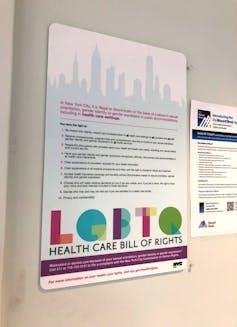
Sign on wall listing New York's 'LGBTQ HEALTH CARE BILL OF RIGHTS'

Fear of discrimination can lead LGBTQ+ people to forgo essential health care.
Lindsey Nicholson/UCG/Universal Images Group via Getty Images

Similarly, LGBQ+ adults in affected states were 71% more likely to report being in fair or poor health after the laws passed, compared to those in states without the laws.

Table of Contents

  • Measuring the harm
  • Worsening disparities
  • What can be done

Measuring the harm

We analyzed data from the Centers for Disease Control and Prevention on the health outcomes of more than 109,000 lesbian, gay, bisexual, queer and heterosexual adults from 2016 to 2018. We focused on eight states, comparing two that enacted conscientious objection laws during that period (Illinois and Mississippi) and six that did not (Louisiana, Minnesota, Ohio, Texas, Wisconsin and Virginia).

To isolate the effect of the laws themselves, we compared changes in health outcomes among LGBQ+ and heterosexual adults living in states with or without religious exemptions to health care, both before and after the laws passed. Making all these comparisons at once allowed us to identify differences in health outcomes due to the laws rather than preexisting differences between states.

We found that conscientious objection laws were associated with significant harms to LGBQ+ adults, including a decline in HIV testing and a worsening of self-rated health.

Our findings highlight how laws permitting clinicians to refuse to provide health care to LGBQ+ patients deepen existing health disparities. Notably, conscientious objection laws are just one type of policy restricting LGBTQ+ people’s access to health care.

The Trump administration has slashed budgets for the federal Ryan White HIV/AIDS program and state-level AIDS drugs assistance programs, reducing the availability of HIV prevention and treatment services. States have also moved to restrict access to gender-affirming care for both minors and adults, despite its additional benefit of helping to reduce new HIV infections. Employers have successfully declined to provide insurance coverage of highly effective HIV prevention medications under religious freedom laws.

Marchers holding sign reading 'HEALTHCARE for EVERY BODY!' in rainbow coloring

Laws that pose LGBTQ+ rights as a matter of health equality may garner more support than economic or social equality.
Erik McGregor/LightRocket via Getty Images

Worsening disparities

LGBTQ+ people already face greater health challenges than their heterosexual peers, including higher rates of unmet health care needs and discrimination in medical settings.

HIV preexposure prophylaxis, or PrEP, can lower the risk of contracting HIV from sex by 99%. However, patients are required to receive an HIV test before PrEP can be prescribed. If providers are unwilling or unable to engage with LGBQ+ patients on their sexual health, people who could benefit most from HIV prevention tools, such as PrEP, may never receive them.

Moreover, since the risk of contracting HIV is closely linked to the social determinants of health, such as having safe and stable housing and employment, barriers to HIV testing could further widen health gaps.

Similarly, the worsening in self-rated health among LGBQ+ adults suggests that the cumulative effect of these laws on well-being is real and immediate. A person’s perception of their own health status is one of the strongest predictors of earlier death.

What can be done

Acknowledging the health consequences of conscientious objection laws could help policymakers and the public better understand their impact.

A 2026 national study found that Americans were more motivated to support policies that address LGBTQ+ inequality when these laws were framed as improving health inequality rather than economic inequality or sense of belonging. This finding suggests that people perceive health inequality as unjust and are less likely to blame LGBTQ+ individuals for those circumstances.

Health care systems can build more affirming environments that actively reassure LGBTQ+ patients will receive fair and equitable care. This can encourage more timely access to preventive services, such as vaccinations and cancer screenings.

For LGBTQ+ people, knowing your rights as a patient and seeking out LGBTQ+-affirming providers and community health centers can help mitigate some of the harms of restrictive laws.


ShareTweetSharePin
Next Post
Power up! Could force be the secret to supercharging your fitness?

Power up! Could force be the secret to supercharging your fitness?

Most Read

What causes stuttering? A speech pathology researcher explains the science and the misconceptions around this speech disorder

What causes stuttering? A speech pathology researcher explains the science and the misconceptions around this speech disorder

December 15, 2022
morning back pain

Morning Again Ache Trigger Is Not the Mattress

October 11, 2021
3 women stroke prevention

Silent Stroke Symptoms in Women: What You Might Be Overlooking

February 27, 2026

Why Circadian Rhythms Matter for Your Health

July 30, 2024
lower back pain relief exercises

5 decrease again ache aid workouts

October 11, 2021

4 steps to building a healthier relationship with your phone

January 28, 2025
3 years after legalization, we have shockingly little information about how it changed cannabis use and health harms

3 years after legalization, we have shockingly little information about how it changed cannabis use and health harms

October 15, 2021
bleeding in gum

When The Bleeding in gum Is Severe ?

October 11, 2021
Good Night Sleep

6 Causes of Good Evening Sleep

October 11, 2021
Nasal vaccines promise to stop the COVID-19 virus before it gets to the lungs – an immunologist explains how they work

Nasal vaccines promise to stop the COVID-19 virus before it gets to the lungs – an immunologist explains how they work

December 14, 2022
Kick up your heels – ballroom dancing offers benefits to the aging brain and could help stave off dementia

Kick up your heels – ballroom dancing offers benefits to the aging brain and could help stave off dementia

January 3, 2023
Ten small changes you can make today to prevent weight gain

Ten small changes you can make today to prevent weight gain

October 12, 2021

COVID vaccines: how one can pace up rollout in poorer international locations

October 5, 2021
Biden is getting prostate cancer treatment, but that’s not the best choice for all men − a cancer researcher describes how she helped her father decide

Biden is getting prostate cancer treatment, but that’s not the best choice for all men − a cancer researcher describes how she helped her father decide

May 20, 2025
Five ways to avoid pain and injury when starting a new exercise regime

Five ways to avoid pain and injury when starting a new exercise regime

December 30, 2022
Support and collaboration with health-care providers can help people make health decisions

Support and collaboration with health-care providers can help people make health decisions

December 16, 2021
Greece to make COVID vaccines mandatory for over-60s, but do vaccine mandates work?

Greece to make COVID vaccines mandatory for over-60s, but do vaccine mandates work?

December 1, 2021
woman covered with white blanket

Exploring the Impact of Sleep Patterns on Mental Health

August 4, 2024

Maximize Your Performance – Sync with Your Circadian Rhythms

August 9, 2024

This Simple Hygiene Habit Could Cut Your Risk of Stroke, New Research Reveals

February 1, 2025
GLP-1 drugs may fight addiction across every major substance, according to a study of 600,000 people

GLP-1 drugs may fight addiction across every major substance, according to a study of 600,000 people

March 6, 2026

Multiple sclerosis: the link with earlier infection just got stronger – new study

October 12, 2021
Nurses’ attitudes toward COVID-19 vaccination for their children are highly influenced by partisanship, a new study finds

Nurses’ attitudes toward COVID-19 vaccination for their children are highly influenced by partisanship, a new study finds

December 2, 2022
As viral infections skyrocket, masks are still a tried-and-true way to help keep yourself and others safe

As viral infections skyrocket, masks are still a tried-and-true way to help keep yourself and others safe

December 14, 2022
GPs don’t give useful weight-loss advice – new study

GPs don’t give useful weight-loss advice – new study

December 16, 2022
Four ways to avoid gaining weight over the festive period – but also why you shouldn’t fret about it too much

Four ways to avoid gaining weight over the festive period – but also why you shouldn’t fret about it too much

December 22, 2022
Backlash to transgender health care isn’t new − but the faulty science used to justify it has changed to meet the times

Backlash to transgender health care isn’t new − but the faulty science used to justify it has changed to meet the times

January 30, 2024
Why are some people faster than others? 2 exercise scientists explain the secrets of running speed

Why are some people faster than others? 2 exercise scientists explain the secrets of running speed

April 29, 2024
Nutrition advice is rife with misinformation − a medical education specialist explains how to tell valid health information from pseudoscience

Nutrition advice is rife with misinformation − a medical education specialist explains how to tell valid health information from pseudoscience

January 28, 2025
News of war can impact your mental health — here’s how to cope

Binge-eating disorder is more common than many realise, yet it’s rarely discussed – here’s what you need to know

December 2, 2022
  • Twenty47HealthNews
  • Health & Wellness
  • Disclaimer

© 2020 DAILY HEALTH NEWS

  • Twenty47HealthNews
  • Health & Wellness
  • Disclaimer
    • Terms of Use
    • Privacy Policy
    • DMCA Notice

© 2020 DAILY HEALTH NEWS










