• Home
  • Health & Wellness
  • Disclaimer
    • Terms of Use
    • Privacy Policy
    • DMCA Notice
  • Home
  • Health & Wellness
  • Disclaimer
    • Terms of Use
    • Privacy Policy
    • DMCA Notice
24/7 Health News
No Result
View All Result
Home Article

Everyday chemicals, global consequences: How disinfectants contribute to antimicrobial resistance

December 22, 2025
in Article
Everyday chemicals, global consequences: How disinfectants contribute to antimicrobial resistance

During the COVID-19 pandemic, disinfectants became our shield. Hand sanitizers, disinfectant wipes and antimicrobial sprays became part of daily life. They made us feel safe. Today, they are still everywhere: in homes, hospitals and public spaces.

But there’s a hidden cost. The chemicals we trust to protect us may also inadvertently help microbes evolve resistance and protect themselves against antibiotics.

Table of Contents

  • QACs: The chemicals in most disinfectants
  • The paradox of protection
  • Rethinking clean

QACs: The chemicals in most disinfectants

Among the most common active ingredients in disinfectants are quaternary ammonium compounds (QACs). They are found not only in the wipes, sprays and liquids we use to clean surfaces at home and in hospitals, but also in everyday products like fabric softeners and personal care products.

Roughly half of the products on the U.S. Environmental Protection Agency’s (EPA) List N of disinfectants effective against SARS-CoV-2 and List Q for emerging viral pathogens contain QACs.

Due to their widespread use, QACs enter wastewater treatment plants in substantial amounts, with effluents and sewage sludge being the main pathways through which QACs are released into the environment.

Within wastewater treatment plants, more than 90 per cent of QACs are typically removed, but small amounts remain in the effluents and reach rivers and lakes, where they accumulate.

Once QACs enter the environment, they meet microbial communities, networks of bacteria, archaea and fungi that recycle nutrients, purify water and support food webs.

Given that QACs are designed to kill microbes, it is no surprise that they can affect environmental ones. Yet microbial communities are remarkably adaptable; some die, but others survive and evolve resistance.
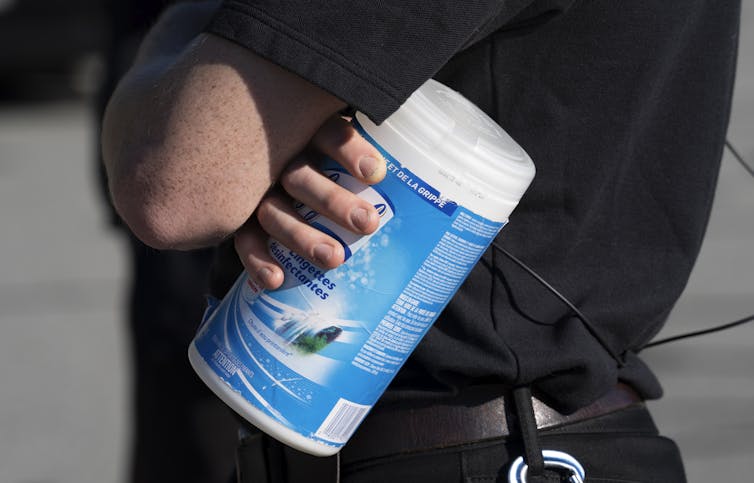
Photo of a person's torso in dark clothing, holding a cannister of disinfectant wipes
The chemicals we trust to protect us from microbes may also inadvertently help microbes protect themselves against antibiotics by evolving resistance.
THE CANADIAN PRESS/Jonathan Hayward

The paradox of protection

Unlike antibiotics, which target specific cellular processes, QACs attack microbes and viruses in many ways, damaging cell walls, proteins and lipids. This broad attack makes QACs powerful disinfectants.

However, microbes are resourceful. Faced with these chemicals, some strengthen their cell membranes, pump toxins out or form protective biofilms. These adaptations don’t just help them survive QACs, but increasing evidence shows they can also boost antibiotic resistance.

At the genetic level, QAC resistance genes are often carried on mobile DNA, segments of genetic material that can move between different bacteria. When these elements carry both QAC and antibiotic resistance genes, the resistances travel together and can spread across bacterial communities, a phenomenon called co-resistance.

In other cases, a single defence mechanism protects against both QACs and antibiotics, a process known as cross-resistance. The widespread and increasing use of QACs amplifies these mechanisms, creating more opportunities for resistance to spread. This, in turn, establishes pathways through which antimicrobial resistance can reach human pathogens, contributing to the global rise of antibiotic-resistant infections.

According to a new World Health Organization (WHO) report, antimicrobial resistance is “critically high and rising” globally: In 2023, one in six laboratory-confirmed bacterial infections responsible for common illnesses worldwide were resistant to antibiotic treatment. Between 2018 and 2023, resistance increased in more than 40 per cent of the pathogen-antibiotic combinations that are monitored, with an average annual rise of five to 15 per cent.
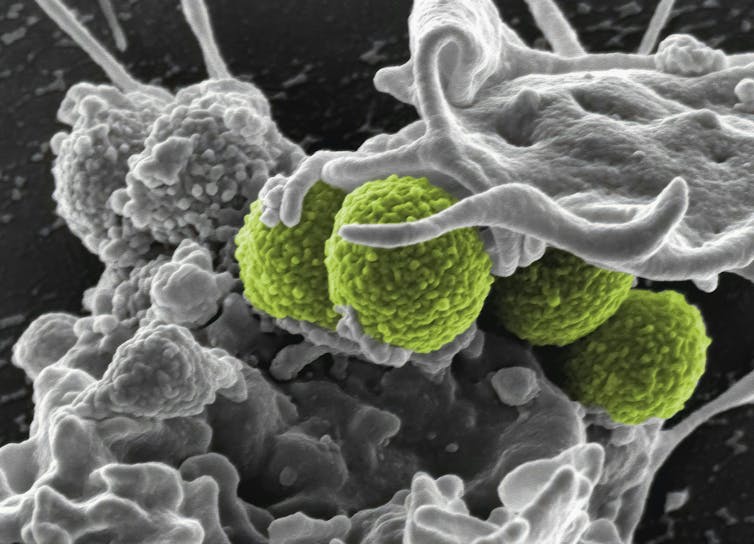
Round green bacteria in a grey matrix
Microscopic view of methicillin-sesistant Staphylococcus aureus (MRSA), a drug-resistant bacteria that is a leading cause of hospital-associated infections.
(Unsplash/NIAID)

The WHO estimates that in 2019, bacterial antimicrobial resistance directly caused 1.27 million deaths and contributed to nearly five million more worldwide. What begins as a household cleaning choice can ripple outward, connecting our everyday habits to one of the most pressing public health challenges of our time.

Antimicrobial resistance is often seen as a clinical problem caused by antibiotic misuse, but it begins much earlier, in households, wastewater, rivers, lakes and soils. These are battlegrounds where microbes share resistance traits and adapt to human-made chemical pressures. Once resistance arises, it can make its way back to us.

At its core, the disinfectant dilemma is a feedback loop: we disinfect to prevent disease, but the chemicals we rely on may quietly make microbes harder to control.

Rethinking clean

This doesn’t mean we should stop disinfecting. Disinfectants play an essential role in infection control, especially in hospitals and high-risk settings where their benefits far outweigh their risks. The issue lies in their overuse in everyday life, where “clean” is often equated with “microbe-free”, regardless of necessity or consequence.

What we rarely consider is that cleaning doesn’t end when the surface looks hygienic. Some disinfectants remain active long after use, continuing to shape microbial communities well beyond their intended moment of control. QACs are a clear example: they persist in the environment, exposing microbes to low, chronic selective pressures that can favour the development of resistance.

Other disinfectants, such as alcohol and bleach, may carry different, but still meaningful environmental risks, underscoring the need for risk assessments that more explicitly integrate long-term ecological consequences.

Ultimately, the disinfectant dilemma reminds us that managing microbes is as much about ecology as it is about chemistry. To clean responsibly, we need to think beyond what kills microbes today and consider how our choices shape the microbial world we will face tomorrow.


ShareTweetSharePin
Next Post
Betty Reid Soskin, the Oldest National Park Service Ranger Has Died

Betty Reid Soskin, the Oldest National Park Service Ranger Has Died

Most Read

What causes stuttering? A speech pathology researcher explains the science and the misconceptions around this speech disorder

What causes stuttering? A speech pathology researcher explains the science and the misconceptions around this speech disorder

December 15, 2022
morning back pain

Morning Again Ache Trigger Is Not the Mattress

October 11, 2021

Why Circadian Rhythms Matter for Your Health

July 30, 2024
lower back pain relief exercises

5 decrease again ache aid workouts

October 11, 2021

4 steps to building a healthier relationship with your phone

January 28, 2025
Nasal vaccines promise to stop the COVID-19 virus before it gets to the lungs – an immunologist explains how they work

Nasal vaccines promise to stop the COVID-19 virus before it gets to the lungs – an immunologist explains how they work

December 14, 2022
3 years after legalization, we have shockingly little information about how it changed cannabis use and health harms

3 years after legalization, we have shockingly little information about how it changed cannabis use and health harms

October 15, 2021
Good Night Sleep

6 Causes of Good Evening Sleep

October 11, 2021
bleeding in gum

When The Bleeding in gum Is Severe ?

October 11, 2021
Kick up your heels – ballroom dancing offers benefits to the aging brain and could help stave off dementia

Kick up your heels – ballroom dancing offers benefits to the aging brain and could help stave off dementia

January 3, 2023

COVID vaccines: how one can pace up rollout in poorer international locations

October 5, 2021
Biden is getting prostate cancer treatment, but that’s not the best choice for all men − a cancer researcher describes how she helped her father decide

Biden is getting prostate cancer treatment, but that’s not the best choice for all men − a cancer researcher describes how she helped her father decide

May 20, 2025
Ten small changes you can make today to prevent weight gain

Ten small changes you can make today to prevent weight gain

October 12, 2021

Maximize Your Performance – Sync with Your Circadian Rhythms

August 9, 2024
Greece to make COVID vaccines mandatory for over-60s, but do vaccine mandates work?

Greece to make COVID vaccines mandatory for over-60s, but do vaccine mandates work?

December 1, 2021
woman covered with white blanket

Exploring the Impact of Sleep Patterns on Mental Health

August 4, 2024

This Simple Hygiene Habit Could Cut Your Risk of Stroke, New Research Reveals

February 1, 2025
Five ways to avoid pain and injury when starting a new exercise regime

Five ways to avoid pain and injury when starting a new exercise regime

December 30, 2022

Multiple sclerosis: the link with earlier infection just got stronger – new study

October 12, 2021
Support and collaboration with health-care providers can help people make health decisions

Support and collaboration with health-care providers can help people make health decisions

December 16, 2021
As viral infections skyrocket, masks are still a tried-and-true way to help keep yourself and others safe

As viral infections skyrocket, masks are still a tried-and-true way to help keep yourself and others safe

December 14, 2022
News of war can impact your mental health — here’s how to cope

Binge-eating disorder is more common than many realise, yet it’s rarely discussed – here’s what you need to know

December 2, 2022
Nurses’ attitudes toward COVID-19 vaccination for their children are highly influenced by partisanship, a new study finds

Nurses’ attitudes toward COVID-19 vaccination for their children are highly influenced by partisanship, a new study finds

December 2, 2022
Four ways to avoid gaining weight over the festive period – but also why you shouldn’t fret about it too much

Four ways to avoid gaining weight over the festive period – but also why you shouldn’t fret about it too much

December 22, 2022
GPs don’t give useful weight-loss advice – new study

GPs don’t give useful weight-loss advice – new study

December 16, 2022
Backlash to transgender health care isn’t new − but the faulty science used to justify it has changed to meet the times

Backlash to transgender health care isn’t new − but the faulty science used to justify it has changed to meet the times

January 30, 2024
Why are some people faster than others? 2 exercise scientists explain the secrets of running speed

Why are some people faster than others? 2 exercise scientists explain the secrets of running speed

April 29, 2024
Nutrition advice is rife with misinformation − a medical education specialist explains how to tell valid health information from pseudoscience

Nutrition advice is rife with misinformation − a medical education specialist explains how to tell valid health information from pseudoscience

January 28, 2025
How hot is too hot for the human body? Our lab found heat + humidity gets dangerous faster than many people realize

How hot is too hot for the human body? Our lab found heat + humidity gets dangerous faster than many people realize

July 6, 2022
FDA limits access to COVID-19 vaccine to older adults and other high-risk groups – a public health expert explains the new rules

FDA limits access to COVID-19 vaccine to older adults and other high-risk groups – a public health expert explains the new rules

May 21, 2025
  • Home
  • Health & Wellness
  • Disclaimer

© 2020 DAILY HEALTH NEWS

  • Home
  • Health & Wellness
  • Disclaimer
    • Terms of Use
    • Privacy Policy
    • DMCA Notice

© 2020 DAILY HEALTH NEWS










