“People can assess me, interview me, incarcerate me, observe me, and they can think they know what I need,” said Shawn, a man in his early 50s who spent 15 years in and out of prison. “And that can be an educated assessment, but at the end of the day, I live inside of this body, inside of this head. I know what I need.”
Shawn is one of 29 formerly incarcerated Black men living in Philadelphia I interviewed as part of my research on coping with the mental health effects of imprisonment. His name and the names of other people quoted in this article are pseudonyms chosen to protect their privacy.
I study incarceration, mental health and access to health care. I’ve previously written about how confinement in jails and prisons leaves a lasting impact on mental health. But I also wanted to understand how the men I interviewed recognized and addressed their own mental health needs — through coping strategies, conversations with friends and family, and seeking mental health treatment.
Table of Contents
Depressed but ‘doing OK’
Both research and clinical practice often fail to accurately capture how formerly incarcerated Black men identify their own mental health needs. That’s in part because implicit bias and anti-Black racism shape how mental health is assessed and treated in both correctional and community facilities.
Most of the men I spoke with said the mental health evaluations they received while incarcerated were designed only to “check the boxes” and conveyed a sense that no one really cared.
“They’d listen. They’d ask the pertinent questions,” Malcolm, 62, explained. “Then they’d talk down to you. And then they forget all about you.”
A few of the men received diagnoses they didn’t understand or believe. John, 29, described how a judge ordered him to have a mental health evaluation and that he was diagnosed as having post-traumatic stress disorder.
“I didn’t take it serious,” he said. “I didn’t start understanding mental health and believing it until I was locked up for a long period of time. I started reading up on it and studying it. …That’s how I started understanding therapy was important.”
Comparing the way participants described their mental health in their own words during the interviews with standardized screening tools revealed an important pattern. Most described themselves as “good,” “blessed,” “at peace” or “doing OK.” Yet nearly all reported symptoms of depression, anxiety or PTSD.
More than half reported three or more PTSD symptoms, such as trauma-related nightmares or feeling constantly on guard and easily startled.
These findings underscore that what appears to be resilience or well-being on the surface may mask underlying mental health needs, and the way those needs are expressed is shaped by culture and life experiences.
Maskot/Maskot Collection via Getty Images
Coping mechanisms
Participants described self-reliance as essential to coping with incarceration and life after release. Physical separation from family and community, along with strained relationships and limited resources after release, left many feeling like they had to manage mental distress on their own.
“When you’re in prison, you learn to depend on yourself,” Ken, 56, said.
Some said incarceration reinforced existing coping strategies they’d had, such as exercising, praying, journaling, reading and meditation.
“I was always into being active,” said Tay, 31, who took part in a military-style bootcamp while incarcerated. “I learned how to use [exercise] to cope with my emotions.”
Others were introduced to new coping skills through educational, vocational and recreational programs inside their correctional facilities. Men spoke about how earning GEDs, taking college courses, learning trades and participating in other structured programs helped them manage stress and connect with others.
Unfortunately, the availability of such programs is limited.
Bottled-up feelings
Many of my study’s participants described wanting to “do things differently” after incarceration by expressing their emotions rather than suppressing them.
Some directly connected bottling up feelings to behaviors that had led to their incarceration.
“[You’ve] let a lot of stuff build up and then [you’ll] go outside and lash out on the first person you see,” David, 30, explained. “I’m getting more comfortable with expressing myself, whether it’s to my mom or if it’s to a friend.”
But finding the right people to confide in could be difficult.
“I try to express myself every day. People laugh and make a joke out of it,” Shakur, 21, said. “If I had somebody sitting one-on-one, talking to me about my problems, I’d feel better.”
Navigating romantic relationships was also difficult.
“We come back to them broken. And they trying to fix us, but they don’t know how to fix us. They’re broken too,” said Thomas, 44.
Mass incarceration doesn’t just fracture individuals – it erodes romantic relationships, as those left behind often navigate their own economic strain, limited resources and emotional distress.
Participants emphasized that speaking with people who shared similar experiences made it easier to express themselves and helped them navigate moments of distress.
Deep distrust of institutions
Many participants expressed deep distrust of mental health treatment within correctional facilities.
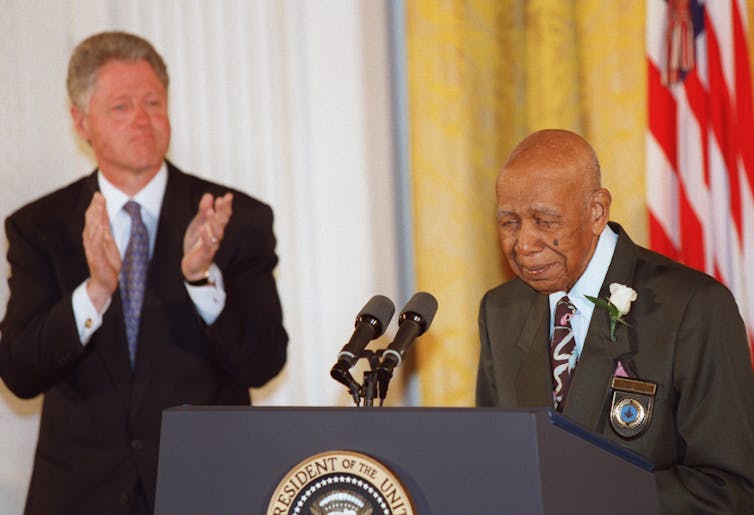
“Being a Black man living to 62 years old, I don’t trust the government from the Tuskegee experiment to the thing they had going on in Holmesburg prison,” said Carl. “How can you put your trust in that?”
Paul J. Richards/AFP via Getty Images
The Tuskegee study was a research study conducted by the U.S. federal government from 1932 to 1972. It followed Black men with syphilis but withheld effective treatment, even after the cure was made widely available in the 1940s. This caused preventable suffering and deaths.
During the Holmesburg Prison experiments, conducted at a Philadelphia prison from the 1950s through the 1970s, University of Pennsylvania researchers tested pharmaceuticals and chemicals on incarcerated men, many of them Black, without adequate informed consent.
Some of the men I interviewed also reported experiencing or witnessing mistreatment after reporting mental health concerns, and they expressed fears that seeking help while incarcerated would lead to punishment rather than support.
Stigma and seeking help
After release, participants shared concerns that they would be seen as “weak” by their peers for talking about their problems. This mental health stigma served as a barrier to seeking treatment.
“It’s not normal for guys like us, as far as being Black, African American, to reach out to a therapist,” said David.
Some men, like Antonio, who described feeling “like walls was closing in on me,” were motivated to seek treatment due to significant mental distress. Others were driven by a desire to improve their relationships with their wives or children.
Nearly 70% of participants had used formal mental health services at some point. Some were mandated to receive treatment, while others sought help voluntarily – sometimes at local walk-in clinics and behavioral health centers such as Wedge Recovery Centers, a Philadelphia staple that was mentioned by several participants but closed in May 2025 due to financial losses.
Communities can work together to reduce stigma around seeking mental health support and formal treatment, take expressions of mental distress from formerly incarcerated men seriously, and create spaces where they feel safe being vulnerable.
Participants named visible, neighborhood clinics with walk-in behavioral health services as places they felt able to go in moments of need. Increasing the visibility of these services, conducting outreach and integrating formerly incarcerated men as peer navigators can help build trust.
Read more of our stories about Philadelphia, or sign up for our Philadelphia newsletter on Substack.

















