• Twenty47HealthNews
  • Health & Wellness
  • Disclaimer
    • Terms of Use
    • Privacy Policy
    • DMCA Notice
  • Twenty47HealthNews
  • Health & Wellness
  • Disclaimer
    • Terms of Use
    • Privacy Policy
    • DMCA Notice
24/7 Health News
No Result
View All Result
Home Article

Gene-edited meat in Canada: To label or not to label?

February 15, 2026
in Article
Gene-edited meat in Canada: To label or not to label?

The Canadian government’s recent approval of the first gene-edited animal to enter the food system has reignited debates over whether foods produced using genetic engineering techniques should be labelled.

Gene-edited animals, including faster-growing fish, heat-tolerant cows and disease-resistant pigs, have already been approved in the United States, Japan and several countries in South America. These decisions, including Canada’s approval, were made with limited public awareness and input.

Advocacy groups such as the Canadian Biotechnology Action Network, political parties including the Bloc Québécois and organic pork producers are calling for mandatory labelling of gene-edited meat in Canada.

Table of Contents

  • Public demand
  • Why label gene-edited meat?
  • Mandatory versus voluntary labelling
  • A lack of public engagement

Public demand

Public opinion research indicates that many Canadians view labelling gene-edited foods as essential. Polling commissioned by the Canadian Health Food Association suggests many Canadians want greater transparency about the use of gene editing for food production.

Studies in the United States also suggest that consumer acceptance increases when the benefits of gene editing are clearly communicated.

Similarly, a survey commissioned by the company that developed Canada’s first approved gene-edited pig found that many Canadians would consider purchasing gene-edited pork if health and environmental benefits were delivered.

Why label gene-edited meat?

Food labelling serves multiple purposes: it provides information about a product’s ingredients and the production methods involved. Labels also play a democratic role by promoting transparency and accountability. This in turn allows consumers to make choices that reflect health considerations as well as their ethical, political and environmental values.

Debates over the labelling of gene-edited meat often hinge on tensions between ethical principles such as protection and autonomy. On the one hand, governments are tasked with protecting the food supply and ensuring food safety. On the other hand, individual consumers have the right to know how food is produced and to make choices accordingly.

Proponents of labelling argue that consumers have a fundamental right to know what’s in their food, how it was produced and what potential risks are involved.

With gene-edited meat, public concerns include health and safety risks, as well as environmental consequences, animal welfare, corporate control of the food system via patents and licensing and threats to food sovereignty.

For example, gene-edited animals could potentially be harmed by unintended consequences, including off-target side effects. It is imperative to ensure traceability in commercial settings with clear mechanisms to report on animal health and welfare.
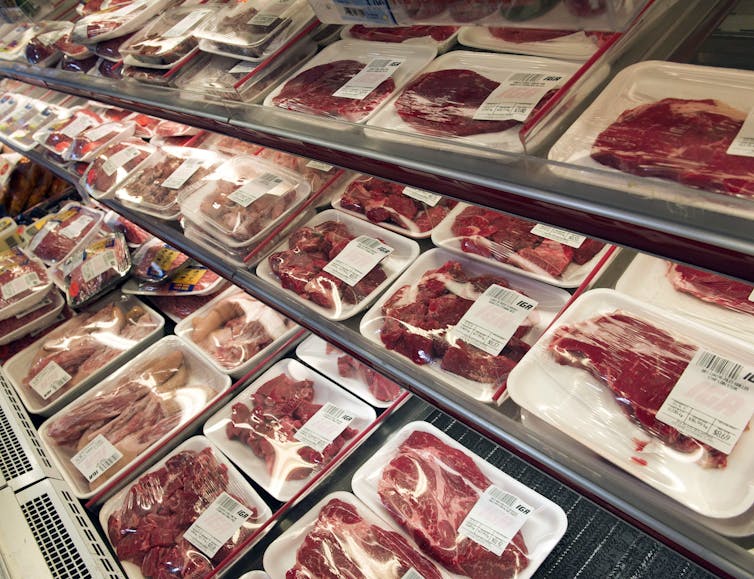
THE CANADIAN PRESS/Ryan Remiorz
Packaged meat at a grocery store in Montréal.
A supermarket display of packaged meat.

By enhancing consumer choice, labelling can also foster market competition.

Opponents of labelling argue that gene-edited foods are scientifically proven to be safe and that labelling could mislead consumers into assuming there is a risk where none exists. They argue that labels can create fear and confusion, potentially undermining the adoption of breeding techniques that could enhance health, reduce environmental impacts and improve food security.

Labelling also has political consequences. Market-based approaches shift responsibility to individual consumers, which can foreclose other avenues for collective decision-making about how food systems should be governed.

Mandatory versus voluntary labelling

Canada currently doesn’t require the labelling of genetically modified (GMO) or gene-edited foods. Under the Food and Drugs Act, labelling is mandated only when a product poses a health or safety concern.

This is at odds with approaches elsewhere. For example, the U.S. National Bioengineered Food Disclosure Standard requires companies to label genetically engineered foods, while decisions about the labelling of gene-edited foods are made on a case-by-case basis.

In Canada, voluntary labelling is permitted provided it’s truthful and not misleading. The Canadian Standards Board, scheduled soon to cease operations due to budget cuts, provides guidance on voluntary labelling for genetically engineered foods. Notably, its definition of genetic engineering excludes both conventional breeding and gene editing.

The Canada organics sector relies on voluntary non-GMO food labelling. Similar to international organic standards, certified organic products in Canada prohibit the use of genetically engineered and gene-edited seeds, feed and food.

A farmer's market display with boxes of organic cherry tomatoes and ears of corn.
Canada’s organic food sector relies on voluntary non-GMO labels.
(Anne Preble/Unsplash)

Following Health Canada’s approval of gene-edited pigs in January, organic pork producer duBreton introduced Canada’s first verified non-gene-edited and non-cloned meat label.

This proposed label was also a response to a now-paused federal proposal to exclude cloned animals from the definition of novel foods, a move that would allow cloned meat to enter the market without consumer or government notification.

A lack of public engagement

The labelling of gene-edited meat raises several questions. Food labels can support consumer autonomy and transparency, but labels are not good at conveying complicated information. Labels also privilege market forces for making collective decisions, instead of other democratic processes such as public deliberation and stringent regulation.

In a regulatory context that largely promotes biotechnology while offering few opportunities for meaningful public engagement, it remains unclear whether labelling is the most effective democratic approach to gene-edited meat in Canada.

As gene-edited animals potentially become more common in global food systems, the question is not just whether to label these products, but which political opportunities labelling creates or restricts — and for whose benefit.


ShareTweetSharePin
Next Post
Readers reply: can you acquire courage?

Readers reply: can you acquire courage?

Most Read

What causes stuttering? A speech pathology researcher explains the science and the misconceptions around this speech disorder

What causes stuttering? A speech pathology researcher explains the science and the misconceptions around this speech disorder

December 15, 2022
morning back pain

Morning Again Ache Trigger Is Not the Mattress

October 11, 2021

Why Circadian Rhythms Matter for Your Health

July 30, 2024
lower back pain relief exercises

5 decrease again ache aid workouts

October 11, 2021

4 steps to building a healthier relationship with your phone

January 28, 2025
bleeding in gum

When The Bleeding in gum Is Severe ?

October 11, 2021
3 years after legalization, we have shockingly little information about how it changed cannabis use and health harms

3 years after legalization, we have shockingly little information about how it changed cannabis use and health harms

October 15, 2021
Nasal vaccines promise to stop the COVID-19 virus before it gets to the lungs – an immunologist explains how they work

Nasal vaccines promise to stop the COVID-19 virus before it gets to the lungs – an immunologist explains how they work

December 14, 2022
Good Night Sleep

6 Causes of Good Evening Sleep

October 11, 2021
Kick up your heels – ballroom dancing offers benefits to the aging brain and could help stave off dementia

Kick up your heels – ballroom dancing offers benefits to the aging brain and could help stave off dementia

January 3, 2023
Biden is getting prostate cancer treatment, but that’s not the best choice for all men − a cancer researcher describes how she helped her father decide

Biden is getting prostate cancer treatment, but that’s not the best choice for all men − a cancer researcher describes how she helped her father decide

May 20, 2025

COVID vaccines: how one can pace up rollout in poorer international locations

October 5, 2021
Ten small changes you can make today to prevent weight gain

Ten small changes you can make today to prevent weight gain

October 12, 2021

Maximize Your Performance – Sync with Your Circadian Rhythms

August 9, 2024
Support and collaboration with health-care providers can help people make health decisions

Support and collaboration with health-care providers can help people make health decisions

December 16, 2021
Greece to make COVID vaccines mandatory for over-60s, but do vaccine mandates work?

Greece to make COVID vaccines mandatory for over-60s, but do vaccine mandates work?

December 1, 2021
Five ways to avoid pain and injury when starting a new exercise regime

Five ways to avoid pain and injury when starting a new exercise regime

December 30, 2022

Multiple sclerosis: the link with earlier infection just got stronger – new study

October 12, 2021

This Simple Hygiene Habit Could Cut Your Risk of Stroke, New Research Reveals

February 1, 2025
woman covered with white blanket

Exploring the Impact of Sleep Patterns on Mental Health

August 4, 2024
News of war can impact your mental health — here’s how to cope

Binge-eating disorder is more common than many realise, yet it’s rarely discussed – here’s what you need to know

December 2, 2022
Nurses’ attitudes toward COVID-19 vaccination for their children are highly influenced by partisanship, a new study finds

Nurses’ attitudes toward COVID-19 vaccination for their children are highly influenced by partisanship, a new study finds

December 2, 2022
Why are some people faster than others? 2 exercise scientists explain the secrets of running speed

Why are some people faster than others? 2 exercise scientists explain the secrets of running speed

April 29, 2024
GPs don’t give useful weight-loss advice – new study

GPs don’t give useful weight-loss advice – new study

December 16, 2022
Four ways to avoid gaining weight over the festive period – but also why you shouldn’t fret about it too much

Four ways to avoid gaining weight over the festive period – but also why you shouldn’t fret about it too much

December 22, 2022
Backlash to transgender health care isn’t new − but the faulty science used to justify it has changed to meet the times

Backlash to transgender health care isn’t new − but the faulty science used to justify it has changed to meet the times

January 30, 2024
Nutrition advice is rife with misinformation − a medical education specialist explains how to tell valid health information from pseudoscience

Nutrition advice is rife with misinformation − a medical education specialist explains how to tell valid health information from pseudoscience

January 28, 2025
How hot is too hot for the human body? Our lab found heat + humidity gets dangerous faster than many people realize

How hot is too hot for the human body? Our lab found heat + humidity gets dangerous faster than many people realize

July 6, 2022

🧬 How Your DNA Affects Exercise: The Science of Personalized Fitness

May 21, 2025
FDA limits access to COVID-19 vaccine to older adults and other high-risk groups – a public health expert explains the new rules

FDA limits access to COVID-19 vaccine to older adults and other high-risk groups – a public health expert explains the new rules

May 21, 2025
  • Twenty47HealthNews
  • Health & Wellness
  • Disclaimer

© 2020 DAILY HEALTH NEWS

  • Twenty47HealthNews
  • Health & Wellness
  • Disclaimer
    • Terms of Use
    • Privacy Policy
    • DMCA Notice

© 2020 DAILY HEALTH NEWS










