
• Home
  • Health & Wellness
  • Disclaimer
    • Terms of Use
    • Privacy Policy
    • DMCA Notice
  • Home
  • Health & Wellness
  • Disclaimer
    • Terms of Use
    • Privacy Policy
    • DMCA Notice
24/7 Health News
No Result
View All Result
Home Article

How does your body make poop?

August 28, 2025
in Article
Why are some people faster than others? 2 exercise scientists explain the secrets of running speed

Curious Kids is a series for children of all ages. If you have a question you’d like an expert to answer, send it to CuriousKidsUS@theconversation.com.


How does your body make poop? Owen, 4, Wakefield, Massachusetts


Much of the food you eat is absorbed by your digestive system, which includes your stomach and your intestines.

But some of what you eat makes it all the way through those twists and turns and comes out the other end as poop. How does that happen?

Imagine you start your day by eating a bowl of crunchy cereal with milk. The process of digestion begins as you start to chew.

Your teeth grind up the cereal into smaller particles, making it easier to swallow and digest. Your saliva contains an enzyme, a kind of chemical, called amylase that starts breaking down the cereal on a molecular level.

I’m a doctor who regularly treats children and adults with digestive problems. Some of my patients have problems absorbing nutrients from their food and others poop too often or not often enough. When they describe their symptoms, I consider the process of how our bodies make poop and which steps can go wrong.

Table of Contents

  • Your stomach is full of enzymes and acid
  • Your long and winding small intestine
  • Your slow and short colon
  • Lots of bacteria

Your stomach is full of enzymes and acid

Everything you eat contains three types of molecules that provide your body with the energy you need to live: carbohydrates, fats and proteins.

Amylase, an enzyme in saliva, begins breaking down the starches, a kind of carbohydrate, while the cereal is still in your mouth.

After you swallow, the milky cereal travels down your esophagus, a tube that carries swallowed food from your mouth to your stomach. That’s where digestion really gets going.

Your stomach contains hydrochloric acid, which breaks the food down into much smaller pieces. Over several hours, that acid and additional enzymes continue to pulverize the carbohydrates and protein from your bowl of cereal.
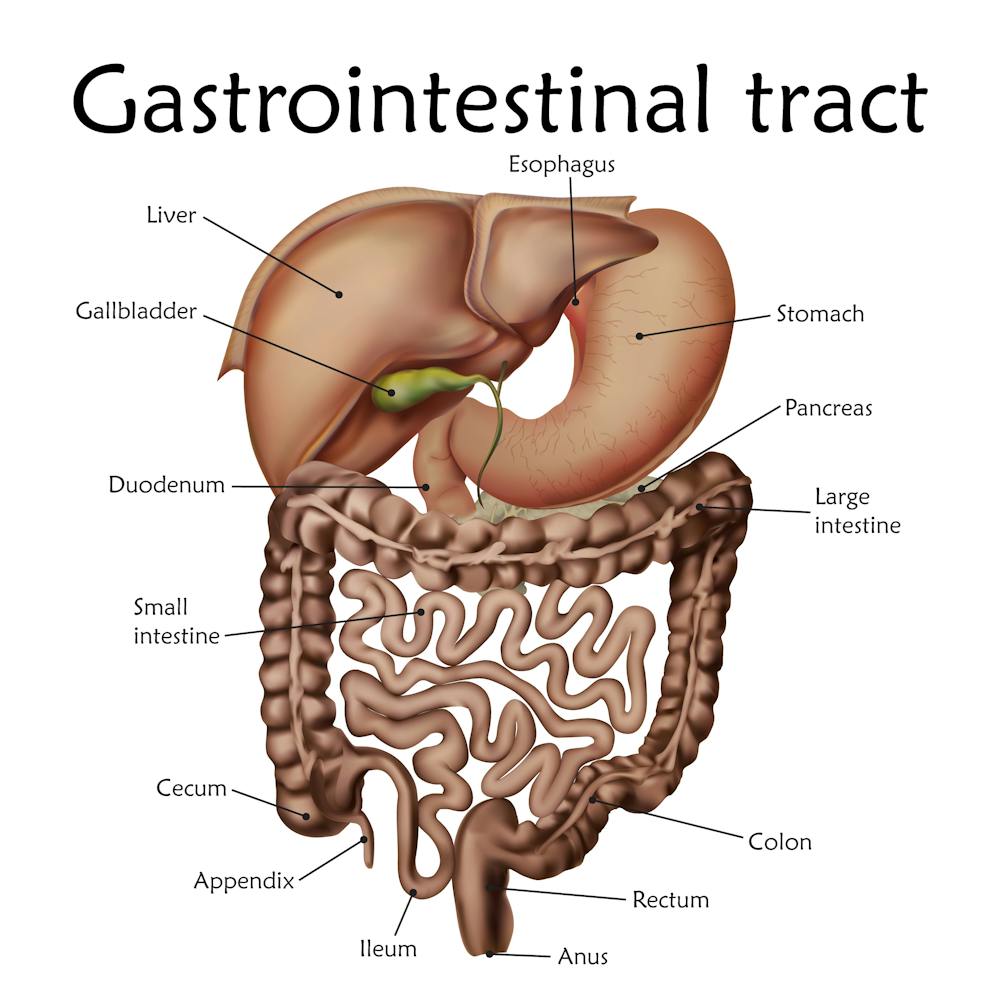
Diagram of the human gastrointestinal tract

What you ingest travels a long way before what’s left makes an exit.
Veronika Zakharova/Science Photo Library via Getty Images

Your long and winding small intestine

Two or three hours later, your breakfast will leave your stomach and enter the small intestine, which is a long and coiled tube that is contained in your abdomen behind your belly button. By that point, the digestive process will have turned those big chunks of cereal into tiny particles that are small enough for your body to absorb.

By coursing through your bloodstream, these teeny particles will deliver energy and the building blocks for growth to the cells all over your body.

The small intestine is perfectly suited to perform the job of absorbing nutrients partly because it’s gigantic. Regardless of your height, it can be over 20 feet (6 meters) long, and its surface is covered with villi, tiny protrusions with a texture that resembles a shag carpet.

Those millions of villi create a huge amount of surface area, which is ideal for absorbing the nutrients in what you’ve eaten once it has been digested. The small intestine also contains many types of bacteria, which assist in breaking down the food particles.

The small intestine also produces more enzymes to help break down the carbohydrates in breads and pasta into simple sugars that are easily absorbed. As food enters into the small intestine, other organs also contribute their digestive juices to the mix.

The liver and gallbladder mix a greenish liquid called bile into the food.

Bile helps break down fats contained in food. Pancreatic enzymes help break down the carbohydrates, fats, proteins and the other nutrients in the food you eat.

Pink picture of the intestines.

Your small intestine and large intestine both have important jobs.
Dmytro Lukyanets/iStock via Getty Images Plus

Your slow and short colon

The journey through your small intestine takes between two and six hours to complete. By this point, your bowl of cereal is unrecognizable. It has turned into chyme, a greenish liquid. Chyme gets its color from the bile made in the liver.

As the chyme reaches the end of the small intestine, it enters into your large intestine, also known as the colon. The large intestine gets its name due to being wider than the small intestine, even though it is much shorter.

The colon is about 5 feet (1.5 meters) long. Unlike the villi-lined small intestine, it doesn’t absorb any nutrients. Instead it does another important job: It absorbs water from the slimy green chyme your digestive system made from your breakfast. The small intestine also absorbs water into the bloodstream, where it is delivered to your kidneys to make urine.

So the intestines also play a small part in making your pee, as well as your poop.

This process is much slower than those earlier steps. It can take a whole day, and up to three days, to complete. By the time the chyme reaches the end of the colon, it has solidified and probably turned from green to brown.

The brown color of poop comes from the bile that is added by the liver to your bowl of cereal as it makes its way through the small intestine. The bile is changed by bacteria from green to brown. Without bile your poop would be a pale silver or clay color.

Lots of bacteria

What’s in your poop?

When it leaves your body, poop contains some leftover water, as well as undigested food such as plant fiber, as well as some dead intestinal cells. And, it may surprise you to learn, almost half of it, measured by weight, consists of bacteria.

Your intestines contain trillions of these bacteria, which help you digest what you eat. Unlike some other kinds of bacteria, they do not make you sick. The ones that come out as part of your poop give it that stinky smell.

Each part of your digestive system, from your mouth to your colon, plays an important role in extracting from what you eat the energy and water that your body needs. They all work together to help you absorb most of that energy and water, while eliminating what you do not need.


Hello, curious kids! Do you have a question you’d like an expert to answer? Ask an adult to send your question to CuriousKidsUS@theconversation.com. Please tell us your name, age and the city where you live.

And since curiosity has no age limit – adults, let us know what you’re wondering, too. We won’t be able to answer every question, but we will do our best.


ShareTweetSharePin
Next Post
Balancing kratom’s potential benefits and risks − new legislation in Colorado seeks to minimize harm

Balancing kratom’s potential benefits and risks − new legislation in Colorado seeks to minimize harm

Most Read

What causes stuttering? A speech pathology researcher explains the science and the misconceptions around this speech disorder

What causes stuttering? A speech pathology researcher explains the science and the misconceptions around this speech disorder

December 15, 2022
morning back pain

Morning Again Ache Trigger Is Not the Mattress

October 11, 2021

Why Circadian Rhythms Matter for Your Health

July 30, 2024
lower back pain relief exercises

5 decrease again ache aid workouts

October 11, 2021

4 steps to building a healthier relationship with your phone

January 28, 2025
Nasal vaccines promise to stop the COVID-19 virus before it gets to the lungs – an immunologist explains how they work

Nasal vaccines promise to stop the COVID-19 virus before it gets to the lungs – an immunologist explains how they work

December 14, 2022
3 years after legalization, we have shockingly little information about how it changed cannabis use and health harms

3 years after legalization, we have shockingly little information about how it changed cannabis use and health harms

October 15, 2021
Good Night Sleep

6 Causes of Good Evening Sleep

October 11, 2021
bleeding in gum

When The Bleeding in gum Is Severe ?

October 11, 2021
Kick up your heels – ballroom dancing offers benefits to the aging brain and could help stave off dementia

Kick up your heels – ballroom dancing offers benefits to the aging brain and could help stave off dementia

January 3, 2023

COVID vaccines: how one can pace up rollout in poorer international locations

October 5, 2021
Biden is getting prostate cancer treatment, but that’s not the best choice for all men − a cancer researcher describes how she helped her father decide

Biden is getting prostate cancer treatment, but that’s not the best choice for all men − a cancer researcher describes how she helped her father decide

May 20, 2025
Ten small changes you can make today to prevent weight gain

Ten small changes you can make today to prevent weight gain

October 12, 2021

Maximize Your Performance – Sync with Your Circadian Rhythms

August 9, 2024
Greece to make COVID vaccines mandatory for over-60s, but do vaccine mandates work?

Greece to make COVID vaccines mandatory for over-60s, but do vaccine mandates work?

December 1, 2021
woman covered with white blanket

Exploring the Impact of Sleep Patterns on Mental Health

August 4, 2024

This Simple Hygiene Habit Could Cut Your Risk of Stroke, New Research Reveals

February 1, 2025
Five ways to avoid pain and injury when starting a new exercise regime

Five ways to avoid pain and injury when starting a new exercise regime

December 30, 2022

Multiple sclerosis: the link with earlier infection just got stronger – new study

October 12, 2021
Support and collaboration with health-care providers can help people make health decisions

Support and collaboration with health-care providers can help people make health decisions

December 16, 2021
As viral infections skyrocket, masks are still a tried-and-true way to help keep yourself and others safe

As viral infections skyrocket, masks are still a tried-and-true way to help keep yourself and others safe

December 14, 2022
News of war can impact your mental health — here’s how to cope

Binge-eating disorder is more common than many realise, yet it’s rarely discussed – here’s what you need to know

December 2, 2022
Nurses’ attitudes toward COVID-19 vaccination for their children are highly influenced by partisanship, a new study finds

Nurses’ attitudes toward COVID-19 vaccination for their children are highly influenced by partisanship, a new study finds

December 2, 2022
Four ways to avoid gaining weight over the festive period – but also why you shouldn’t fret about it too much

Four ways to avoid gaining weight over the festive period – but also why you shouldn’t fret about it too much

December 22, 2022
GPs don’t give useful weight-loss advice – new study

GPs don’t give useful weight-loss advice – new study

December 16, 2022
Backlash to transgender health care isn’t new − but the faulty science used to justify it has changed to meet the times

Backlash to transgender health care isn’t new − but the faulty science used to justify it has changed to meet the times

January 30, 2024
Why are some people faster than others? 2 exercise scientists explain the secrets of running speed

Why are some people faster than others? 2 exercise scientists explain the secrets of running speed

April 29, 2024
Nutrition advice is rife with misinformation − a medical education specialist explains how to tell valid health information from pseudoscience

Nutrition advice is rife with misinformation − a medical education specialist explains how to tell valid health information from pseudoscience

January 28, 2025
How hot is too hot for the human body? Our lab found heat + humidity gets dangerous faster than many people realize

How hot is too hot for the human body? Our lab found heat + humidity gets dangerous faster than many people realize

July 6, 2022
FDA limits access to COVID-19 vaccine to older adults and other high-risk groups – a public health expert explains the new rules

FDA limits access to COVID-19 vaccine to older adults and other high-risk groups – a public health expert explains the new rules

May 21, 2025
  • Home
  • Health & Wellness
  • Disclaimer

© 2020 DAILY HEALTH NEWS

  • Home
  • Health & Wellness
  • Disclaimer
    • Terms of Use
    • Privacy Policy
    • DMCA Notice

© 2020 DAILY HEALTH NEWS










