Every March, millions of Americans fill out brackets and tune in to watch the NCAA college basketball tournaments known as March Madness. The men’s and women’s competitions unfold in parallel, each with their own brackets, champions, storylines and fan bases.
The separation reflects one of the most deeply embedded assumptions in sports: that women and men perform differently enough that they must compete apart.
The divide is so normal, it’s rarely explained: On average, men are faster, stronger and have more endurance. As a result, performance differences between men and women are often assumed to follow directly from these physical traits.
This notion shape how sports organizations structure competition, how coaches train athletes and how researchers study performance. Sex becomes a shortcut – a way to predict what athletes can do before they ever step onto the court.
As an exercise scientist who studies the physical demands of Paralympic sports, I wanted to know whether this assumption actually holds up.
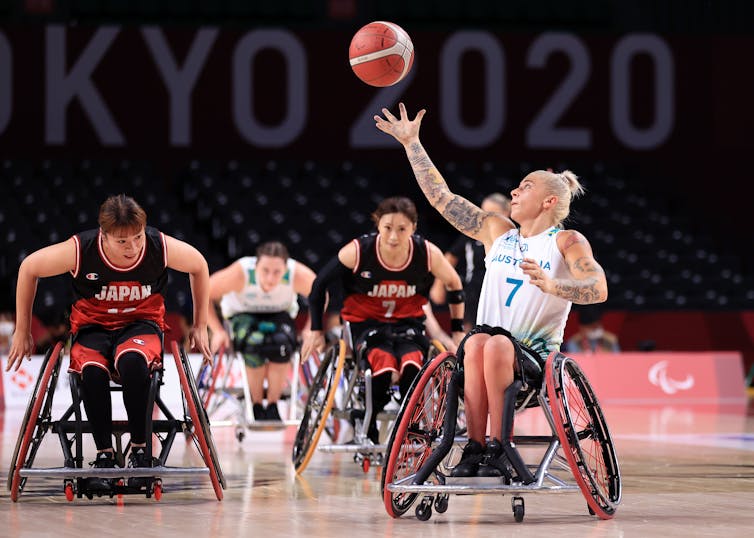
My research on elite wheelchair basketball suggests it may not. I found that many of the differences widely attributed to physiological differences between women and men in sports are far less pronounced in wheelchair basketball players – and in most cases absent altogether.
It may seem that wheelchair sports are too different from nondisabled sports to compare. But in my view, they may instead reveal what sports look like when performance is measured by what athletes can do, rather than presumptions tied to their sex.
Table of Contents
Testing different abilities
In most sports, presumptions about physical differences between the sexes appear early, often starting with elementary school physical education classes and youth teams.
Wheelchair basketball works differently. Although international competitions have separate women’s and men’s teams, athletes at the national level often train together, while women sometimes compete in men’s leagues and vice versa.
As part of my Ph.D. research, I examined how elite wheelchair basketball players move during competition by asking athletes from the Australian national men’s and women’s teams to wear movement sensors during five international-level games in 2022.
The sensors recorded how often players accelerated and decelerated, how frequently they changed direction, how fast they moved and how much distance they covered. Accelerations, decelerations and changes of direction are typically the most physically demanding movements in wheelchair basketball. To ensure fair comparisons, I adjusted all measures for playing time.
A consistent difference emerged. Players with less severe impairments – those with greater trunk control and stability – performed more high-intensity actions than players with more severe impairments. Female athletes with less severe impairments accelerated and decelerated more frequently and reached higher peak speeds, and male athletes showed the same pattern.
When I compared performance by sex, however, the differences were much less pronounced. Across most measures – including distance covered, average speed and high-intensity movements – female and male athletes performed similarly over the course of multiple games.
Performance beyond sex
If sex-based performance differences are so common in sports, why didn’t they appear in my research? The answer lies partly in how wheelchair basketball is organized.
To compete, athletes are assigned a classification based on how their impairment affects movement during play. These classifications range from 1.0 to 4.5, with lower numbers indicating more severe impairments. The system is designed to account for athletes with wide variations in physical disabilities, particularly differences in trunk control, balance and the ability to generate force and change direction in their game wheelchairs.
During games, teams must stay under a combined classification limit of 14 points for the five players on court. This means lineups are built around functional movement ability rather than sex, balancing players with different movement capacities within lineups so that no single team gains an unfair advantage.

Carmen Mandato/Staff via Getty Images Sports
With this in mind, it makes sense that classification, not sex, explained the differences I observed. In other words, wheelchair basketball is designed around physical variation in sports – not just between women and men, but across individuals with very different movement capacities and roles on the court. In this context, sex becomes one variable among many, rather than the primary basis for performance.
This pattern isn’t unique to wheelchair basketball. In wheelchair rugby, where women and men compete together on the same international teams, research has also found that game demands are shaped more by players’ classification and on-court roles than by sex.
Challenging sports science norms
My findings challenge a near-universal assumption in sports: that sex is the primary factor defining physical ability.
To be clear, there are contexts where sex-based comparisons matter. Differences in average muscle mass, body size and hormone profiles can influence performance in many sports, which is one reason competitions are typically separated into women’s and men’s divisions. Safety concerns are also frequently cited as a reason for maintaining separate competitions.
But when sex becomes the primary framework for understanding performance, it can obscure other important factors such as strength, body size, training history and access to coaching.
Research supports this idea. One study comparing athletes by both sex and strength found that many differences often attributed to sex were better explained by strength. Another review found little consistent evidence for sex-specific movement patterns in jumping and landing tasks, concluding that many reported differences are better explained by training exposure, motor skill or sociocultural factors than by sex alone.
Put simply, what is often labeled a sex difference may instead reflect unequal opportunities to develop physical capacity – much of which is trainable – rather than fixed, innate ability.
This perspective does not mean sex differences disappear, but it suggests that they may not always be the most informative way to understand performance. In some cases, focusing primarily on sex-based categories may even risk underselling what some young athletes are capable of.
Looking more closely at individual factors such as strength, agility, sport-specific skills and training exposure may give coaches a clearer picture of how athletes actually perform, rather than relying on long-standing presumptions about what girls and boys are capable of.

















