• Twenty47HealthNews
  • Health & Wellness
  • Disclaimer
    • Terms of Use
    • Privacy Policy
    • DMCA Notice
  • Twenty47HealthNews
  • Health & Wellness
  • Disclaimer
    • Terms of Use
    • Privacy Policy
    • DMCA Notice
24/7 Health News
No Result
View All Result
Home Article

Ontario is closing its supervised consumption sites, calling them a failure. So what counts as ‘success?’

March 30, 2026
in Article
Ontario is closing its supervised consumption sites, calling them a failure. So what counts as ‘success?’

The Ontario government recently said it will cut provincial funding for seven supervised drug consumption sites in Toronto, Ottawa, Niagara, Peterborough and London, with 90 days given to wind down their operations.

In their place, the province is spending $378 million on 19 Homelessness and Addiction Recovery Treatment (HART) hubs, which explicitly exclude supervised consumption and needle exchange services.

While Premier Doug Ford’s government’s framing of supervised consumption as a “failed experiment” is selective, it’s not baseless in the way that defenders of these sites sometimes imply.

By certain measures, the sites have not lived up to their potential: the program has not clearly reduced provincewide overdose deaths, and the communities that host them bear costs that defenders too often dismiss.

But “failure” requires a definition of success, and the government’s is not the only one that matters. HART hubs offer care for people on a recovery pathway, while supervised consumption sites exist for those who are not on that pathway yet or who have left it. Entirely replacing safe consumption sites with HART hubs doesn’t address the primary function these sites have served: keeping people who are not in treatment alive. By this measure, the sites are a clear success.

Table of Contents

  • Success by whose measure?
  • Where the sites fall short
  • What closures get wrong

Success by whose measure?

Whether supervised consumption sites “succeed” depends entirely on what they’re expected to do. If we judge the sites against Health Canada’s stated goals — keeping people alive on site, connecting them to treatment, reducing infections and lessening strain on emergency services — the evidence is strong.

No one has ever died of an overdose inside a supervised consumption site in Canada. And sites across the country have reversed more than 50,000 overdoses since 2017.

In Ontario, where more than 2,200 people died from opioid toxicity in 2024 and fentanyl was involved in more than 83 per cent of those deaths, the sites function as a last line of defence for people at highest risk. Since 2021, about one in five opioid toxicity deaths in Ontario has occurred among people experiencing homelessness — the same population these sites primarily serve.

Beyond lives saved, safe consumption sites generate measurable returns the government’s own cost-benefit logic should recognize: Vancouver’s Insite refers thousands of clients to health and social care monthly and a Calgary cost analysis found each overdose managed at a supervised consumption site saved approximately $1,600 in avoided ambulance and emergency department costs. Those resource savings are especially important amid severe emergency room overcrowding in Ontario.

Where the sites fall short

But the Ontario government’s claim that these programs lack population-level impact is not just rhetoric: the two largest provincial-level studies — covering British Columbia and Ontario — found no statistically significant effect on opioid mortality, emergency department visits or hospitalizations.

A systematic review also found that the studies carried high risk of bias because they didn’t account for confounding factors like housing, treatment access and drug supply composition.

A neighbourhood-level study of Toronto found a two-thirds reduction in overdose mortality within 500 metres of sites, but that finding did not replicate at larger geographic scales.

One possible explanation for this lack of effect is coverage: Ontario’s supervised consumption sites provided roughly 150 spaces accommodating up to 9,000 episodes per day, while the province may have 300,000 to 400,000 at-risk opioid users. Expecting a handful of supervised consumption sites to reduce provincewide overdose mortality is akin to stationing a single fire truck in a forest and asking why the wildfire kept burning.

Community concerns, which the Ford government often cites in arguing that safe consumption sites have failed, are similarly grounded in real experiences.

A study published in JAMA Network Open examining Toronto’s safe consumption sites found no long-term rise in overall crime, as well as fewer assaults and robberies. But the same study documented initial increases in break-and-enters near a number of sites.


Read more:
New study: Some crimes increased, others decreased around Toronto supervised consumption sites


Nearby residents have also described visible disorder, open drug use and discarded equipment.

Dismissing these experiences as NIMBYism or overblown only undermines the case for safe consumption sites. Advocates need to take these concerns seriously if they want the sites to survive politically.
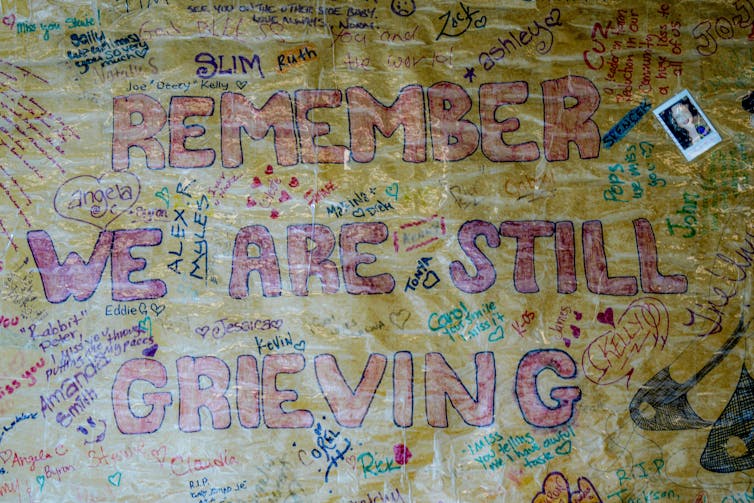
A wall mural reading Remember we are still grieving
A mural is displayed on the wall in the consumption room at the Parkdale Queen West Community Health Centre in Toronto in March 2025. The site is one the supervised drug consumption sites throughout the province that have been slated for closure by the Ontario government.
THE CANADIAN PRESS/Chris Young

What closures get wrong

Despite this mixed evidence, there’s little to suggest that Ontario’s plan to shift patients to the HART hubs will lead to success.

The Ontario government has cited a Canadian Centre of Recovery Excellence study that found no increase in mortality after the closure of one overdose prevention site in Red Deer, Alta.

But that study’s authors have acknowledged it was inconclusive because it covered only a six-month period. And a single study of a single site closure does not constitute an evidence base for dismantling an entire network of services across a province where opioid deaths remain catastrophically high.

Supervised consumption sites are not beyond criticism: they can be better designed, better integrated and more responsive to the communities that host them. But improving them requires better policy, not selective evidence and site closures.

The $378 million committed to HART hubs could expand addiction treatment without eliminating the services that keep people alive. Adding treatment capacity does not require removing the safety net beneath it.


ShareTweetSharePin

Most Read

What causes stuttering? A speech pathology researcher explains the science and the misconceptions around this speech disorder

What causes stuttering? A speech pathology researcher explains the science and the misconceptions around this speech disorder

December 15, 2022
morning back pain

Morning Again Ache Trigger Is Not the Mattress

October 11, 2021
3 women stroke prevention

Silent Stroke Symptoms in Women: What You Might Be Overlooking

February 27, 2026

4 steps to building a healthier relationship with your phone

January 28, 2025
lower back pain relief exercises

5 decrease again ache aid workouts

October 11, 2021

Why Circadian Rhythms Matter for Your Health

July 30, 2024
Good Night Sleep

6 Causes of Good Evening Sleep

October 11, 2021
Nasal vaccines promise to stop the COVID-19 virus before it gets to the lungs – an immunologist explains how they work

Nasal vaccines promise to stop the COVID-19 virus before it gets to the lungs – an immunologist explains how they work

December 14, 2022
3 years after legalization, we have shockingly little information about how it changed cannabis use and health harms

3 years after legalization, we have shockingly little information about how it changed cannabis use and health harms

October 15, 2021
bleeding in gum

When The Bleeding in gum Is Severe ?

October 11, 2021
Kick up your heels – ballroom dancing offers benefits to the aging brain and could help stave off dementia

Kick up your heels – ballroom dancing offers benefits to the aging brain and could help stave off dementia

January 3, 2023
Ten small changes you can make today to prevent weight gain

Ten small changes you can make today to prevent weight gain

October 12, 2021

COVID vaccines: how one can pace up rollout in poorer international locations

October 5, 2021
Biden is getting prostate cancer treatment, but that’s not the best choice for all men − a cancer researcher describes how she helped her father decide

Biden is getting prostate cancer treatment, but that’s not the best choice for all men − a cancer researcher describes how she helped her father decide

May 20, 2025
Five ways to avoid pain and injury when starting a new exercise regime

Five ways to avoid pain and injury when starting a new exercise regime

December 30, 2022
Support and collaboration with health-care providers can help people make health decisions

Support and collaboration with health-care providers can help people make health decisions

December 16, 2021
Greece to make COVID vaccines mandatory for over-60s, but do vaccine mandates work?

Greece to make COVID vaccines mandatory for over-60s, but do vaccine mandates work?

December 1, 2021
woman covered with white blanket

Exploring the Impact of Sleep Patterns on Mental Health

August 4, 2024

Maximize Your Performance – Sync with Your Circadian Rhythms

August 9, 2024

This Simple Hygiene Habit Could Cut Your Risk of Stroke, New Research Reveals

February 1, 2025
GLP-1 drugs may fight addiction across every major substance, according to a study of 600,000 people

GLP-1 drugs may fight addiction across every major substance, according to a study of 600,000 people

March 6, 2026

Multiple sclerosis: the link with earlier infection just got stronger – new study

October 12, 2021
Nurses’ attitudes toward COVID-19 vaccination for their children are highly influenced by partisanship, a new study finds

Nurses’ attitudes toward COVID-19 vaccination for their children are highly influenced by partisanship, a new study finds

December 2, 2022
As viral infections skyrocket, masks are still a tried-and-true way to help keep yourself and others safe

As viral infections skyrocket, masks are still a tried-and-true way to help keep yourself and others safe

December 14, 2022
GPs don’t give useful weight-loss advice – new study

GPs don’t give useful weight-loss advice – new study

December 16, 2022
Four ways to avoid gaining weight over the festive period – but also why you shouldn’t fret about it too much

Four ways to avoid gaining weight over the festive period – but also why you shouldn’t fret about it too much

December 22, 2022
Backlash to transgender health care isn’t new − but the faulty science used to justify it has changed to meet the times

Backlash to transgender health care isn’t new − but the faulty science used to justify it has changed to meet the times

January 30, 2024
Nutrition advice is rife with misinformation − a medical education specialist explains how to tell valid health information from pseudoscience

Nutrition advice is rife with misinformation − a medical education specialist explains how to tell valid health information from pseudoscience

January 28, 2025
News of war can impact your mental health — here’s how to cope

Binge-eating disorder is more common than many realise, yet it’s rarely discussed – here’s what you need to know

December 2, 2022

🧬 How Your DNA Affects Exercise: The Science of Personalized Fitness

May 21, 2025
  • Twenty47HealthNews
  • Health & Wellness
  • Disclaimer

© 2020 DAILY HEALTH NEWS

  • Twenty47HealthNews
  • Health & Wellness
  • Disclaimer
    • Terms of Use
    • Privacy Policy
    • DMCA Notice

© 2020 DAILY HEALTH NEWS









