It starts with a slight scratchiness at the back of your throat.
Then, a sneeze.
Then coughing, sniffling and full-on congestion, with or without fever, for a few insufferable days.
Viral upper respiratory tract infections – also known as the common cold – afflict everyone, typically three times per year, lasting, on average, nine days.
Colds don’t respond to antibiotics, and most over-the-counter medications deliver modest results at best.
In recent years, research has emerged demonstrating the effectiveness of the ancient practice of nasal saline irrigation in fighting the common cold in both adults and children.
Not only does nasal saline irrigation decrease the duration of illness, it also reduces viral transmission to other people, minimizes the need for antibiotics and could even lower a patient’s risk of hospitalization. Better yet, it costs pennies and doesn’t require a prescription.
I’m both an adjunct assistant professor of medicine and a practicing physician. As a family doctor, I see the common cold every day. My patients are usually skeptical when I first recommend nasal saline irrigation. However, they frequently return to tell me that this practice has changed their life. Not only does it help with upper respiratory viruses, but it also helps manage allergies, chronic congestion, postnasal drip and recurrent sinus infections.
Table of Contents
What is nasal saline irrigation?
Nasal saline irrigation is a process by which the nasal cavity is bathed in a saltwater solution. In some studies, this is accomplished using a pump-action spray bottle.
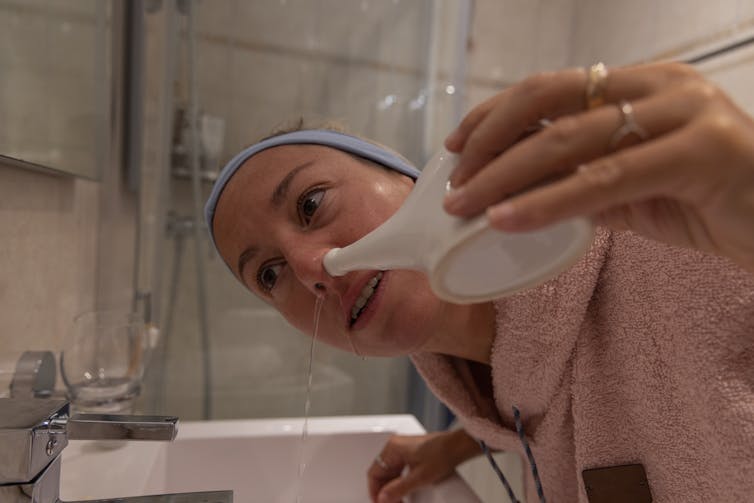
In others, participants used a traditional neti pot, which is a vessel resembling a teapot.
This practice of nasal irrigation originated in the Ayurvedic tradition, which is a system of alternative medicine from India dating back more than 5,000 years.
The neti pot can be traced back to the 15th century. It garnered mainstream interest in the U.S. in 2012 after Dr. Oz demonstrated it on the “Oprah Winfrey Show.” But it’s not the only device that has historically been employed for such purposes. Ancient Greek and Roman physicians had their own nasal lavage devices. Such practices were even discussed in medical journals such as The Lancet over a century ago, in 1902.

swissmediavision/E+ via Getty Images
How does nasal saline irrigation work?
Nasal saline has a few key benefits. First, it physically flushes debris out of the nasal passage. This not only includes mucus and crust, but also the virus itself, along with allergens and other environmental contaminants.
Second, salt water is slightly lower on the pH scale compared with fresh water. Its acidity creates an environment that is inhospitable for viruses and makes it harder for them to replicate.
Third, nasal saline helps restore the actions of part of our natural defense system, which is composed of microscopic, hairlike projections called cilia that line the surface of the nasal passage. These cilia beat in a coordinated fashion to act like an escalator, propelling viruses and other foreign particles out of the body. Nasal saline irrigation helps keep this system running effectively.
What the research shows
A study of more than 11,000 people published in The Lancet in 2024 demonstrated that nasal saline irrigation, initiated at the first sign of symptoms and performed up to six times per day, reduced the duration of symptomatic illness by approximately two days. Meanwhile, smaller studies have reported that the reduced duration of illness could be as high as four days.
Research has also demonstrated that nasal saline irrigation can help prevent the spread of illness. A study in hospitalized patients showed that after detection of COVID-19 via nasal swab, nasal saline irrigation performed every four hours over a 16-hour period decreased COVID-19 viral load by 8.9%. Meanwhile, the viral load in the control group continued to increase during that time.
The benefits of nasal saline also extend beyond acute infectious illnesses. When performed regularly by patients with allergic rhinitis, also known as hay fever, a meta-analysis of 10 randomized controlled trials showed that nasal saline irrigation can enable a 62% reduction in the use of allergy medications. It’s also effective for chronic congestion, postnasal drip and recurrent sinus infections.
Why it matters
Besides helping patients feel better faster, one of the most valuable benefits of nasal saline irrigation is that its use can help decrease unnecessary antibiotic prescriptions, which are a major contributor to antibiotic resistance.
It is well established that antibiotics do not shorten the duration or reduce the severity of respiratory tract infections. Despite this, studies have shown that patients are happier when they leave their doctor’s office with an antibiotic prescription in hand.
This may be why 10 million inappropriate antibiotic prescriptions are given each year for viral respiratory tract infections. In one study of more than 49,000 patient encounters for respiratory infections, antibiotics were unnecessarily prescribed to 42.4% of patients.
One reason patients with upper respiratory viral infections tend to initially feel better with antibiotics is because of their off-target, anti-inflammatory properties. However, this benefit can be better achieved with anti-inflammatory medications such as ibuprofen or naproxen, that can be taken in conjunction with nasal saline irrigation.
Overall, nasal saline irrigation is a cheap, effective, evidence-based alternative that will not only shorten the duration of illness but also prevent its spread, minimize the need for unnecessary antibiotics and keep people out of the hospital.
How to do it
For those who want to try it, you don’t need anything fancy. Even a neti pot is not necessary. Many pharmacies sell salt water in a container with a nozzle and even spray bottles that can be refilled with a homemade saltwater solution.
You’ll mix approximately half a teaspoon of non-iodized salt with 1 cup of water. It’s important for your safety that the water be either distilled water or boiled for at least five minutes and then cooled to destroy any harmful bacteria. You can also add a pinch of baking soda to reduce any potential sting.
Note that saltier solutions are not more effective. However, some studies have suggested natural seawater, due to its additional minerals such as magnesium, potassium and calcium, could offer even greater benefits. Saltwater solutions can also be purchased commercially, which might be worth a try for those with an insufficient response to saline alone.
You can use nasal saline irrigation after any potential exposure to an infectious illness. For best results, you’ll want to start irrigating the nasal passage at the first sign of an infection. You can repeat rinses throughout the day as often as needed for the duration of the illness. At minimum, you’ll want to irrigate the nasal passages every morning and evening. You can also consider gargling salt water as an adjunctive therapy.

















