• Twenty47HealthNews
  • Health & Wellness
  • Disclaimer
    • Terms of Use
    • Privacy Policy
    • DMCA Notice
  • Twenty47HealthNews
  • Health & Wellness
  • Disclaimer
    • Terms of Use
    • Privacy Policy
    • DMCA Notice
24/7 Health News
No Result
View All Result
Home Article

Stroke survivors can counterintuitively improve recovery by strengthening their stronger arm – new research

February 2, 2026
in Article
Stroke survivors can counterintuitively improve recovery by strengthening their stronger arm – new research

Stroke survivors often face substantial and long-lasting problems with their arms. Both arms often decline together: When one arm is more severely affected by the stroke, the other becomes more difficult to use as well. Compared with a healthy person’s dominant hand, a stroke survivor may take up to three times longer to complete everyday tasks using their less-impaired arm.

This creates a frustrating reality. People with severe impairment in one arm must rely almost entirely on their other arm for daily activities, such as eating, dressing and household tasks. When that “good” arm works slowly or awkwardly, even simple activities become tiring and discouraging, and some people may begin to avoid them altogether.

But that good arm can be strengthened. In our newly published research in the journal JAMA Neurology, we found that training the less-impaired arm in people living with chronic stroke can improve everyday hand function, in some cases even better than focusing only on the most impaired arm.

Table of Contents

  • What is a stroke?
  • Training the less-impaired arm
  • Strengthening what remains

What is a stroke?

A stroke occurs when the flow of oxygen-carrying blood to part of the brain is interrupted by a blockage in a blood vessel or by bleeding. Without oxygen, brain cells begin to die.

Because each side of the brain mainly controls the opposite side of the body, a stroke often causes movement problems on the side of the body opposite the brain injury. For this reason, stroke rehabilitation has traditionally focused on restoring movement in the most impaired arm.

[embedded content]
If someone’s face is drooping, their arm is weak or they’re having difficulty with speech, it’s time to call 911.

However, research over the past few decades has shown that both sides of the brain contribute to controlling movements for both arms, although they play different roles. As a result, damage to one side of the brain can affect movement on both sides of the body.

As expected, the arm opposite the brain injury often has major problems with weakness, stiffness and voluntary control, limiting its use for reaching, grasping and manipulating objects. But the other arm, usually thought to be unaffected from the stroke, is frequently not normal either. Many stroke survivors experience reduced strength, slower movements and poorer coordination in the less-impaired arm.

Training the less-impaired arm

As neuroscientists who study how the brain controls movement after stroke, these findings led us to a simple question: Could training the less-impaired arm help it work better?

In a clinical trial of over 50 patients, we studied people living with chronic stroke who had severe impairments in one arm, making it unusable for everyday tasks. These individuals depended almost entirely on their less-impaired arm to manage daily life.

Participants were randomly assigned to one of two rehabilitation groups: one that trained their most-impaired arm, and one that trained their less-impaired arm. Both received five weeks of therapy that involved challenging, goal-directed hand movements, including virtual reality tasks designed to improve coordination and timing.

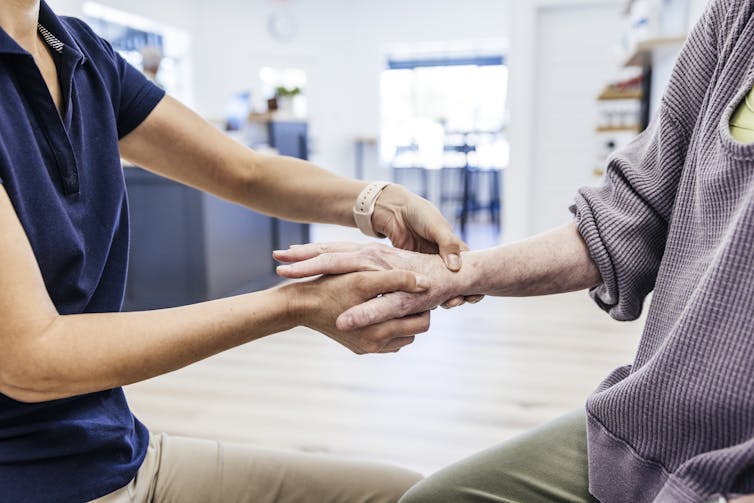
Close-up of health care provider examining a patient's arm

Improving stroke rehabilitation strategies could improve patients’ everyday lives.
The Good Brigade/DigitalVision via Getty Images

Compared to those who trained their most-impaired arm, we found that participants who conditioned their less-impaired arm became faster and more efficient at everyday hand tasks, such as picking up small objects or lifting a cup. These improvements remained six months after training ended.

We believe the lasting benefit of training the less-impaired arm may come from a simple feedback loop: When their arm works better, people naturally use it more, and that extra practice in daily life helps lock in those gains.

Strengthening what remains

Stroke rehabilitation has long focused on the arm that is most visibly impaired. But for many people, full function in that arm never returns. They adapt and rely on their less-impaired arm to get through the day.

“Less-impaired,” however, does not mean unaffected. When this arm becomes the sole tool for daily activities, even mild problems can have major consequences for independence and quality of life. Improving how well this arm works could make everyday tasks faster, easier and less exhausting, even years after a stroke.

Future work will focus on how best to combine training of the less-impaired arm with standard therapy for the more-impaired arm, and how these approaches translate into everyday life at home.

For many survivors, recovery may not mean restoring what was lost but strengthening what remains.


ShareTweetSharePin
Next Post
Octavia Spencer Wants Us To “Detect The SOS” From Our Kidneys

Octavia Spencer Wants Us To “Detect The SOS” From Our Kidneys

Most Read

What causes stuttering? A speech pathology researcher explains the science and the misconceptions around this speech disorder

What causes stuttering? A speech pathology researcher explains the science and the misconceptions around this speech disorder

December 15, 2022
morning back pain

Morning Again Ache Trigger Is Not the Mattress

October 11, 2021

Why Circadian Rhythms Matter for Your Health

July 30, 2024
lower back pain relief exercises

5 decrease again ache aid workouts

October 11, 2021

4 steps to building a healthier relationship with your phone

January 28, 2025
bleeding in gum

When The Bleeding in gum Is Severe ?

October 11, 2021
3 years after legalization, we have shockingly little information about how it changed cannabis use and health harms

3 years after legalization, we have shockingly little information about how it changed cannabis use and health harms

October 15, 2021
Nasal vaccines promise to stop the COVID-19 virus before it gets to the lungs – an immunologist explains how they work

Nasal vaccines promise to stop the COVID-19 virus before it gets to the lungs – an immunologist explains how they work

December 14, 2022
Good Night Sleep

6 Causes of Good Evening Sleep

October 11, 2021
Kick up your heels – ballroom dancing offers benefits to the aging brain and could help stave off dementia

Kick up your heels – ballroom dancing offers benefits to the aging brain and could help stave off dementia

January 3, 2023
Biden is getting prostate cancer treatment, but that’s not the best choice for all men − a cancer researcher describes how she helped her father decide

Biden is getting prostate cancer treatment, but that’s not the best choice for all men − a cancer researcher describes how she helped her father decide

May 20, 2025

COVID vaccines: how one can pace up rollout in poorer international locations

October 5, 2021
Ten small changes you can make today to prevent weight gain

Ten small changes you can make today to prevent weight gain

October 12, 2021

Maximize Your Performance – Sync with Your Circadian Rhythms

August 9, 2024
Support and collaboration with health-care providers can help people make health decisions

Support and collaboration with health-care providers can help people make health decisions

December 16, 2021
Greece to make COVID vaccines mandatory for over-60s, but do vaccine mandates work?

Greece to make COVID vaccines mandatory for over-60s, but do vaccine mandates work?

December 1, 2021
Five ways to avoid pain and injury when starting a new exercise regime

Five ways to avoid pain and injury when starting a new exercise regime

December 30, 2022

Multiple sclerosis: the link with earlier infection just got stronger – new study

October 12, 2021

This Simple Hygiene Habit Could Cut Your Risk of Stroke, New Research Reveals

February 1, 2025
woman covered with white blanket

Exploring the Impact of Sleep Patterns on Mental Health

August 4, 2024
News of war can impact your mental health — here’s how to cope

Binge-eating disorder is more common than many realise, yet it’s rarely discussed – here’s what you need to know

December 2, 2022
Nurses’ attitudes toward COVID-19 vaccination for their children are highly influenced by partisanship, a new study finds

Nurses’ attitudes toward COVID-19 vaccination for their children are highly influenced by partisanship, a new study finds

December 2, 2022
Why are some people faster than others? 2 exercise scientists explain the secrets of running speed

Why are some people faster than others? 2 exercise scientists explain the secrets of running speed

April 29, 2024
GPs don’t give useful weight-loss advice – new study

GPs don’t give useful weight-loss advice – new study

December 16, 2022
Four ways to avoid gaining weight over the festive period – but also why you shouldn’t fret about it too much

Four ways to avoid gaining weight over the festive period – but also why you shouldn’t fret about it too much

December 22, 2022
Backlash to transgender health care isn’t new − but the faulty science used to justify it has changed to meet the times

Backlash to transgender health care isn’t new − but the faulty science used to justify it has changed to meet the times

January 30, 2024
Nutrition advice is rife with misinformation − a medical education specialist explains how to tell valid health information from pseudoscience

Nutrition advice is rife with misinformation − a medical education specialist explains how to tell valid health information from pseudoscience

January 28, 2025
How hot is too hot for the human body? Our lab found heat + humidity gets dangerous faster than many people realize

How hot is too hot for the human body? Our lab found heat + humidity gets dangerous faster than many people realize

July 6, 2022

🧬 How Your DNA Affects Exercise: The Science of Personalized Fitness

May 21, 2025
FDA limits access to COVID-19 vaccine to older adults and other high-risk groups – a public health expert explains the new rules

FDA limits access to COVID-19 vaccine to older adults and other high-risk groups – a public health expert explains the new rules

May 21, 2025
  • Twenty47HealthNews
  • Health & Wellness
  • Disclaimer

© 2020 DAILY HEALTH NEWS

  • Twenty47HealthNews
  • Health & Wellness
  • Disclaimer
    • Terms of Use
    • Privacy Policy
    • DMCA Notice

© 2020 DAILY HEALTH NEWS










