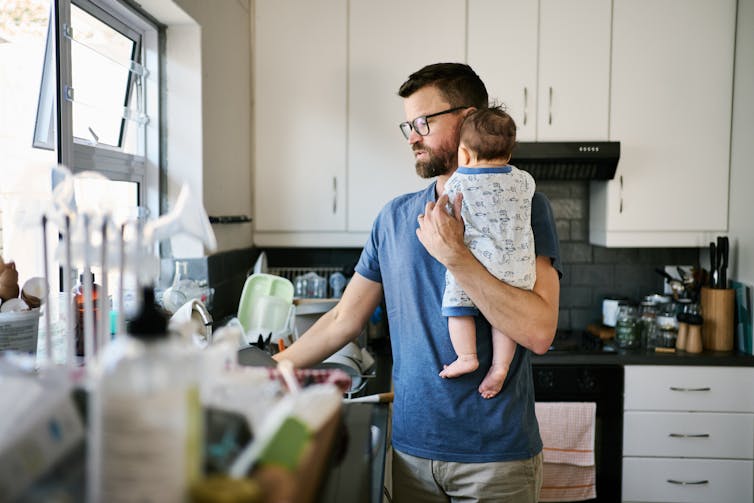
As child care costs outpace wages, more families are facing difficult decisions about whether to scale back work in order to care for loved ones. Caregiving remains the top reason women ages 25-54 leave the workforce.
And it’s not just parents who struggle. Nearly 60 million Americans provide care for an adult family member, and two-thirds say they have trouble balancing their jobs with their caregiving responsibilities. Nearly 1 in 4 working caregivers reported either missing work or being less productive because of their care duties.
When the demands become too much to juggle, some people quit their jobs, cut back on their hours or turn down promotions in order to provide unpaid care. For many households, that’s a financial strain; others save money that way. But even so, the decision can feel heavy – like leaving behind a sense of purpose that extends beyond the family.
These choices force deeper questions: What counts as meaningful work? What do we owe to others, and what’s reasonable to expect of any one person?
For many people, work and family are central to identity and how they hope to make a difference in the world. Men and women struggling with whether to step back from a career may wonder whether doing so is the best use of skills or training. Do we owe the world something “bigger”? As much as we care about loved ones, caregiving can feel too small and personal to matter.
As someone who writes and teaches about ethics and social policy, I believe philosophy can help people see these decisions more clearly. Ethics doesn’t give tidy answers or eliminate the tension between work and care, but it can help us understand their moral value.
‘Too small’?
Today, American culture often measures moral worth in terms of results and impact – where doing good means doing more. In this context, stepping back from a professional career to care for a loved one can feel like a failure of ambition or responsibility.
If ambition is measured by observable progress, caregiving is especially vulnerable to being misread as “leaning out.” Many of the daily tasks of caregiving – feeding, bathing, dressing and driving to appointments – can seem inconsequential. The end result of much of this work is invisible: You wind up in the same place you were before. For all the work that goes into sustaining life, there aren’t many “impressive outcomes” to point to.

AJ_Watt/E+ via Getty Images
In fact, one of care’s most important benefits lies in preventing outcomes: avoiding injuries, medication errors, hospital admissions, developmental delays, cognitive decline, loneliness, depression and so on. These “nonevents” are easy to overlook. In public health, this is sometimes referred to as the “preparedness paradox”: The better prevention works, the less visible its effects.
Appreciating the full value of care means considering what would happen without it. If the answer is that there would be more risk, more crises or more downstream costs, then care is making a difference. Health care ethicists, for example, use this kind of counterfactual reasoning to evaluate harm and benefit, asking how a patient would have fared without an intervention. Caregiving that reduces vulnerability and prevents suffering is a genuine moral achievement.
Still, helping a handful of people can look minor compared to careers measured by reach or scale. Good care requires a level of presence and attentiveness that just can’t be scaled.
But that isn’t a failure. “Smallness” is actually part of the point: Care is personal – and “personal” doesn’t mean morally trivial.
In fact, there’s a rich philosophical tradition that puts meeting the needs of the people we’re responsible for at the very heart of moral life. Relationships are core to who we are. In care ethicists’ view, attachments to other people are not distractions from morality but expressions of what it means to live a good human life.
Close relationships make special claims on us. Ties with particular people carry moral weight, not just emotions – they give genuine reasons to act. As philosopher Samuel Scheffler notes, it makes little sense to say we value a relationship if we don’t think it places any demands on us. Caring about another person’s needs is part of what it means to care about them.
Attending to a loved one’s needs and interests honors those special claims and imbues care tasks with extra meaning – showing someone that we believe they’re worth our time and attention. Caring for loved ones might be modest in reach, but making another person feel truly seen and valued can make a deep impact.
‘Too personal’?
Even if care isn’t “too small” to matter, it might still seem too personal to matter much to the wider world. But while care is certainly personal, it’s also socially significant.

travelism/E+ via Getty Images
As care ethicists like Joan Tronto and Eva Kittay argue, caring for particular people reveals something universal about the human condition: Everyone is dependent and sustained by care at different points in our lives. Former first lady Rosalynn Carter captured it simply: “There are only four kinds of people in the world – those who have been caregivers, those who are currently caregivers, those who will be caregivers and those who will need caregivers.”
Understanding dependency as a shared human condition helps explain why care is foundational to collective well-being. Unpaid caregiving in the U.S. is worth an estimated US$1.1 trillion annually, making it one of the largest sources of social support.
However, care has value beyond its economic impact. Care makes family, community and civic life possible, with benefits that reach well beyond the household. As economist Nancy Folbre writes in “The Invisible Heart”: “Parents who raise happy, healthy, and successful children create an especially important public good” – one that will benefit employers, neighbors and fellow citizens.
Treating care as a private matter rather than a shared social good has consequences. It places the moral and practical weight of caregiving on individual families – most often on women. I believe this narrow view unfairly shifts responsibility and also distorts value, limiting society’s sense of what matters.
Policy changes could ease the strain on caregivers but wouldn’t remove the personal choices families face every day. Even in a more supportive system, I believe Americans would need ways of thinking about work and care that give a fuller account of their value. Caregiving’s broader public benefits are diffuse and hard to measure. But recognizing that care sustains not only families but communities too is a reminder that paid work and unpaid care are not opposites. They are both ways to contribute to the common good.
Of course, loved ones’ needs can often be met without career changes. But when families need to make tough choices, it helps to have a fuller picture. Care ethics is not a demand for perfect caregiving or self-sacrifice; it’s an argument that care matters and that people deserve support as they respond to real limits. Stepping back from work to care doesn’t have to mean stepping back from contributing to the world – it changes where contribution happens.

















