
Medically Reviewed
Dr. Jose Rossello, MD, PhD, MHCM
Preventive Medicine & Public Health Specialist
Last Reviewed: February 11, 2026
Table of Contents
Summary of Key Findings
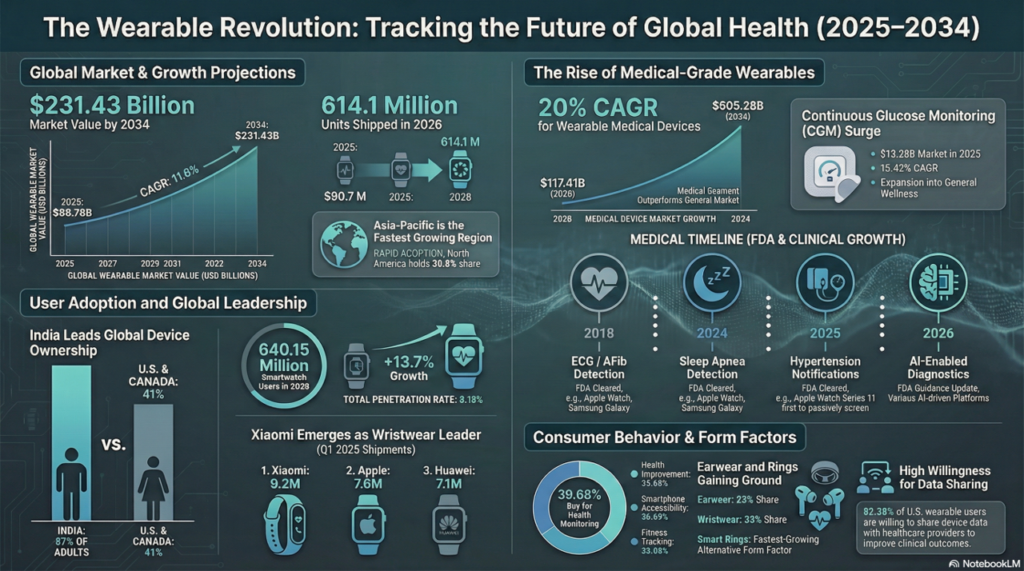
Wearable technology has evolved from simple step counters into sophisticated health monitoring platforms capable of detecting atrial fibrillation, measuring blood oxygen, and even screening for hypertension. The global wearable technology market was valued at USD 86.78 billion in 2025 and is projected to reach USD 231.43 billion by 2034, exhibiting a CAGR of 11.60%. An estimated 614.1 million wearable devices will ship globally in 2026, and 640 million people worldwide are projected to be smartwatch users this year alone.[1]
This comprehensive guide synthesizes the latest data (2023–2026) from IDC, Canalys, Statista, the FDA, peer-reviewed journals, and industry market reports to provide clinicians, researchers, marketers, investors, and consumers with the most complete wearable health technology statistics available. Every statistic links directly to its primary source, enabling verification and deeper exploration.
Key Takeaways
- The global wearable technology market reached $86.78 billion in 2025 and is projected to hit $231.43 billion by 2034 (CAGR 11.6%)[1]
- Global wearable device shipments are projected to reach 614.1 million units in 2026, up from 590.7 million in 2025[2]
- 640.15 million people worldwide are expected to use smartwatches in 2026, up from 562.86 million in 2025[3]
- 57% of adults in India own a wearable device—the highest rate globally—while the U.S./Canada stands at 41%[2]
- Apple Watch Series 11 received FDA clearance for hypertension notifications in September 2025, rolling out to over 150 countries[4]
- The continuous glucose monitoring (CGM) market reached $13.28 billion in 2025 and is growing at a 15.42% CAGR[5]
- The FDA issued updated guidance in January 2026 reducing oversight of low-risk AI-enabled wearables and wellness devices[6]
- Wearable medical device shipments reached an estimated 160 million units in 2024, nearly doubling from 85 million in 2021[2]
What Is Wearable Health Technology?
Wearable health technology encompasses electronic devices worn on the body that monitor, record, and transmit physiological and behavioral health data in real time. These devices range from consumer smartwatches and fitness bands to clinical-grade continuous glucose monitors and cardiac rhythm sensors. Modern wearables integrate accelerometers, photoplethysmography (PPG) sensors, electrocardiogram (ECG) electrodes, and increasingly, AI-powered algorithms to deliver actionable health insights.[7]
The category has expanded well beyond wrist-worn devices. The market now includes earwear (smart earbuds with biometric sensors), smart rings (like Oura), smart clothing, smart glasses, and wearable medical patches. Connectivity features such as Bluetooth, Wi-Fi, and cellular enable seamless data synchronization with smartphones and cloud-based health platforms.[2]
Key device categories include:
- Smartwatches: Apple Watch, Samsung Galaxy Watch, Huawei Watch, Garmin — offering ECG, SpO2, heart rate, sleep tracking, and increasingly blood pressure monitoring
- Fitness trackers/wristbands: Xiaomi Band, Fitbit — focused on activity, steps, and basic health metrics
- Continuous glucose monitors (CGMs): Dexcom, Abbott FreeStyle Libre — providing real-time glucose data for diabetes management[5]
- Smart rings: Oura Ring — sleep tracking, HRV, temperature, and readiness scores
- Wearable medical devices: Cardiac monitors (iRhythm), wearable defibrillators, remote patient monitoring patches[8]
Wearable Technology Market Size and Growth
Global Market Overview
The global wearable technology market was valued at USD 86.78 billion in 2025 and is projected to grow from USD 96.44 billion in 2026 to USD 231.43 billion by 2034, at a CAGR of 11.60%. Other estimates place the 2025 market even higher at $92.90 billion, with projections to $229.97 billion by 2033 at a 12.1% CAGR. MarketsandMarkets projects the market to reach $176.77 billion by 2030 from $84.53 billion in 2025, at a CAGR of 15.9%.[9]
Regional market breakdown (2025):
- North America: Largest market, accounting for 38.80% of global market share[1]
- Asia Pacific: Fastest-growing region, fueled by massive adoption in India, China, and Southeast Asia[1]
- Europe: Second-largest market, with strong adoption of fitness and medical wearables[2]
Market Segmentation by Product Type
The wearable market is increasingly diversified across product categories:[2]
| Product Category | Market Share | 2025 Shipments | 2028 Projected |
|---|---|---|---|
| Wristwear (watches + bands) | 35% [2] | 218.15M units [2] | 237.30M units [2] |
| Earwear | 23% [2] | 367.85M units [2] | 402.25M units [2] |
| Eyewear | 17% [2] | 1.75M units [2] | 2.17M units [2] |
| Smart clothing | — | 350.97M units [2] | 374.28M units [2] |
| Smart rings | — | 2.31M units [2] | 3.23M units [2] |
Wearable Medical Devices Market
The wearable medical devices segment is growing even faster than the consumer market. It is projected to grow from $117.41 billion in 2026 to $505.28 billion by 2034, exhibiting a CAGR of 20%. Wearable medical sensor and device shipments reached an estimated 160 million units in 2024, nearly doubling from 85 million units in 2021. Key growth drivers include Medicare and Medicaid reimbursements for remote patient monitoring, expanding FDA clearances, and aging populations in developed countries.[10]
Global Device Shipments
Overall Shipment Trends
Global wearable device shipments have grown dramatically over the past decade and are projected to continue rising:[2]
- 2019: 346.4 million units — the year of explosive growth, more than doubling from 2018[2]
- 2020: 444.7 million units — COVID-19 drove health-monitoring demand[2]
- 2021: 533.6 million units — all-time peak[2]
- 2022: 492.1 million units — slight dip amid supply chain disruptions[2]
- 2023: 506.6 million units — recovery begins[2]
- 2024: 559.7 million units (estimated)[2]
- 2025: 590.7 million units (estimated)[2]
- 2026: 614.1 million units (projected)[2]
- 2028: 645.7 million units (projected)[2]
In Q3 2025 alone, global wearable band shipments rose 3% year-over-year, while market value jumped 12% to $12.3 billion, driven by premium AI and 5G-enabled devices.[11]
Wrist-Worn Device Shipments by Vendor (2025)
The competitive landscape shifted notably in 2025. In Q1 2025, the global wrist-worn device market shipped 45.6 million units, a 10.5% year-over-year increase.[12]
| Rank | Vendor | Q1 2025 Shipments | YoY Growth |
|---|---|---|---|
| 1 | Xiaomi | 9.2M units | Strong [13] |
| 2 | Apple | 7.6M units | +5% [13] |
| 3 | Huawei | 7.1M units | +36% [13] |
| 4 | Samsung | 4.9M units | +74% [13] |
| 5 | Garmin | 1.8M units | +10% [13] |
Xiaomi rose to the top of the global wrist-worn market, displacing Apple through aggressive pricing and the new Band 10 launch. Huawei benefited from HarmonyOS ecosystem synergy, while Samsung’s 74% growth was driven by a dual-track strategy of mass-market expansion and premium positioning. Apple posted its highest YoY growth since 2023, with U.S. retailers increasing inventory ahead of potential tariffs.[13]
In the broader smartwatch category, Apple led Q3 2025 with 23% market share, followed by Huawei at 17%. By Q4 2024 data, Apple held 28% of worldwide smartwatch shipments.[14]
Smartwatch and Fitness Tracker Users
Global User Growth
The number of smartwatch users worldwide has experienced explosive growth and is projected to surpass 640 million in 2026:[3]
- 2020: 97.63 million users[3]
- 2021: 140.92 million (+44.3%)[3]
- 2022: 212.84 million (+51.1%)[3]
- 2023: 323.99 million (+52.2%)[3]
- 2024: 454.69 million (+40.3%)[3]
- 2025: 562.86 million (+23.8%)[3]
- 2026: 640.15 million (projected, +13.7%)[3]
- 2029: 740.53 million (projected)[3]
The global smartwatch penetration rate has climbed from 1.30% in 2020 to 7.20% in 2025 and is projected to reach 8.13% in 2026.[2]
Fitness/activity tracker wristwear users are growing on a parallel track, reaching an estimated 433.9 million in 2025 and projected to hit 462.65 million in 2026 and 524.93 million by 2029.[3]
U.S. User Demographics
In the United States, wearable adoption varies significantly by generation:[2]
| Generation | 2020 Users | 2024 Users (Projected) |
|---|---|---|
| Gen Z | 12.8M | 20.5M [2] |
| Millennials | 25.8M | 27.6M [2] |
| Gen X | 16.7M | 17.5M [2] |
| Baby Boomers | 8.9M | 9.3M [2] |
Adults aged 35–44 show the highest adoption rate for wearable fitness technologies at 49%, followed by 18–34 at 40%, 45–64 at 29%, and 65+ at 25%. Gender distribution is nearly equal, with 35% of U.S. women and 34% of U.S. men using wearable fitness or wellness technologies as of 2023.[3]
Global Device Ownership by Country
Wearable device ownership varies dramatically by country:[2]
| Country | Ownership Rate |
|---|---|
| India | 57% [2] |
| Mainland China | 53% [2] |
| United Kingdom | 52% [2] |
| Sweden | 50% [2] |
| Netherlands | 44% [2] |
| Germany | 42% [2] |
| United States/Canada | 41% [2] |
| South Korea | 40% [2] |
| Brazil | 33% [2] |
India’s leading position reflects the rapid adoption of affordable wearables from brands like Xiaomi, Noise, and Fire Boltt, which have captured significant market share in Asia.[2]
How Consumers Use Wearable Health Devices
Fitness Metrics Tracked
Step counting remains the dominant use case, but health monitoring is rapidly growing:[2]
- 64% of U.S. wearable users track daily step counts[2]
- 36% use wearables for exercise motivation (reminders, badges)[2]
- 31% track speed and distance using GPS[2]
- 28% store workout data[2]
- 27% track weight loss[2]
- 25% measure performance or exertion[2]
- 17% plan workouts; 16% follow workouts through an app[2]
- 9% use personalized coaching features[2]
Motivating Factors for Purchase
A 2022 global survey identified the primary reasons consumers purchase wearable devices:[2]
- 39.68% — Health monitoring and improvement (top reason)[2]
- 36.69% — Easier accessibility to smartphone functions[2]
- 33.05% — Fitness tracking and training optimization[2]
- 31.77% — Keeping up with technology trends[2]
- 28.27% — Reasonable price-to-functionality ratio[2]
- 27.39% — Integration with existing brand ecosystem[2]
The shift toward health as the primary motivator marks a significant evolution from the early wearable market, where fitness and novelty were the dominant drivers.
Data Sharing and Clinical Integration
Among U.S. adults who use wearable health devices, a majority (82.38%) expressed willingness to share health data from their wearables with their healthcare providers. About 30% of U.S. adults use wearable health care devices, with nearly half (47.33%) using them every day. Wearable device mentions in clinical notes have increased dramatically, from 0.0002% of notes in the earliest tracked period to steadily rising figures, reflecting growing clinician awareness and integration.[15]
FDA-Cleared Health Features and Clinical Milestones
Apple Watch Health Features Timeline
The Apple Watch has become the benchmark for consumer health wearable capabilities, with a steady progression of FDA-cleared features:
| Year | Feature | Regulatory Status |
|---|---|---|
| 2018 | ECG / Atrial Fibrillation Detection | FDA cleared [16] |
| 2020 | Blood Oxygen (SpO2) Monitoring | Wellness feature (not FDA cleared) [17] |
| 2022 | Crash Detection / Fall Detection | Safety feature |
| 2024 | Sleep Apnea Detection | FDA cleared [8] |
| Sept 2025 | Hypertension Notifications | FDA cleared [4] |
| Aug 2025 | Blood Oxygen Restored (U.S.) | Redesigned to resolve patent dispute [18] |
The Apple Watch Series 11, launched in September 2025, introduced FDA-cleared hypertension notifications — the first consumer wearable capable of passively screening for high blood pressure. A clinical study confirmed the feature performs consistently across age groups, genders, races, and skin tones. By passively monitoring and flagging possible signs of hypertension, the Apple Watch helps fill a dangerous diagnostic gap — hypertension often goes unnoticed for years, but users can now be alerted within just one month of wearing the watch.[4]
Samsung’s Galaxy Watch series offers comparable capabilities, including sleep apnea detection, heart rate monitoring, and ECG functionality, reinforcing its position as a key innovator in consumer healthcare wearables.[8]
Clinical Accuracy of Consumer Wearables
Studies have increasingly validated consumer wearable accuracy for clinical-grade measurements:
- Apple Watch ECG: FDA-cleared for atrial fibrillation detection with sensitivity and specificity comparable to clinical ECG[19]
- Apple Watch SpO2: A 2023 meta-analysis found it “roughly comparable to medical-grade pulse oximeters,” though outlier results can occur. A 2025 study confirmed acceptable accuracy for cardiac patients both at rest and post-exercise[17]
- Heart Rate Monitoring: Multiple studies confirm Apple Watch, Samsung, and Garmin devices provide clinically useful heart rate measurements across various activity levels[20]
Large-Scale Research Studies
The Apple Heart & Movement Study — one of the largest wearable-based research studies ever conducted — enrolled over 250,000 participants who generated 186 million days of health data, including analysis of 2.9 million sleep nights. This study demonstrated wearables’ capacity to generate population-level health insights at a scale impossible through traditional clinical trials.[7]
Studies using wearable actigraphy have demonstrated a 15–20% increase in detecting subtle treatment effects compared with self-reported measures, enhancing the statistical power of clinical research. Foundation models trained on over 2.5 billion hours of wearable data from 162,000 individuals reveal that behavioral metrics — patterns of activity, sleep consistency, and mobility — often predict health outcomes more effectively than raw sensor signals alone.[7]
Continuous Glucose Monitoring (CGM) Market
Market Growth
The CGM market represents one of the fastest-growing segments within wearable health technology. The market was valued at $13.28 billion in 2025 and is estimated to grow from $15.33 billion in 2026 to $31.38 billion by 2031, at a CAGR of 15.42%.[5]
The sensors segment delivered 84.35% of revenue in 2025, underpinning a 17.10% CAGR. Continuous material innovation has increased wear life from 10 to 14 days on mainstream disposables, while implantable variants promise annual exchange intervals. This extended longevity directly lowers lifetime ownership costs, making CGMs increasingly accessible beyond the traditional diabetes population.[5]
Key Drivers
The CGM market is expanding beyond diabetes management into general wellness. Key growth drivers include:[21]
- Rising global diabetes prevalence (589 million adults worldwide)
- Increasing consumer preference for on-demand glucose monitoring over traditional finger-stick testing
- Integration with smartphones and cloud-based health platforms for seamless data sharing
- Expanding insurance reimbursement frameworks across major economies
- Growing interest from non-diabetic consumers in metabolic health optimization
Health Outcomes and Clinical Evidence
Wearables and Health Improvement
Empirical research increasingly supports that wearable adoption improves health outcomes. A 2025 study using fixed-effects regression found that adoption of smart wearable devices significantly enhances health levels in older adults, with a coefficient of 0.325 (statistically significant at the 1% level) after controlling for various influencing variables.[22]
A comprehensive systematic review published in JMIR (2025) concluded that wearable devices in clinical care provide multiple benefits:[23]
- Enabling patient-centered care through continuous monitoring
- Enhancing physical activity monitoring with real-time feedback
- Facilitating timely treatment adjustments based on continuous data streams
- Reducing unexpected health events through early warning signals
- Minimizing unnecessary clinic visits via remote monitoring
Wearables in Clinical Trials
Wearable integration into clinical trials is transforming research methodology. A scoping review of 179 studies covering 10.8 million participants found that wearables were used across observational studies (71.5%), predominantly in North America (52.5%), with the most popular devices being smartwatches and wristband trackers. The COVID-19 pandemic accelerated a shift toward larger, web-based studies leveraging wearables for remote data collection.[24]
Cardiovascular Applications
Wearable technologies are revolutionizing cardiovascular medicine by enabling continuous monitoring outside clinical settings. The Apple Watch’s ECG feature has been evaluated in large studies and received FDA clearance for detecting bradycardia, tachycardia, and atrial fibrillation. An estimated 59 million people worldwide live with atrial fibrillation, and wearable-based screening could help identify undiagnosed cases that carry high stroke risk.[16]
FDA Regulation and Digital Health Policy
January 2026 FDA Guidance Update
In a significant regulatory development, the FDA published updated guidance on January 6, 2026 that reduces oversight of certain digital health products, including AI-enabled software and wearable devices.[6]
Key provisions include:
- Low-risk wellness products (fitness wearables, health tracking apps) generally do not require FDA regulatory oversight if they avoid claims related to disease diagnosis or treatment[6]
- AI tools that assist clinicians by summarizing data or suggesting options for independent evaluation may not require FDA clearance[6]
- The FDA clarified broader wellness exemptions for blood pressure and blood glucose wearables, provided values are validated and intended solely for wellness purposes[25]
- High-risk digital health products that diagnose or treat disease remain fully subject to FDA medical device oversight[6]
This risk-based regulatory approach provides clarity for device manufacturers, health systems, and clinics, while supporting innovation in the consumer wellness space.[6]
Technology-Enabled Outcomes Pilot
In late 2025, the FDA partnered with CMS to launch the Technology-Enabled Meaningful Patient Outcomes Pilot, a voluntary program designed to expand access to specific digital health technologies for chronic disease care while collecting real-world performance and safety data. This program provides manufacturers a pathway to demonstrate device utility while facilitating greater patient access.[6]
International Regulatory Landscape
Regulatory frameworks differ significantly across regions:[2]
| Region | Framework | Key Focus |
|---|---|---|
| United States | FDA (Food, Drug, & Cosmetic Act) | Medical-grade devices require clearance; wellness devices exempt [2] |
| European Union | MDR (Medical Device Regulation) + GDPR | Strict conformity assessments for healthcare wearables; strong data privacy [2] |
| China | National frameworks | Product safety and data security, especially health-related functions [2] |
Data Privacy and Security Concerns
Consumer Perceptions
Data privacy remains a significant concern for wearable users. A European survey found that 70% of respondents considered it “very likely” or “somewhat likely” that wearable fitness data could be hacked or compromised (24% very likely, 46% somewhat likely). Despite these concerns, the majority of users (82.38%) are still willing to share data with healthcare providers, suggesting that perceived clinical value outweighs privacy fears.[26]
The Health Data Equity Gap
Access to wearable health technology mirrors broader healthcare disparities. Research shows that wearable users skew toward younger, healthier, wealthier, and more educated populations. Only 30% of U.S. adults use wearable health devices, and adoption is significantly lower among older adults, racial minorities, and lower-income individuals. Researchers emphasize that “more concentrated efforts by clinicians, device makers, and health care policy makers are needed to bridge this divide”.[26]
Spending and Economic Impact
Consumer Spending Trends
Global end-user spending on wearable devices has grown substantially across all categories:[2]
| Category | 2019 Spending | 2022 Spending |
|---|---|---|
| Smartwatches | $18.5B | $31.34B [2] |
| Ear-worn devices | $14.58B | $44.16B [2] |
| Smart patches | $3.9B | $7.15B [2] |
| Head-mounted displays | $2.77B | $4.57B [2] |
| Smart clothing | $1.33B | $2.16B [2] |
| Wristbands | $5.1B | $4.48B (decline) [2] |
Ear-worn devices showed the most dramatic growth, tripling spending from $14.58 billion to $44.16 billion in just three years, while wristbands were the only category to decline.[2]
Brand Leadership in the U.S.
As of mid-2024, U.S. consumer brand preferences for eHealth trackers and smartwatches show Apple dominating at 58% of user share, followed by Fitbit at 25%, Samsung at 20%, Google at 10%, and Garmin at 7%. Globally, the top five players — Apple, Samsung, Abbott, DexCom, and Fitbit — together account for approximately 70–75% of the wearable healthcare devices market.[27]
Emerging Technologies and Future Pipeline
AI Integration in Wearables
AI is rapidly becoming the defining technology differentiator in wearables. By 2025, over 50% of wearables were leveraging AI for more precise health tracking and predictive health insights, particularly in chronic disease management. Foundation models trained on 2.5 billion+ hours of wearable data are revealing that behavioral patterns predict health outcomes more effectively than raw sensor signals.[7]
Advancements in sensor and AI technology are the primary drivers of wearable market growth through 2030. Wearable technology market size is expected to increase by $114.42 billion from 2026–2030 at a CAGR of 17.3%, fueled by these innovations.[28]
Smart Rings and New Form Factors
Smart rings are emerging as a new growth category. Oura raised $100 million in early 2024 to scale production and global expansion. Ring shipments are projected to grow from 2.31 million units in 2025 to 3.23 million by 2028. Similarly, smart glasses shipments are projected to reach 2.17 million units by 2028, driven by enterprise applications in healthcare, logistics, and retail.[2]
Mental Health Monitoring
Wearable devices that track mental health metrics — including stress, mood, and emotional well-being — are a rapidly growing segment. In 2023, mental health wearables accounted for 15% of the overall wearables market, a figure expected to increase as mental health awareness grows and biometric sensors become more sophisticated.[2]
Non-Invasive Glucose Monitoring
The next frontier for consumer wearables is non-invasive continuous glucose monitoring. Multiple companies are developing wrist-worn or patch-based sensors that would eliminate the need for subcutaneous insertion. The FDA’s January 2026 wellness exemptions for blood glucose readings (when validated and intended for wellness purposes) may accelerate this transition.[25]
Wearable Technology and Health Tracking: Key Projections Through 2035
| Metric | 2025 | 2026 | 2030 | 2034-2035 |
|---|---|---|---|---|
| Global wearable market size | $86.78B [1] | $96.44B [1] | ~$177B [29] | $231B [1] |
| Wearable device shipments | 590.7M [2] | 614.1M [2] | — | 645.7M (2028) [2] |
| Smartwatch users worldwide | 562.86M [3] | 640.15M [3] | — | 740.53M (2029) [3] |
| CGM market size | $13.28B [5] | $15.33B [5] | — | $31.38B (2031) [5] |
| Wearable medical devices | — | $117.41B [10] | — | $505.28B (2034) [10] |
| Smartwatch penetration | 7.20% [2] | 8.13% [2] | — | 9.19% (2029) [2] |
Sources
All statistics in this article are sourced from market research firms, government agencies, peer-reviewed journals, and industry reports. Key sources include:
- Fortune Business Insights, Grand View Research, MarketsandMarkets, Precedence Research, Mordor Intelligence (market sizing)
- IDC, Canalys, Statista (shipment and user data)
- U.S. Food and Drug Administration (FDA) digital health guidance documents
- Apple Inc. newsroom and product documentation
- JMIR (Journal of Medical Internet Research) systematic reviews
- PubMed Central (PMC) peer-reviewed clinical studies
- Market.us and Market.us News (comprehensive wearable statistics compilations)
- International regulatory bodies (EU MDR, GDPR)
- Truveta, HealthVerity (real-world clinical data)
- Apple Heart & Movement Study (250,000+ participants)
Post Views: 114
References
- Wearable Technology Market Size & Industry Trends, 2034. https://www.fortunebusinessinsights.com/wearable-technology-market-106000 Accessed March 4, 2026
- Smart Wearables Statistics and Facts (2026). https://scoop.market.us/smart-wearables-statistics/ Accessed March 4, 2026
- Fitness Tracker Statistics and Facts (2026). https://www.news.market.us/fitness-tracker-statistics/ Accessed March 4, 2026
- Apple Watch Series 11 gets FDA-cleared hypertension notifications. https://www.foxnews.com/tech/apple-watch-series-11-gets-fda-cleared-alert-silent-killer-condition Accessed March 4, 2026
- Continuous Glucose Monitoring Market Size & Share Analysis. https://www.mordorintelligence.com/industry-reports/continuous-glucose-monitoring-market Accessed March 4, 2026
- FDA Limits Oversight of AI Health Software and Wearables. https://telehealth.org/news/fda-clarifies-oversight-of-ai-health-software-and-wearables-limiting-regulation-of-low-risk-devices/ Accessed March 4, 2026
- How Wearables Like Oura Are Revolutionizing Clinical Trials — A Look Inside Nuritas’ PeptiSleep Study –. https://www.nuritas.com/how-wearables-like-oura-are-revolutionizing-clinical-trials/ Accessed March 4, 2026
- Wearable Healthcare Devices Market worth US$75.98 billion by 2030 with 10.9% CAGR. https://www.prnewswire.com/news-releases/wearable-healthcare-devices-market-worth-us75-98-billion-by-2030-with-10-9-cagr–marketsandmarkets-302548890.html Accessed March 4, 2026
- Wearable Technology Market Size. https://www.grandviewresearch.com/industry-analysis/wearable-technology-market Accessed March 4, 2026
- Wearable Medical Devices Market Size. https://www.fortunebusinessinsights.com/industry-reports/wearable-medical-devices-market-101070 Accessed March 4, 2026
- Just a moment…. https://omdia.tech.informa.com/pr/2025/dec/global-wearable-band-shipments-up-3percent-setting-stage-for-strong-holiday-season Accessed March 4, 2026
- IDC: Global Wrist-Worn Device Shipments Grew 10.5% in Q1 2025. https://my.idc.com/getdoc.jsp?containerId=prAP53613925 Accessed March 4, 2026
- Wearable band market grows 13% in Q1 2025 | Canalys (part of Omdia) posted on the topic. https://www.linkedin.com/posts/canalys_wearablemarket-xiaomi-apple-activity-7331584763251580928-N588 Accessed March 4, 2026
- https://www.statista.com/statistics/910862/worldwide-smartwatch-shipment-market-share/. https://www.statista.com/statistics/910862/worldwide-smartwatch-shipment-market-share/ Accessed March 4, 2026
- Trends in Consumer Wearable Devices with Cardiac Sensors in a Primary Care Cohort. https://pmc.ncbi.nlm.nih.gov/articles/PMC9308742/ Accessed March 4, 2026
- Consumer-facing Diagnostic Sensors in a Patient with Implantable Cardioverter-Defibrillator. https://pmc.ncbi.nlm.nih.gov/articles/PMC7252641/ Accessed March 4, 2026
- Breathe easy: Apple Watch can read oxygen levels again • The Register. https://www.theregister.com/2025/08/14/apple_watch_revives_blood_oxygen/ Accessed March 4, 2026
- An update on Blood Oxygen for Apple Watch in the U.S.. https://www.apple.com/newsroom/2025/08/an-update-on-blood-oxygen-for-apple-watch-in-the-us/ Accessed March 4, 2026
- https://assets.cureus.com/uploads/original_article/pdf/159222/20231201-26059-cbhyxu.pdf. https://assets.cureus.com/uploads/original_article/pdf/159222/20231201-26059-cbhyxu.pdf Accessed March 4, 2026
- Accuracy of Apple Watch to Measure Cardiovascular Indices in Patients with Cardiac Diseases: Observational Study. https://pmc.ncbi.nlm.nih.gov/articles/PMC12412449/ Accessed March 4, 2026
- Just a moment…. https://www.futuremarketinsights.com/reports/continuous-glucose-monitoring-systems-market Accessed March 4, 2026
- Frontiers. https://www.frontiersin.org/journals/public-health/articles/10.3389/fpubh.2025.1578063/full Accessed March 4, 2026
- Journal of Medical Internet Research. https://www.jmir.org/2025/1/e69077 Accessed March 4, 2026
- https://mhealth.jmir.org/2022/1/e34384/PDF. https://mhealth.jmir.org/2022/1/e34384/PDF Accessed March 4, 2026
- FDA exempts more wearable, AI features from oversight. https://www.medtechdive.com/news/fda-exempts-wearable-ai-features-guidance/809099/ Accessed March 4, 2026
- Patterns of Use and Key Predictors for the Use of Wearable Health Care Devices by US Adults: Insights from a National Survey. https://pmc.ncbi.nlm.nih.gov/articles/PMC7600024/ Accessed March 4, 2026
- Foremost Companies in Wearable Healthcare Devices Market. https://www.marketsandmarkets.com/ResearchInsight/wearable-medical-device-market.asp Accessed March 4, 2026
- Wearable Technology Market Growth Analysis – Size and Forecast 2026-2030. https://www.technavio.com/report/wearable-technology-market-industry-analysis Accessed March 4, 2026
- Wearable Technology Market worth $176.77 billion by 2030. https://www.marketsandmarkets.com/PressReleases/wearable-electronics.asp Accessed March 4, 2026

















