
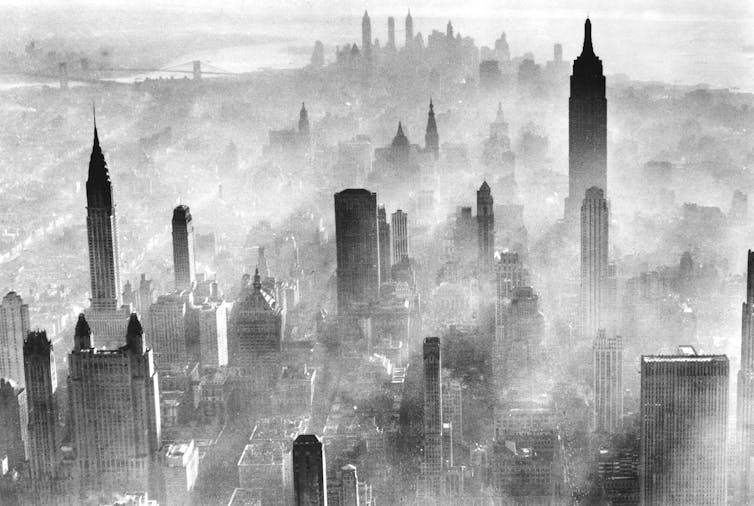
I grew up in rural Colorado, deep in the mountains, and I can still remember the first time I visited Denver in the early 2000s. The city sits on the plain, skyscrapers rising and buildings extending far into the distance. Except, as we drove out of the mountains, I could barely see the city – the entire plain was covered in a brown, hazy cloud.
That brown, hazy cloud was mostly made of ozone, a lung-irritating gas that causes decreases in lung function, inflammation, respiratory symptoms like coughing, and can trigger asthma attacks.
Denver still has air pollution problems, due in part to its geography, which creates temperature inversions that can hold pollution near the ground. But since 1990, ozone has decreased 18% across the U.S., reducing the smog that choked many cities in the 1960s and 1970s. The concentration of tiny dustlike particles of air pollution called PM2.5 has also decreased, by 37% since 2000.
These decreases occurred largely because of one of the most successful public health policies ever implemented by the United States: the Clean Air Act, first passed in 1970. The Clean Air Act regulates air pollution emissions and authorizes the Environmental Protection Agency to set air quality standards for the nation.
For years, when the Environmental Protection Agency assessed the economic impact of new regulations, it weighed both the health costs for Americans and the compliance costs for businesses. The Trump administration is now planning to drop half of that calculation – the monetary health benefits of reducing both ozone and PM2.5 – when weighing the economic impact of regulating sources of air pollution.
I am an environmental epidemiologist, and one of the things I study is people’s exposure to air pollution and how it affects health. Measuring the impact of air quality policies – including quantifying how much money is saved in health care costs when people are exposed to less air pollution – is important because it helps policymakers determine if the benefits of a regulation are worth the costs.
Table of Contents
What air pollution does to your body
Breathing in air pollution like ozone and PM2.5 harms nearly every major system in the human body.
It is particularly hard on the cardiovascular, respiratory and neurological systems. Numerous studies have found that PM2.5 exposure is associated with increased death from cardiovascular diseases like coronary heart disease. Even short-term exposure to either PM2.5 or ozone can increase hospitalizations for heart attacks and strokes.
In the respiratory system, PM2.5 exposure is associated with a 10% increased risk for respiratory diseases and symptoms such as wheezing and bronchitis in children. More recent evidence suggests that PM2.5 exposure can increase the risk of Alzheimer’s disease and other cognitive disorders. In addition, the International Agency for Research on Cancer has designated PM2.5 as a carcinogen, or cancer-causing agent.
Reducing air pollution has been proven to save lives, reduce health care costs and improve quality of life.
For example, a study led by scientists at the EPA estimated that a 39% nationwide decrease in airborne PM2.5 from 1990 to 2010 corresponded to a 54% drop in deaths from ischemic heart disease, chronic obstructive pulmonary disease, lung cancer and stroke.
In the same period, the study found that a 9% decline in ozone corresponded to a 13% drop in deaths from chronic respiratory disease. All of these illnesses are costly for the patients and the public, both in the treatment costs that raise insurance prices and the economic losses when people are too ill to work.

Bettmann via Getty Images
Yet another study found that nationally, an increase of 1 microgram per square meter in weekly PM2.5 exposure was associated with a 0.82% increase in asthma inhaler use. The authors calculated that decreasing PM2.5 by that amount would mean US$350 million in annual economic benefits.
Especially for people with lung diseases like asthma or sarcoidosis, increased PM2.5 concentrations can reduce quality of life by worsening lung function.
Uncertainty doesn’t mean ignore it
The process of calculating precisely how much money is saved by a policy has uncertainty. That was a reason the Trump administration stated for not including health costs in its cost-benefit analyses in 2026 for a plan to change air pollution standards for power plant combustion turbines.
Uncertainty is something we all deal with on a daily basis. Think of the weather. Forecasts have varying degrees of accuracy. The high temperature might not get quite as high as the prediction, or might be a bit hotter. That is uncertainty.
PhotoQuest/Getty Images
The EPA wrote in a notice dated Jan. 9, 2026, that its historical practice of providing estimates of the monetized impact of reducing pollution leads the public to believe that the EPA has a clearer understanding of these monetary benefits than it actually does.
Therefore, the EPA wrote, the agency will stop estimating monetary benefits from reducing pollution until it is “confident enough in the modeling to properly monetize those impacts.”
This is like ignoring weather forecasts because they might not be perfect. Even though there is uncertainty, the estimate is still useful.
Estimates of the monetary costs and benefits of regulating pollution sources are used to understand if the regulation is worth its cost. Without considering the health costs and benefits, it may be easier for infrastructure that emits high levels of air pollution to be built and operated.

Selcuk Acar/Anadolu via Getty Images
What the evidence shows
Several studies have shown the impact of pollution sources like power plants on health.
For example, the retirement of coal and oil power plants has been connected with a reduction in preterm birth to mothers living near the power plants. Scientists studied 57,000 births in California and found the percentage of babies born preterm to mothers living within 3.1 miles (5 kilometers) of a coal- or oil-fueled power plant fell from 7% to 5.1% after the power plant was retired.
Another study in the Louisville, Kentucky, area found that four coal-fired power plants either retiring or installing pollution-reduction technologies such as flue-gas desulfurization systems coincided with a drop in hospitalizations and emergency department visits for asthma and reduced asthma-medication use.
Reducing preterm birth, hospitalizations, emergency department visits and medication use saves money by preventing expensive health care for treatment, hospital stays and medications. For example, researchers estimated that for children born in 2016, the lifetime cost of preterm birth, including medical and delivery care, special education interventions and lost productivity due to disability in adulthood, was in excess of $25.2 billion.
Circling back to Denver: The region is a fast-growing data center hub, and utilities are expecting power demand to skyrocket over the next 15 years. That means more power plants will be needed, and with the EPA’s changes, they may be held to lower pollution standards.

















