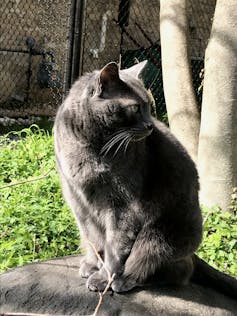
They live in our houses, drink our water and even sleep in our beds. Cats have become an integral part of many households and share much of our lives.
They also share much of their biology with humans. Pet cats get cancer at a rate similar to humans and often develop the same types of cancer. Just like in humans, as health care and diets have improved, cats are living longer, which puts them at a higher lifetime risk of cancer.

(Geoff Wood)
But how similar are cat cancers to human cancers at the genetic level? Research colleagues and I have conducted the largest-ever cancer DNA sequencing study of cat tumours. Our research reveals striking similarities between feline and human cancers, and the results reveal benefits for cats as well as humans.
Newly published work from our international collaboration studied the tumours of 500 cats, including 13 different tumour types. We isolated DNA from these tumours, and mapped the sequence of 1,000 genes that are often found mutated in human cancers.
Cat and human cancers
Overall, the most commonly mutated gene was a cancer protective gene called TP53, which is also the most commonly mutated gene in human cancers. Another example is the gene PIK3CA, which is mutated in about 40 per cent of human breast cancers and was found to be altered in about 50 per cent of cat mammary cancers.
There are drugs that have been specifically developed to work on human cancers with certain mutations like those in PIK3CA. Now that we know what mutations are common in cat cancers, there is an opportunity to test these drugs for treating cats.

(Unsplash/River Kao)
How do we study cancer in cats? Since 2009, the Ontario Veterinary College’s Veterinary Biobank, part of the Institute for Comparative Cancer Investigation at the University of Guelph, has been banking samples of tumours from cats treated at the Animal Cancer Centre.
With owner consent, part of a cat’s tumour that is already being removed during surgery is saved and frozen for future studies. Also banked are blood samples, which serve as a resource for developing more non-invasive cancer tests using cancer-associated molecules found in blood.
Recently, the Veterinary Biobank has joined the Ontario Biobanks consortium of human biobanks to help facilitate more cross-species cancer studies. In addition, cancer clinical trials are being conducted in cat and dog patients to help translate research findings into better outcomes for pets with cancer, and to better inform us about human cancers as well.
Read more:
Treating pets for cancer can revolutionize care for humans
Cats can potentially teach us quite a lot about human cancer. There are several cancers or cancer subtypes that are common in cats but rare in humans. “Triple negative” breast cancer — which lacks estrogen receptors, progesterone receptors and a growth factor receptor called HER2 — is by far the most common subtype in cats. However, it accounts for only 15 per cent of human breast cancers.
This subtype tends to occur in younger women, Black women and women with an inherited genetic predisposition (BRCA1 gene mutation) and is particularly aggressive and hard to treat.
Another example is pancreatic cancer. The acinar subtype that cats get most commonly is relatively rare in humans. Studying these rare human subtypes is potentially easier to do in cats as there are more cases.
Our cat sequencing study also found a few differences in mutation patterns between cat and human cancers. About 25 per cent of human cancers have mutations in RAS genes, whereas RAS mutations are rare in cat cancers. Studying these cancers in cats can help us to understand the biology of RAS genes in cancer.
Cat and mouse genomes

(Unsplash/Roberto Huczek)
Cancer charities and agencies that provide grants to study human health routinely support studies that use rodent models of human cancer, but studying cancer in other species has been a harder sell.
Rodent models are either genetically engineered to develop cancer or are engineered to have a severely deficient immune system so that they can host human cancer cells.
These models are very powerful for examining the molecular mechanisms of cancer but have a poor track record for developing cancer drugs. More than 90 per cent of new cancer treatments developed using mouse models fail in human cancer trials and are never approved for clinical use.
In stark contrast, cat cancers frequently develop spontaneously in the same environment as humans. They also often have many of the same underlying or co-occurring medical conditions as humans, such as obesity, autoimmune diseases, kidney disease, diabetes and various other endocrine disorders.
Cat and human genomes are much more similar than mouse and human genomes, and the organization of cat genomes (the order of genes on the chromosomes) is much closer between cats and humans than between dogs and humans.
The (human) Cancer Genome Atlas is a massive open-access resource of mutations found in different types of cancer. Until now, no such resource existed for cats.
The data from our recent publication is available through the Wellcome Sanger Institute and will serve as a fundamental — and free — resource for researchers studying cancer in cats and humans for the benefit of both species.

















