• Twenty47HealthNews
  • Health & Wellness
  • Disclaimer
    • Terms of Use
    • Privacy Policy
    • DMCA Notice
  • Twenty47HealthNews
  • Health & Wellness
  • Disclaimer
    • Terms of Use
    • Privacy Policy
    • DMCA Notice
24/7 Health News
No Result
View All Result
Home Article

Why many older adults skip hard candy – how aging can change chewing and swallowing

March 23, 2026
in Article
Why many older adults skip hard candy – how aging can change chewing and swallowing

Last Easter while my children were sorting through their baskets of chocolate eggs and jelly beans, my son looked up from the table and asked a simple question:

“Why don’t Grandma and Grandpa eat candy like we do?”

It was the kind of question children ask without really thinking. To him, it seemed obvious: Candy is delicious, so why wouldn’t everyone want it?

From a child’s perspective, it can look like older adults simply lose their taste for sweets. But as a speech-language pathologist who studies swallowing disorders, I know the explanation is often more complicated. In many cases, the issue has less to do with liking candy and more to do with something most people rarely have to think about: swallowing.

Table of Contents

  • Swallowing is more complex than most people realize
  • When swallowing changes become a disorder
  • Food is about more than nutrition
  • Helping older adults continue to enjoy food
  • A different way to see that moment at the table

Swallowing is more complex than most people realize

You hardly notice the act of swallowing. It happens automatically every time we eat or drink. But swallowing is actually a remarkably complex process. More than 30 muscles and several nerves coordinate to move food from the mouth through the throat and into the esophagus while briefly protecting the airway.

One way to think about swallowing is like a carefully timed relay race. Each group of muscles passes food along to the next step at exactly the right moment, while the airway briefly closes to keep food from entering the lungs.

When everything works smoothly, it takes only a second or two.

[embedded content]
Three different phases make up swallowing.

As people age, some parts of this process can change. Chewing muscles may lose a bit of strength. Saliva production can decrease, which makes dry or sticky foods harder to manage. Taste can also shift over time, and the timing of swallowing movements may become slightly slower.

Dental changes or missing teeth can make certain foods harder to chew. These shifts don’t necessarily mean something is wrong, but they can make certain textures more difficult to manage.

Candy is a good example. Many Easter treats – caramels, gummies and sticky chocolate – require strong chewing and precise coordination to swallow comfortably.

For someone whose swallowing has become slightly less efficient, those foods can suddenly feel like more effort than they used to.

When swallowing changes become a disorder

Sometimes, swallowing changes go beyond normal aging. The medical term for difficulty swallowing is dysphagia, and it is a condition that can occur for many reasons. Researchers estimate that about 1 in 25 adults experience dysphagia, making it a relatively common but often overlooked health condition.

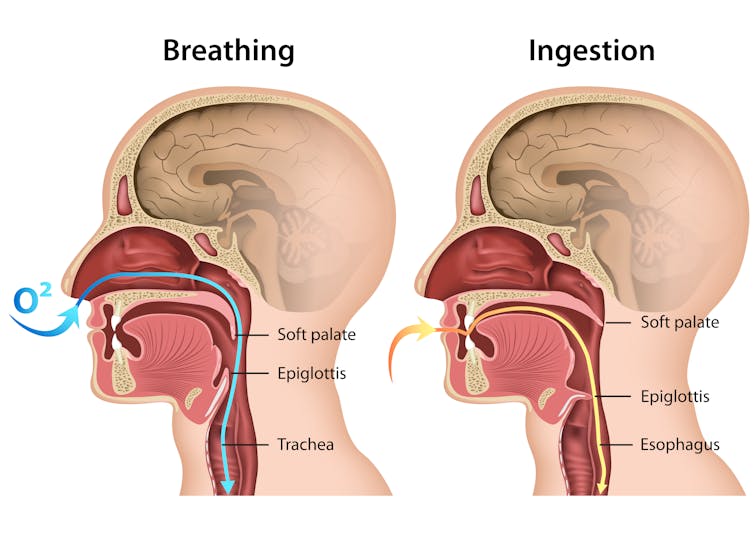
A diagram showing a person's head from the side, with their digestive and nasal passages highlighted.

This diagram shows the digestive and nasal passages used in swallowing and breathing. Multiple muscles must work in tandem to successfully swallow.
medicalstocks/iStock via Getty Images

Stroke, Parkinson’s disease, dementia and other neurological conditions can affect the muscles and nerves that control swallowing. In health care settings, speech-language pathologists frequently see swallowing problems among older adults recovering from illness or managing chronic conditions.

When swallowing becomes difficult, eating can feel tiring or uncomfortable. Some people cough while eating. Others feel like food is getting stuck in their throat or notice that meals take longer than they used to.

To avoid discomfort, many people quietly begin adjusting what they eat. They may choose softer foods, take smaller bites or skip foods that feel harder to swallow.
Sometimes that includes sticky or chewy candies.

To others at the table, it may appear that Grandma or Grandpa no longer enjoys sweets. But these changes are often subtle adaptations that make eating safer and more manageable.

Food is about more than nutrition

Eating is not just about getting calories or nutrients. Food is tied to memory, tradition and connection.

Think about how many family traditions revolve around meals. Holiday dinners, birthday cakes and seasonal treats bring people together. Sharing food is one of the most universal ways in which families celebrate and connect across generations.

When swallowing becomes difficult, the effects go beyond the physical challenge of eating. People may start avoiding certain foods or feel self-conscious eating around others. Over time, they may even withdraw from shared meals.

That’s one reason many clinicians now emphasize quality of life alongside safety when treating swallowing disorders.

Speech-language pathologists are the health care professionals who evaluate and treat swallowing disorders. Through specialized assessments and therapy, they help people find strategies that make eating safer and more comfortable. Sometimes the changes needed are surprisingly small.

Helping older adults continue to enjoy food

Family members are often the first to notice when someone’s eating habits begin to change. Signs that may suggest swallowing difficulty include coughing or throat clearing during meals, needing extra time to chew food, or avoiding certain textures — especially dry or sticky foods.

If these patterns appear regularly, a medical evaluation can help identify whether swallowing changes are involved.

The goal is rarely to eliminate someone’s favorite foods entirely. Instead, clinicians often help people find ways to continue enjoying meals safely – whether that means modifying food textures, adjusting eating strategies or addressing the underlying condition affecting swallowing.

In many cases, these adjustments allow older adults to keep participating in the meals and traditions that matter most to them.

An array of different types of candy

Candy is one example of a food that can become tricker to eat and swallow with age.
MixitIstock/iStock via Getty Images

A different way to see that moment at the table

The next time candy appears at a holiday gathering, a grandparent’s decision to pass might raise a question from a curious child.

Sometimes the explanation really is simple preference. But other times, the answer lies in the quiet changes that can occur in chewing and swallowing as people age. Understanding those changes can help families respond with a little more awareness and patience.

After all, the joy of sharing food together doesn’t disappear with age. It just might require a little more understanding of how the body works.


ShareTweetSharePin

Most Read

What causes stuttering? A speech pathology researcher explains the science and the misconceptions around this speech disorder

What causes stuttering? A speech pathology researcher explains the science and the misconceptions around this speech disorder

December 15, 2022
morning back pain

Morning Again Ache Trigger Is Not the Mattress

October 11, 2021
3 women stroke prevention

Silent Stroke Symptoms in Women: What You Might Be Overlooking

February 27, 2026

4 steps to building a healthier relationship with your phone

January 28, 2025
lower back pain relief exercises

5 decrease again ache aid workouts

October 11, 2021

Why Circadian Rhythms Matter for Your Health

July 30, 2024
Good Night Sleep

6 Causes of Good Evening Sleep

October 11, 2021
Nasal vaccines promise to stop the COVID-19 virus before it gets to the lungs – an immunologist explains how they work

Nasal vaccines promise to stop the COVID-19 virus before it gets to the lungs – an immunologist explains how they work

December 14, 2022
3 years after legalization, we have shockingly little information about how it changed cannabis use and health harms

3 years after legalization, we have shockingly little information about how it changed cannabis use and health harms

October 15, 2021
bleeding in gum

When The Bleeding in gum Is Severe ?

October 11, 2021
Kick up your heels – ballroom dancing offers benefits to the aging brain and could help stave off dementia

Kick up your heels – ballroom dancing offers benefits to the aging brain and could help stave off dementia

January 3, 2023
Ten small changes you can make today to prevent weight gain

Ten small changes you can make today to prevent weight gain

October 12, 2021

COVID vaccines: how one can pace up rollout in poorer international locations

October 5, 2021
Biden is getting prostate cancer treatment, but that’s not the best choice for all men − a cancer researcher describes how she helped her father decide

Biden is getting prostate cancer treatment, but that’s not the best choice for all men − a cancer researcher describes how she helped her father decide

May 20, 2025
Five ways to avoid pain and injury when starting a new exercise regime

Five ways to avoid pain and injury when starting a new exercise regime

December 30, 2022
Support and collaboration with health-care providers can help people make health decisions

Support and collaboration with health-care providers can help people make health decisions

December 16, 2021
Greece to make COVID vaccines mandatory for over-60s, but do vaccine mandates work?

Greece to make COVID vaccines mandatory for over-60s, but do vaccine mandates work?

December 1, 2021
woman covered with white blanket

Exploring the Impact of Sleep Patterns on Mental Health

August 4, 2024

Maximize Your Performance – Sync with Your Circadian Rhythms

August 9, 2024

This Simple Hygiene Habit Could Cut Your Risk of Stroke, New Research Reveals

February 1, 2025
GLP-1 drugs may fight addiction across every major substance, according to a study of 600,000 people

GLP-1 drugs may fight addiction across every major substance, according to a study of 600,000 people

March 6, 2026

Multiple sclerosis: the link with earlier infection just got stronger – new study

October 12, 2021
Nurses’ attitudes toward COVID-19 vaccination for their children are highly influenced by partisanship, a new study finds

Nurses’ attitudes toward COVID-19 vaccination for their children are highly influenced by partisanship, a new study finds

December 2, 2022
As viral infections skyrocket, masks are still a tried-and-true way to help keep yourself and others safe

As viral infections skyrocket, masks are still a tried-and-true way to help keep yourself and others safe

December 14, 2022
GPs don’t give useful weight-loss advice – new study

GPs don’t give useful weight-loss advice – new study

December 16, 2022
Four ways to avoid gaining weight over the festive period – but also why you shouldn’t fret about it too much

Four ways to avoid gaining weight over the festive period – but also why you shouldn’t fret about it too much

December 22, 2022
Backlash to transgender health care isn’t new − but the faulty science used to justify it has changed to meet the times

Backlash to transgender health care isn’t new − but the faulty science used to justify it has changed to meet the times

January 30, 2024
Nutrition advice is rife with misinformation − a medical education specialist explains how to tell valid health information from pseudoscience

Nutrition advice is rife with misinformation − a medical education specialist explains how to tell valid health information from pseudoscience

January 28, 2025
News of war can impact your mental health — here’s how to cope

Binge-eating disorder is more common than many realise, yet it’s rarely discussed – here’s what you need to know

December 2, 2022

🧬 How Your DNA Affects Exercise: The Science of Personalized Fitness

May 21, 2025
  • Twenty47HealthNews
  • Health & Wellness
  • Disclaimer

© 2020 DAILY HEALTH NEWS

  • Twenty47HealthNews
  • Health & Wellness
  • Disclaimer
    • Terms of Use
    • Privacy Policy
    • DMCA Notice

© 2020 DAILY HEALTH NEWS











