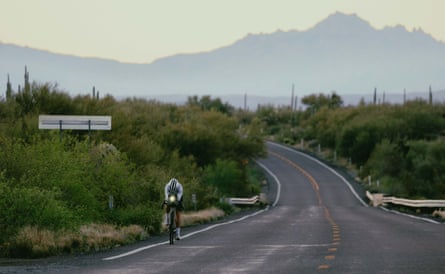
On 11 September 2024, Lael Wilcox returned to Chicago after 108 days in the saddle, smashing the women’s around-the-world cycling record by more than two weeks. The extraordinary feat had taken her 18,000 miles over remote mountains and across 22 countries. But it left Wilcox with a lingering question: could she break Mark Beaumont’s outright record of 78 days and 14 hours?
Shaving 30 days off her time would require a major pivot in philosophy from adventure riding to pure racing, with an emphasis on efficiency, aerodynamics, and rigorous planning. Motivated to prove that women can compete with men in ultra-cycling, Wilcox will start her second attempt on 7 June in Chicago.
Wilcox, who was born and raised in Anchorage, Alaska, is no stranger to beating men in high profile races. In 2016 she finished first overall in the Trans Am Bike Race, a 4,200-mile event across the US. In 2017 she set the fastest time on the Baja Divide, a 1,700-mile self-support race down Mexico’s Baja Peninsula. She also set the women’s record on the Tour Divide in 2015, widely considered the World Series of ultra-cycling, but the 39-year-old says the around-the-world record will require an even higher level of preparation, strategy, and execution.
For the first time in her 11-year racing career, Wilcox will be riding with a full support crew who will handle her nutrition, logistics and bike mechanics, allowing her to focus on pedaling for 16 hours a day. Her route is designed for speed over scenery, with as little elevation as possible (her first lap around the globe had a monstrous 630,000ft of climbs). Although she’ll be riding non-stop for two and a half months, Wilcox says her margin for error to break the record will likely be measured in minutes.
As such, she’s focused on the small things, from aerodynamic testing in a wind tunnel to eating more meals on the bike. “This is the most ambitious thing in my life, by far, so I’ve become obsessed with efficiency,” she says. “I even plan to shave my head right before I start, so I won’t have to wash or brush my hair, which saves a lot of time!”
Wilcox plans to share the route so that fans can cheer her on or even join for a section, but she won’t slow down for others. In her first circumnavigation, Wilcox averaged 15 mph for around 12 hours a day. This time she aims to ride at the same pace for an additional four hours each day. If she is able to ride faster than 15 mph, she’ll be able to sleep more each night. Cutting out stops – apart from breaks for sleeps – is something she’s focused on for her second attempt.
“After watching the video of my first ride, I realized that I stopped all the time,” Wilcox says, “anywhere I saw a fan, I would stop to chat. It was fun, but I could have ridden so much more. Ten minutes of talking each day is 13 hours overall – that’s a half day of stopping!”
Setting the record will take more than just speed and time in the saddle. Because there’s no way to actually ride a loop around the world non-stop, the record has a strict list of rules. She has to travel at least 18,000 miles, cross all lines of longitude, and travel in a single direction. She must start and end at the same spot and hit two antipodal points, or opposite spots on Earth’s surface. The clock runs continuously, so taking direct flights between her seven sections is critical. Also, she must use the same bike model for the full ride, although swapping parts or even a new bike of the same model is acceptable.
Her crew, which includes her wife, Rue Kaladyte, and three to four others, will travel in an RV, checking in on Wilcox a handful of times each day. They’ll also take care of everything from camping spots to cooking meals, changes to the route due to weather, and tracking the wear and tear on bike components, often while Wilcox sleeps.
On her first attempt, Wilcox didn’t plan maintenance stops ahead of time, instead relying on local shops. “When my tires had around 3,000 miles I would just Google shops nearby and sit there while they were working on my bike,” says Wilcox. “This year I have a mechanic taking care of that. We’ll have a spare bike and spare wheelset, spares for all the proprietary parts on the bike, plus an extra pair of shoes that are a size bigger in case my feet swell, which happens.”
The crew will also prepare her meals, meaning her diet will be better than during her last circumnavigation. “I raced across Europe last summer where there was a lot of good food available and I rode so much better,” she says. “I felt indestructible with peach juice, yogurt, and pizza. I used to not care much about fueling, but when that changed I rode a lot better.”
However, Wilcox won’t have a set caloric target. “The quality of food matters more than the quantity to me,” she says. “The trend in bike racing right now is all carbs, but for efforts like this, I also eat a lot of fats. Mostly carbs with some fat, protein, fruits, and veggies. Plenty of sugary drinks too.”
In self-supported races, Wilcox must manage changes to her route due to closed roads or thunderstorms, but this time her crew will take on the burden of logistics. With the goal to ride 240 miles each day, she plans to start each day at 4am and finish around 9pm, doing the majority of her dark miles in the morning when she’s more alert.
There are a few stretches of the route – like the Australian outback and rural North America – where limited cell service and long distances between towns make logistics more challenging, but she isn’t worried about worst case scenarios like the RV breaking down or borders being closed.
“I don’t do doomsday stuff,” says Wilcox. “If I don’t get the record, who cares. It’s a privilege to just get to attempt it. Worst case I still get to ride my bike a lot.”
Wilcox has been training all winter, focused on efficiency and power on the flats, an area which isn’t usually her strength. This means more time at a lower cadence and working on seated power, while building strength in the gym and improving mobility in yoga classes. “Each week I also do a long ride to get used to the distance and make sitting in aero bars for 10 hours feel normal,” says Wilcox.
Although she will be crossing time zones regularly, Wilcox doesn’t plan to use an expedition clock to keep her in the same time zone for the entire ride. “It’s better to just stay in tune with the sun,” she says. “I’ll be losing hours all the time, but then I gain a day at the end. The weirdest part is going to the dead of winter in Australia and New Zealand, but I have to hit opposite sides of the globe. Luckily I’m only in winter for a third of the trip.”
Other than breaking the record, Wilcox says her main goal is to just enjoy the journey. “I know there will be hard moments, but I want to like 90% of it. I get to see so many new places with my wife and take on a goal that we’re both excited and terrified of. I’m so lucky I get to do this again.”
















