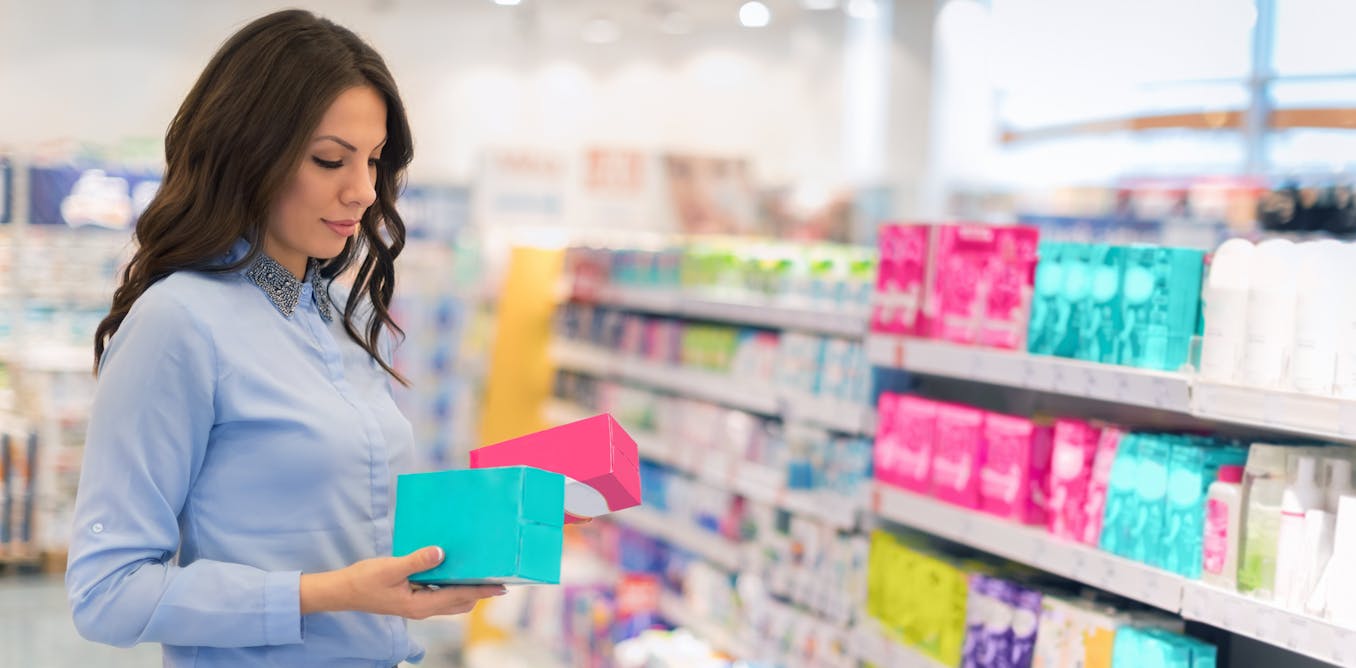
About half of the global population menstruates at some point in their lives. Disposable products, such as tampons and pads, are some of the most popular products used around the globe to manage menstrual flow.
Unfortunately, studies have shown that many personal care products, including shampoo, lotion, nail polish and menstrual products, contain hazardous chemicals. Items used in or near the vagina are of particular concern because they are in contact with vaginal mucous membranes – the moist tissue lining the inside of the vagina that secretes mucus. These tissues can absorb some chemicals very efficiently.
People use menstrual products 24 hours a day for multiple days monthly, over the course of many years. Tampons, which are used internally, are surrounded by the permeable vaginal mucous membrane for up to eight hours at a time.
I am an environmental epidemiologist, and I study chemical exposure, its sources and its health effects. As a person who menstruates, I also must make my own decisions around menstrual products and manage the challenge of finding accurate information about women’s health risks, which receive less research attention and funding than men’s health.
In 2024, I co-authored the first paper that detected metals in tampons, including toxic metals like lead and arsenic. My colleagues and I also wrote a review paper that surveyed the scientific literature and found about two dozen studies measuring chemicals in menstrual products.
The various chemicals that these studies detected were typically at concentrations low enough to make their health impact unclear. However, they included chemicals known to disrupt the endocrine system, which makes and controls hormones that are essential for bodies to function.
Table of Contents
How contaminants get into menstrual products
The first modern tampon in the U.S. was patented in 1931. Nearly a century later, tampons still are made primarily from cotton, rayon or a blend of the two.
Chemicals may get into tampons and other menstrual products in a number of ways. Some chemicals, like heavy metals, are present in soil, either naturally or due to pollution, and may be absorbed by cotton plants.
Other chemicals, such as zinc, may be intentionally added to menstrual products to prevent the growth of harmful bacteria. Still others, such as phthalates – synthetic chemicals used to manufacture plastics – may leach into menstrual products from plastic packaging or be added as part of a fragrance.
Research suggests that these chemicals are present in a large proportion of menstrual products – we found lead present in all 30 tampons we tested. What we don’t yet know is if these chemicals can get into people’s bodies in a high enough concentration to cause health effects in either the reproductive system or elsewhere in the body.
Limited federal regulations
The U.S. Food and Drug Administration regulates tampons, menstrual cups and scented menstrual pads as Class II medical devices, which carry moderate to medium risk. Unscented menstrual pads are Class I medical devices, which are considered low-risk. These categories are based on the risk the device may present to a consumer who uses it in the intended way.
FDA guidance for Class II devices offers only a few general guidelines with respect to chemicals. For menstrual tampons and pads, it recommends – but does not require – that products should not contain two specific dioxin products or “any pesticide and herbicide residues.” Dioxins are a chemical by-product of the bleaching process to whiten cotton, and they are associated with cancer and endocrine disruption. Using non-chlorine bleaching methods can reduce dioxin formation.
The most stringent regulation of tampons in the U.S. occurred after an illness called toxic shock syndrome became a public concern in the 1970s and 1980s. Menstrual toxic shock syndrome occurs when the bacteria Staphlococcus aureus grows in the vagina on inserted menstrual products and releases a toxin called TSST-1. This substance can be absorbed through the vaginal mucosa and cause a variety of symptoms, including fever, high blood pressure, shock and even death.
During this epidemic, in which at least 52 cases were recorded and seven people died over a period of eight months, tampons were associated with the syndrome – especially a highly absorbent tampon called Rely, which was pulled from the market.
In response, the FDA created a task force that recommended standardizing the tampon absorbencies and advised consumers to use the lowest absorbency for their flow. This is why tampons in the U.S. now come in a range of absorbencies, from light through regular to super and ultra, so that users can choose the level they need while minimizing risk of toxic shock.
Living in a ‘soup of chemicals’
Just because a chemical is present in a menstrual product doesn’t mean it can get into the body. However, chemicals like lead and arsenic are known threats to human health. So it’s important to study whether harmful chemicals present in menstrual products could contribute to health problems.
Humans in the modern world live in what expert toxicologist Linda Birnbaum, former director of the National Institute of Environmental Health Sciences, calls a “soup of chemicals.” Simply being present on Earth means being exposed to many chemicals, at different concentrations, all at once. This makes it difficult to unravel the relationship between a single chemical exposure and health.
Nonetheless, science has shown that chemical exposure from at least one menstrual product – vaginal douches – does affect health. Vaginal douching is the process of washing or cleaning the inside of the vagina with water or other fluids.
Elevate Your Health for Just $29.99/Month
Join the Precision Wellness Subscription at My Healing 365 and get discounted services, priority coaching access, virtual care, and exclusive wellness resources to support your physical, emotional, and hormonal health.
Join for $29.99/MonthThe American College of Obstetricians and Gynecologists recommends avoiding this process, which can harm healthy bacteria in the vagina, increasing the risk of vaginal infections and other diseases.
In addition, a 2015 study found that women who use vaginal douches have higher concentrations of a chemical called monoethyl phthalate in their urine. Exposure to this substance is associated with reproductive health problems, such as reduced fertility and increased pregnancy risk.
Can these chemicals be absorbed?
Scientists are working now to determine what concentrations of metals and other chemicals can leach out of tampons and other menstrual products. One 2025 study estimated that volatile organic compounds, a group of chemicals that vaporize quickly, can be absorbed through the vaginal mucosa. Volatile organic compounds may be added to menstrual products as part of fragrances, adhesives or other product components.
My team and I are now shifting our focus to the relationship between menstrual product use, various chemicals, and menstrual pain and bleeding severity. We want to see whether some chemicals will be elevated in menstrual blood, whether these chemical levels are higher in people who use tampons, and whether the chemicals are associated with greater menstrual pain and bleeding.
States are starting to act on this issue. For example, in 2024, Vermont became the first U.S. state to ban multiple chemicals from disposable menstrual products. California bans PFAS, a widely used group of highly persistent chemicals, from menstrual products. New York adopted a law in December 2025 barring multiple toxic chemicals from menstrual products.
California also enacted a law in October 2025 that requires manufacturers of disposable tampons and pads to measure concentrations of arsenic, cadmium, lead and zinc in their products, and to share those measurements with the state, which can publish them. More information like this will help support informed choices for millions of consumers who rely on menstrual products every month.

























