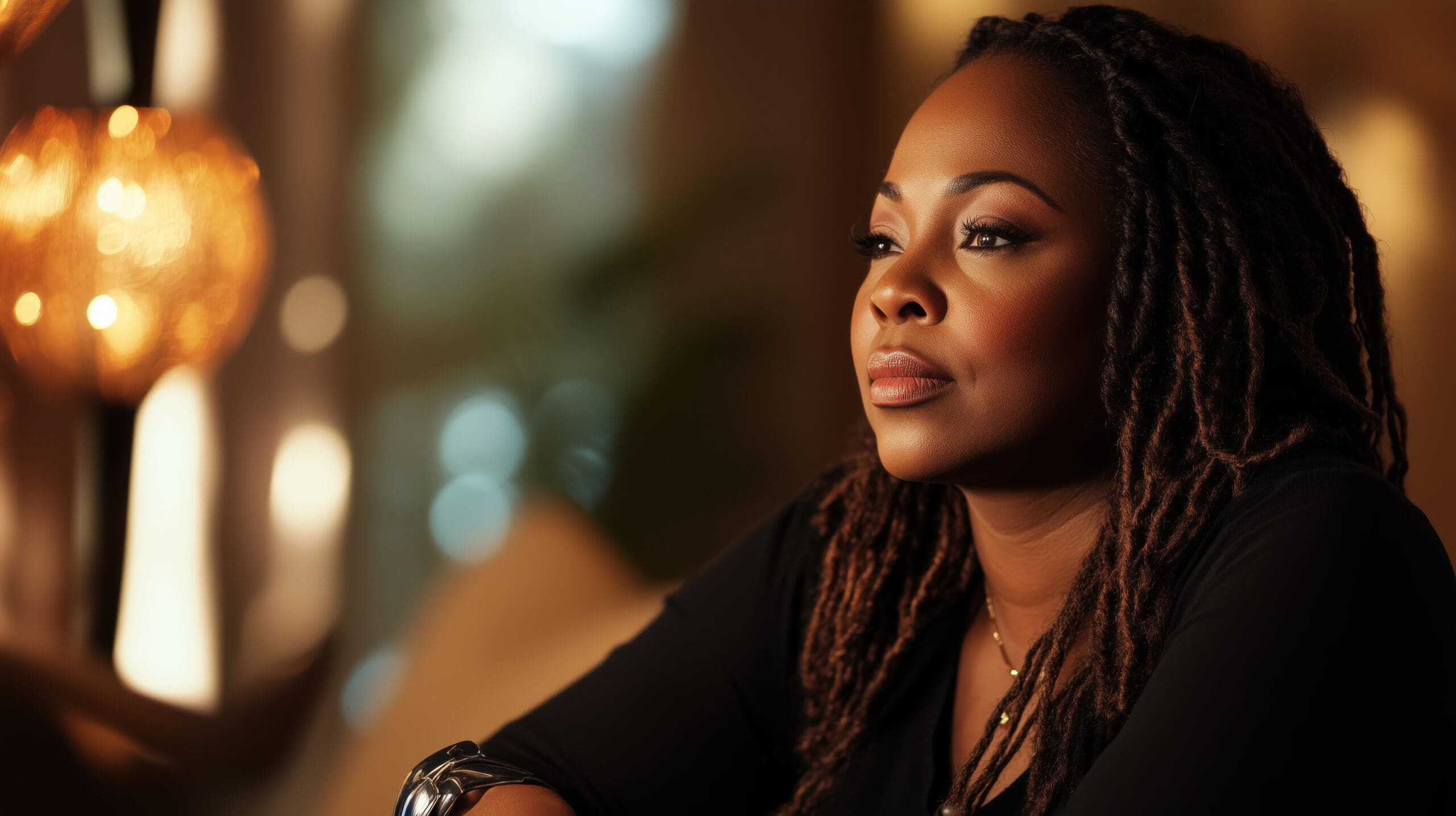
Highland Project Founder Gabriell Wyatt launched The Legacy Studio to help Black women reconsider their personal and professional legacies. The Legacy Studio is a guided practice resource designed to expand the ideas behind their Meet Me at the Highland™ podcast. It seeks to decriminalize the act of sitting still at a time when rushing towards progress, or the perception of progress, is idealized.
This digital resource is arriving at a point when Black women are being rapidly forced out of the workplace, creating financial anxiety and physical stressors.
Table of Contents
Why She Launched the Legacy Studio
“What I’ve seen year after year, and what I know in my core as a Black woman, is that we carry so much responsibility to our communities, to our organizations, our families, and we’ve rarely had intentional space to reflect on the deeper arc of our lives, and that’s really become the invitation of the legacy studio. It’s become an invitation to pause,” Wyatt tells Black Health Matters.
Seeking Clarity Through Ancestry
Focused on lineage-based leadership, the Legacy Studio’s programming seeks to add context to the cultural moment. It doesn’t seek to ignore current challenges but to place them in a timeline of other obstacles.
“Black Lives have always been under attack in a system of oppression,” Wyatt states plainly.
“I know the moments that Black women are experiencing right now, the rug is being pulled from underneath them constantly. We also have to recognize that isn’t new and in these moments, we have the blueprints of our ancestors,” she continues. “If we don’t recognize the pause in between, these moments in between our breath, we won’t establish clarity on where we need to go next.”
The Impact of Economic Anxiety
Economic anxiety lands differently in the lives of Black women, who find themselves being breadwinners more often. The saying “when White America catches a cold, Black America catches pneumonia” can be proven in the bank balances of many of our mothers, sisters, aunts, and friends.
“African-American women bear a strikingly high level of financial responsibility compared to women from all other racial/ethnic groups,” according to the Journal of Social Science & Medicine. Physical conditions disproportionately impacting Black women, like high blood pressure and heart disease, are associated with the stress that can show up when trying to keep afloat.
Framing is tough when unemployment funds are dwindling, but Wyatt argues that failing to do so can result in confusion and danger, making things worse. She advocates for looking, not only to the past, but next door for a chance at survival or thriving.
Why Having Financial Freedom Matters to Black Women
“The role of financial freedom is incredibly important for Black women in communities,” says Wyatt. “The legacy of the Highland Project has been about reimagining wealth and financial freedom for Black women in communities because we know that we’re not a culture historically of individualism and of capitalism. We know that historically, we’re a culture of collectivism, a culture of honoring the village over the individual. And so I think it’s incredibly important that in a modern-day society where pop culture is constantly picking at us to imagine lives as millionaires, where we leave our communities behind, that we recognize and pull forward the clarity.”
Acknowledging The Need for a Pause
Those choosing entrepreneurship can make major sacrifices, such as access to healthcare and a severe lack of downtime.
Some Black women are demonstrating leadership by stepping aside, abandoning roles as founders and CEOS for more peace. This includes several Black women in the public eye who have sat on vision boards and panels as beacons of possibility for those with an LLC and a dream.
Diarrha N’Diaye-Mbaye shuttered Ami Cole and joined Skims. Anifa Mvuemba placed Hanifa on pause. Others quietly shrank away from the demands of entrepreneurship to pursue what they wanted their lives to look like outside of the boardroom.
These choices are not seen as failures by Wyatt. “We’re often asked to hold a vision for what’s possible in these roles while absorbing the most amount of uncertainty,” she says. “When we see leaders, 1st acknowledge that there’s a choice to be made, that in and of itself, in my opinion, is a success.”
Gen Z and Gen Alpha appear to be rejecting that. A 2025 study from the International Journal of Social Science and Human Research found that younger people are not willing to abandon their personal lives to level up in the office.
Elevate Your Health for Just $29.99/Month
Join the Precision Wellness Subscription at My Healing 365 and get discounted services, priority coaching access, virtual care, and exclusive wellness resources to support your physical, emotional, and hormonal health.
Join for $29.99/Month“For far too long, we’ve been expected to lead at the speed of urgency, and what I think that this generation of young girls are watching is that rest is not weakness, but it’s a power,” she says, “Stillness is not the opposite of leadership. It’s what sustains it.”
Creating A Living Legacy By Choosing Ourselves
Wyatt sees walking towards stiller waters as brave. “To have the courage to make a choice to prioritize wellness in a society where we’ve been told everything but that as black women and as black humans, that’s also a victory,” she says.
“When we care for our wellness. and our communities support our care for our wellness, we’re actually able to shape, I think, broader patterns in our community of what’s now becoming more and more accessible as another way of being, another way of building a future, building a future that isn’t prioritizing urgency, but it is instead prioritizing our longevity, our vitality.”
She thinks public examples of redefining leadership are powerful resources for the next generation of Black women leading.
“This frankly, is at the heart of legacy,” she says. ”It’s about remembering that our lives are part of a much larger story.”

























