Cancers that were once considered incurable now have new treatment options. Among these innovations are CAR-T (chimeric antigen receptor T cell) therapies that modify a patient’s T cells, which play an important role in immune systems.
The T cells are modified to induce the expression of a receptor that is capable of recognizing and attacking cancer cells. These therapies have provided therapeutic responses in previously untreatable forms of leukemias and lymphomas.
However, they’re associated with significant accessibility challenges in Canada due to their high cost and complexity. To address these issues, Canadian academic researchers and public institutions are developing non-commercial CAR-T therapies that promise to improve accessibility by reducing costs while keeping comparable clinical outcomes.
As a PhD candidate at Université Laval in collaboration with the National Research Council, my research focus is cell engineering to produce lentiviral vectors needed in CAR-T therapies. I’m interested in making CAR T-cell therapy more broadly available.
Table of Contents
CAR-T cell therapy process
These personalized treatments are called ex vivo autologous therapies. They use the patient’s own cells, which are harvested from blood, modified outside the body and then re-injected into the patient.
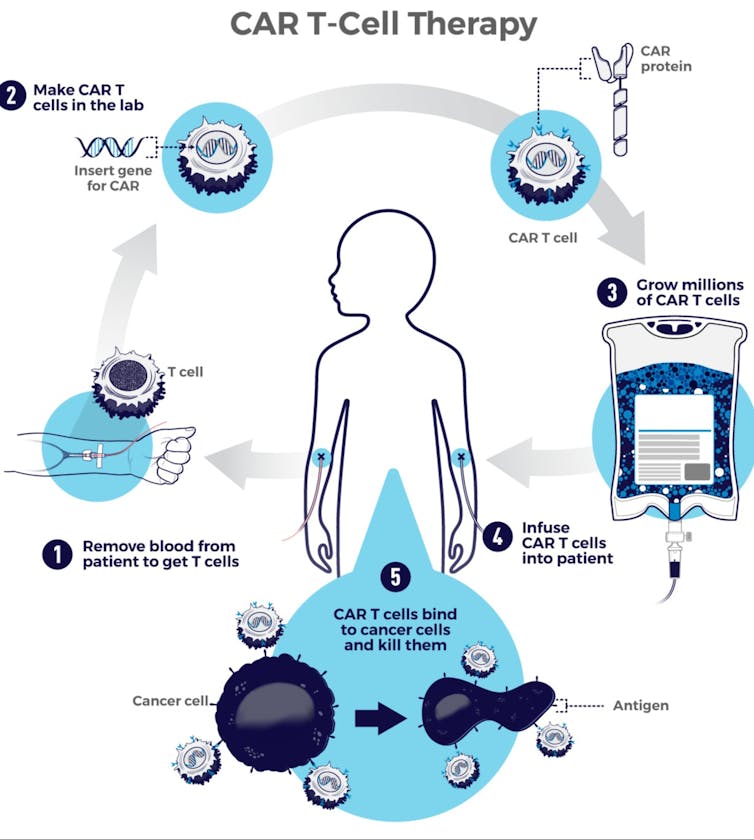
National Cancer Institute, CC BY
The process follows several key steps. First, apheresis is performed to filter the patient’s blood and collect only T lymphocytes. Once isolated, the T lymphocytes are exposed to a modified virus carrying the CAR gene, programming them to express the CAR receptor and target cancer cells. Once modified, cells are cultured until sufficient quantities are produced. After expansion in culture, the T lymphocytes are reinfused into the patient’s body, creating a personalized therapy.
Various types of CARs can be expressed on the surface of T lymphocytes to target different types of cancer cells. For example, antiCD-19 CARs and antiCD-22 CARs are used to treat leukemia and lymphoma while anti-BCMA CARs are used for myeloma.
A complex and costly centralized model
Currently, six CAR-T therapies are available in Canada. These treatments are made by pharmaceutical companies at few sites where all the stages of production occur for several regions or countries. In this centralized model, cells collected from patients are sent to these companies, modified there and then distributed to the point-of-care location for reinjection into the patient.
This process takes four to six weeks between cell collection and reinfusion. This delay can be critical depending on the patient’s condition, and often necessitates a temporary therapy, called bridging therapy, to stabilize the progression of the disease. This prolonged turnaround time is attributed to the multiple preparation steps and the logistical complexity of centralized manufacturing.
These treatments cost between $440,000 and $630,000, which represents a high cost for public institutions and a big impact on provincial budgets. This pricing limits patient access to these treatments depending on the province of residence. For example, Kimriah an antiCD-19 CAR therapy is only reimbursed in Alberta, Ontario and Québec.
Elevate Your Health for Just $29.99/Month
Join the Precision Wellness Subscription at My Healing 365 and get discounted services, priority coaching access, virtual care, and exclusive wellness resources to support your physical, emotional, and hormonal health.
Join for $29.99/MonthFurthermore, these therapies are only offered in large hospitals due to the expertise and infrastructure required. These geographic barriers prevent patients in remote areas from receiving the same care, resulting in unequal treatment for the same disease.
Non-commercial academic production
Academic therapies are those developed by public institutions such as research institutes, universities and hospitals. In Canada, three academically developed CAR-T therapies are currently undergoing clinical trials targeting forms of lymphoma and leukemia.
Two of these trials target the CD19 antigen (ACIT001/EXC002 and CLIC-1901), while one targets CD22 antigen (CLIC-2201). Because these therapies are in the clinical trials phase, they aren’t yet commercially available, but data is being collected.
The CLIC-1901 therapeutic treatment is unique in that it involves collaboration among different Canadian stakeholders: viral vector components are manufactured in Vancouver at BC Cancer, viral vectors are then produced in Ottawa at the Ottawa Hospital Research Institute and the patient’s cells are engineered into CAR-T cells back in Vancouver at BC Cancer. Finally, treatment re-injections are performed at the same clinical sites, either Vancouver General Hospital or The Ottawa Hospital, where they were originally collected.
The ACIT001/EXC002 treatment relies on two production sites in Alberta to supply four centres spread across the province.
Ultimately, the CLIC clinical trials aim to validate the efficacy of a CAR-T cell treatment made in Canada, paving the way for broader access to other sites and provinces across the country.

(NIAID)
Benefits for the health system
These academic therapies present several advantages for the Canadian health-care system. Unlike centralized commercial therapies, this approach benefits from in-house production, avoiding the shipment of patient cells to distant manufacturing facilities and reducing turnaround time between collection and reinfusion.
The median vein-to-vein time is only 15 days for CLIC1901 and ACIT001/EXC002. This rapid production notably eliminates the need for bridging therapy.
Although the cost of CLIC-1901 has not yet been determined, researchers expect it to be significantly lower than commercial alternatives currently available. For ACIT001/EXC002, the announced cost is less than $100,000. By comparison, academic production of CAR-T therapy at Hospital Clínic in Barcelona, Spain has reduced costs to approximately €89,000 (equivalent of $145,000). For CLIC-2201, no cost estimate is currently available
These academic CAR-T therapies align with the accessibility principles outlined in Section 3 of the Canada Health Act, guaranteeing all Canadians access to health services, without financial or other barriers. With these three clinical trials, patients from three provinces already benefit from this treatments. The goal for the CLIC therapies is also to extend the distribution to six provinces: British Columbia, Ontario, Manitoba, Saskatchewan, New Brunswick and Alberta.
This decentralized model helps reduce access inequalities both geographically, through the presence of these treatments across more provinces, and economically through their reduced cost.
Finally, these academic therapies demonstrate promising efficacy. Until now, CLIC-1901 shows clinical results that are equivalent, or even superior, to certain commercial treatments. Preliminary results suggest that CLIC-1901 may have a lower toxicity rate than commercial products. However, conclusions are limited by the sample size on this point.
For ACIT001/EXC002, the results for safety and efficacy are comparable to those currently available on the market, while results for CLIC-2201 are still awaited.
The success of these various clinical phases paves the way for advanced stages and the widespread development of academic CAR-T therapies in Canada.

























