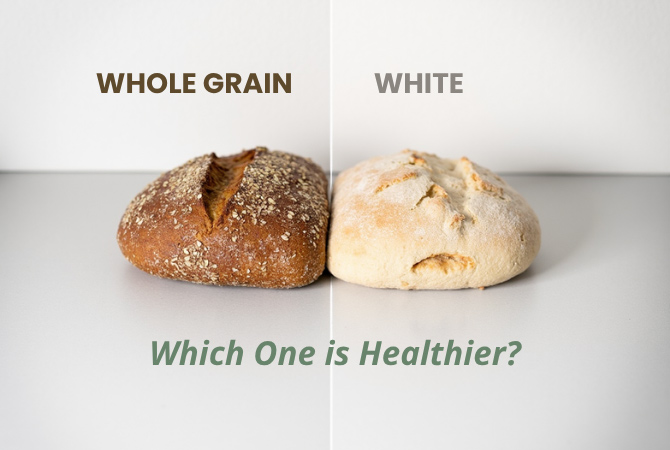
White bread and whole grain bread are both popular, but they are not the same when it comes to nutrition. Whole grain is usually less refined and higher in fibre, but then you also see words like whole wheat, wholemeal and brown bread, which can make things a bit confusing. So let’s clear that up and look at how whole grain bread really compares to white bread.
Table of Contents
Whole grain vs white bread: at a glance
- Whole grain bread is usually the healthier choice because it is less refined and tends to contain more fibre.
- White bread is often lower in fibre and digested more quickly, so it may be less filling and can affect blood sugar more sharply.
- It is not always as simple as colour alone, because some brown breads are still fairly refined and not truly whole grain.
What actually makes them different?
The main difference is how much of the grain is still left in the flour. Whole grain bread is made using all three parts of the grain: the bran, the germ and the endosperm.
The bran is the outer layer, and it contains most of the fibre.
The germ is the small inner part that contains healthy fats as well as some vitamins and minerals.
The endosperm is the starchy part, which mostly provides carbohydrates for energy.
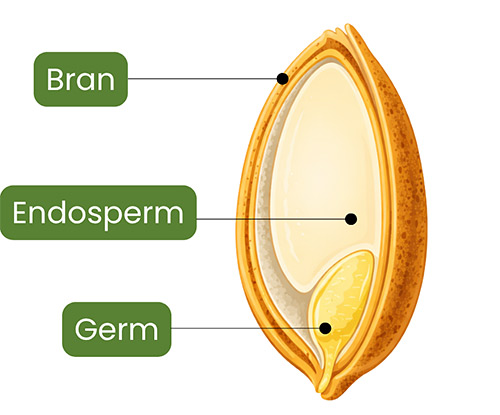
White bread is made with more refined flour, where the bran and germ are removed and mostly just the endosperm is left. That is why white bread is usually lower in fibre and often lower in naturally occurring nutrients than whole grain bread. This is where terms like whole grain, whole wheat and wholemeal start to matter.
Bread terms explained
When you start comparing bread properly, these are the words you keep seeing. They are related, but they do not all mean exactly the same thing.
Whole grain bread
This is the broad term. It means the bread is made using whole grains, but that does not always mean wheat. Whole grain bread can also be made with grains like rye, oats or quinoa. And just because a loaf says whole grain on the packaging does not mean it is 100% whole grain.
Whole wheat bread
This is a type of whole grain bread made specifically from whole wheat. This is the term you will usually see more in the US.
Wholemeal bread
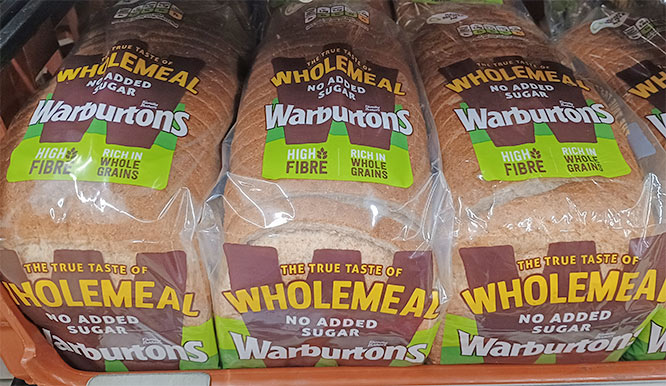
This is the term you will usually see more in the UK. It is basically the UK version of whole wheat bread, and when a loaf is labelled wholemeal, it must be made with 100% wholemeal flour.
Brown bread
This is the least clear term of all. It might contain some whole grain flour, but not always. So if you want a genuinely whole grain loaf, brown bread on its own is not enough to rely on.
How do they compare in real life?
If you are trying to decide which one makes more sense to buy, it helps to compare them side by side.
| What to compare | Whole grain bread | White bread |
|---|---|---|
| Fibre | Usually around 2 to 3.2g per slice and roughly 6.4 to 6.8g per 100g in common loaves | Usually around 0.9 to 1g per slice and roughly 2.3 to 2.4g per 100g in common loaves |
| Calories | Often quite similar by weight. In common loaves, roughly 88 to 103 calories per slice and about 221 to 231 kcal per 100g | In common loaves, roughly 93 to 98 calories per slice and about 233 to 244 kcal per 100g |
| Glycaemic index | Often slightly lower, but it depends on how processed the loaf is | Usually higher and quicker to raise blood sugar |
| Fullness | Usually more filling because of the extra fibre | Usually less filling |
| Nutrients | Usually keeps more of the grain’s natural fibre, magnesium, zinc, iron and B vitamins | Usually lower naturally, although white flour is often enriched or fortified with iron and some B vitamins |
What do the nutrition labels actually show?
The biggest difference is usually fibre, not calories. That is the part many people miss. If you only glance at calories per slice, whole grain bread and white bread can look quite similar. But once you look at fibre, the gap is usually much bigger.
UK examples
Here’s what that looks like with a few everyday loaves. The UK labels below show both per slice and per 100g, which makes the comparison easier.
Slice size varies a lot between loaves, so per-slice numbers can be misleading. That is why comparing per 100g as well gives you a fairer picture.
What stands out here?
- The calorie difference is fairly small.
- The fibre difference is much bigger.
- Looking at per 100g confirms the same pattern, not just per slice.
US examples
US bread labels do not always make comparison as easy, because they usually show nutrition per slice or per serving, not per 100g.
Even so, the same pattern still shows up: whole wheat bread usually gives you more fibre, while calories can vary quite a bit depending on the loaf and slice size.
The figures below come from current product labels for common US loaves.
What stands out?
- True whole wheat still comes out better for fibre. Both Nature’s Own 100% Whole Wheat and Sara Lee Classic 100% Whole Wheat give 2g of fibre per slice.
- A standard white loaf can be much lower in fibre. Nature’s Own Perfectly Crafted Thick Sliced White has less than 1g of fibre per slice.
- Calories can vary a lot depending on the loaf style. The thick-sliced Nature’s Own white loaf is much higher in calories per slice, which is exactly why calories alone can be misleading if the slices are not the same size.
- The wording on the front of the pack matters. Sara Lee White Made with Whole Grain may look like “white bread,” but it is not the same as a standard white loaf, which is why it still gives 1g of fibre per slice.
So the US examples point in the same direction as the UK ones: whole wheat usually gives you more fibre, but once you start comparing calories per slice, things can look quite different depending on how big and dense the slices are.
Elevate Your Health for Just $29.99/Month
Join the Precision Wellness Subscription at My Healing 365 and get discounted services, priority coaching access, virtual care, and exclusive wellness resources to support your physical, emotional, and hormonal health.
Join for $29.99/MonthAnd what about vitamins and minerals?
This part is a bit less straightforward, because white bread can still have added vitamins and minerals even though whole grain bread usually comes out better overall.
Whole grain bread
- usually provides more of the grain’s naturally occurring vitamins and minerals
- can contain more magnesium, zinc, iron and B vitamins than white bread
White bread
- has fewer natural vitamins and minerals because refining removes part of them
- is often fortified or enriched with certain vitamins and minerals
- in the UK, that includes calcium, iron, niacin and thiamin, with folic acid also being added from 13 December 2026
- in the US, enriched flour standards include thiamin, riboflavin, niacin, iron and folic acid
What this means in practice
- white bread is not without vitamins and minerals
- but fortification only puts back some of what was lost
- and it does not recreate the same natural mix of nutrients found in whole grain bread
How do they affect blood sugar?
White bread usually raises blood sugar more quickly because it is more refined. Whole grain bread is often a better choice, but not always by a huge amount. A soft, heavily processed whole grain loaf can still behave quite a lot like white bread.
Harvard explains that refined grains tend to have a higher glycaemic index, but also points out that finely ground grain is digested faster, which is why processing matters so much.
A simple way to think about it:
- GI = how quickly a food raises blood sugar
- GL = how much that normal portion is likely to affect blood sugar overall
The key point
One study found that wholemeal bread and white bread had almost identical peak rises in blood glucose. So the difference is not always as big as people expect.
What seems to matter more is how processed the bread is. Breads with more intact whole grains tend to have a lower glycaemic index than breads made from more finely milled flour.
So the main takeaway is this: whole grain bread is often better, but the type of loaf matters. A less processed, grainier loaf is usually better for blood sugar than a soft fluffy loaf.
How to tell if a loaf is actually whole grain
The front of the pack can make a loaf sound healthier than it really is, so it helps to know what to look for. The easiest way to check is to look at the wording used and then glance at the ingredients list.
What to look for
- Wholemeal is usually the clearest option in the UK, because it means the bread is made with 100% wholemeal flour.
- 100% whole wheat is usually the clearest option in the US, because it tells you the loaf is made fully from whole wheat rather than a mix.
- Whole grain on the front does not always mean the bread is 100% whole grain, so it is still worth checking the ingredients.
- Brown bread is not a reliable term. A loaf can be brown without being a true whole grain loaf.
- The ingredients list matters because it tells you more than the front of the pack. If the loaf sounds healthy on the outside but the ingredients suggest otherwise, trust the ingredients.
The key point:
Do not rely on colour or marketing words alone. If you want a true whole grain loaf, check what the bread is actually made from.
If you want a closer look at whole grain bread on its own, including its benefits and possible downsides, you can also read my guide on whether whole grain bread is good for you.
FAQs
Is whole grain bread better for weight loss than white bread?
Usually, yes. Not because it is magically low in calories, but because it tends to be higher in fibre and often more filling. That can make it easier to stay satisfied. Harvard also notes that whole grains are linked with better weight control, while refined grains are more associated with weight gain over time.
Does whole grain bread or enriched white bread have more folate?
Sometimes enriched white bread can have more folic acid than whole grain bread, because white flour is often fortified. That can happen in the US, and in the UK this will also apply from 13 December 2026. But whole grain bread still usually comes out better overall because it gives you more fibre and a broader mix of naturally occurring nutrients.
Whole wheat vs wholemeal: what’s the difference?
In everyday use, they are very similar. Whole wheat is the term you will usually see in the US, while wholemeal is more common in the UK.
The UK term is actually stricter on pack, because bread can only be called wholemeal if all of the flour used is wholemeal flour (whole grain).
In the US, whole wheat bread is also a defined bread standard made with whole wheat flour rather than regular refined flour.
Is whole grain bread always 100% whole grain?
No. A loaf can say whole grain on the front without being 100% whole grain, which is why the ingredients list still matters. 100% whole grain is a more specific claim than just whole grain.
Is whole grain bread lower in calories than white bread?
Not necessarily. The calorie difference is often quite small, and sometimes a white loaf can even look lower in calories per slice simply because the slice is smaller. The bigger difference is usually fibre, not calories. That is why it helps to compare both per slice and per 100g where possible.
Does freezing bread make any difference to blood sugar?
Possibly a little. One small study found that freezing and defrosting bread, especially if it was then toasted, lowered the glycaemic response compared with fresh white bread. I would treat that as an interesting extra rather than the main takeaway. The bigger point is still that a less processed, grainier loaf is usually the better choice.
So which one should you choose?
If you are choosing between a standard white loaf and a true whole grain loaf, whole grain is usually the better option. It tends to give you more fibre, is less refined and is often more filling too. That said, not every loaf that looks brown or sounds wholesome is truly whole grain, so it is always worth checking the label. And if blood sugar is a concern, a less processed, grainier loaf is usually a better choice than a soft fluffy one.
























