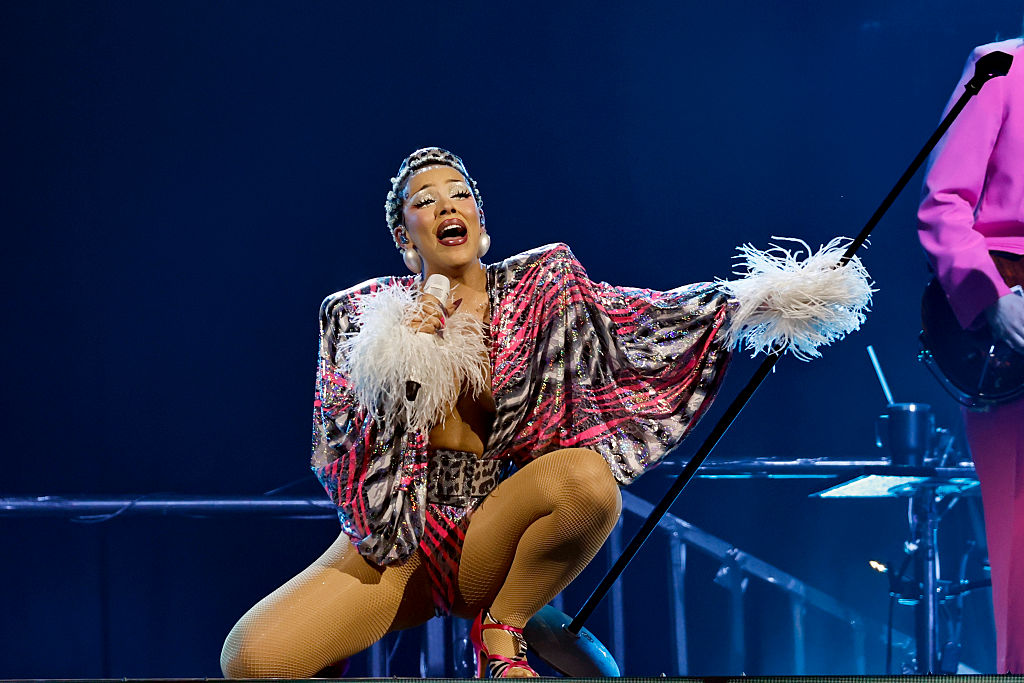
Doja Cat opened up about her mental health journey in a recent TikTok where she revealed that she was diagnosed with Borderline Personality Disorder (BPD) years ago. She shared the ways that BPD has impacted her life. “I’ve learned from a very young age to pretend that I like stuff, to pretend that I’m happy, to pretend that I don’t like stuff that I do,” she said.
“It caught up with me, and I think it always does for people, I’m now struggling with BPD,” she said in the TikTok post. “It’s an agonizing condition,” she added.
@dojacat:/♬ original sound – Doja Cat
Table of Contents
Doja Cat Has Been in Treatment for Eight Years
The “Paint the Town Red” rapper, whose real name is Amala Ratna Zandile Dlamini, says she is in treatment. “I’ve been in therapy for years now, and I am so relieved and so proud of myself. I’ve made it so far, and I still make mistakes, but it is, like, an eight-year process of curing of treatment and healing,” she continued.
What Is Borderline Personality Disorder?
According to The National Institute of Mental Health, “Borderline personality disorder is a mental illness that severely impacts a person’s ability to regulate their emotions” and “this loss of emotional control can increase impulsivity, affect how a person feels about themselves, and negatively impact their relationships with others.” A 2022 article in Frontiers in Sociology reports that “There are many distinct stressors that predispose individuals to develop BPD or engage in self-harm behaviors.” It is sometimes referred to as Emotionally Unstable Personality Disorder and is extremely common.
People with BPD can face intense stigma in clinical and interpersonal settings. The Journal of the American Medical Association reported that individuals with BPD are at an increased risk of suicide and found “Psychotherapy, particularly dialectical behavior therapy, has been shown to be effective in reducing suicidal behavior.”
Can You Have Borderline Personality Disorder Without Knowing It?
Dlamini said she had been dealing with BPD “probably forever.” It’s possible to be experiencing BPD symptoms without knowing what they are.
“When we talk about personality disorders, it’s something that’s typically been with somebody for a really long time, right? So it feels germane to them, or it feels like ‘That is just how I am.’ And so, sometimes it’s not a change overnight,” Dr. Thea Gallagher, PsyD, Director, Wellness Programs, and Clinical Associate Professor, Department of Psychiatry at NYU Grossman School of Medicine.
Elevate Your Health for Just $29.99/Month
Join the Precision Wellness Subscription at My Healing 365 and get discounted services, priority coaching access, virtual care, and exclusive wellness resources to support your physical, emotional, and hormonal health.
Join for $29.99/Month“It can go undiagnosed because of the fact that it feels like it’s your normal. It’s your baseline, and it sometimes can be really hard to see outside of it,” she explains.
Familiarity doesn’t make BPD hopeless. Dialectical behavioral therapy has been proven to help. “When you’re feeling that way, you can really work on that,” adds Thea. “These are skills and tools that really help people to manage their emotions, to navigate suicidal thoughts, to manage more of their interpersonal distress, and the highs and lows.”
How Does Borderline Personality Disorder Uniquely Impact Black Women?
Some studies have shown that there is a lack of intersectional research studies that examine the lived experiences of marginalized persons with BPD. This presents a unique challenge for Black women. Biases in clinical settings negatively affect Black women as well.
According to The Journal of Nervous and Mental Disease, “African-American women with BPD may present with more severe symptoms of lack of anger control and fewer suicidal behaviors than those of white women with BPD, raising the possibility that they are misdiagnosed and receive treatments that are not optimal for BPD.”
How Can Borderline Personality Disorder Impact One’s Experience in the Workplace?
“If you have borderline personality disorder. You might also need to protect your own emotions,” says Gallagher. “Because you could have these intense and rapidly changing emotions.”
Those are not always easy to navigate in a professional context. Some try to avoid it through masking. This is not a clinical term associated with BPD, but the concept has risen in popularity. “Masking is the process of intentionally, or unintentionally, hiding aspects of yourself to avoid harm,” according to Autism in Adulthood.
Dlamini praised her fellow performer Chappel Roan for refusing to “people please” during interactions with the paparazzi in her TikTok video. There have been multiple videos circulating on social media, receiving criticism for her less-than-sunny disposition. “I love that she can be uncomfortable, comfortably, in front of people and protect herself, and be honest, I had to learn how to be honest,” she said. “I had to learn how to be honest with myself. I lied to myself for years, for most of my life.
The “Agora Hills” rapper found hope in Chappel Roan’s approach. “I love it. I love that she can do that without hurting people,” she says. “She hasn’t hurt one person by being herself, and that shows that I can do the same.”
If you or a loved one is struggling with mental health issues, call or text 988 to reach The Substance Abuse and Mental Health Services Administration Suicide & Crisis Lifeline.
Resources
National Institute of Mental Health: Borderline Personality
Journal of the American Medical Association