Medically Reviewed
Dr. Jose Rossello, MD, PhD, MHCM
Preventive Medicine & Public Health Specialist
Last Reviewed: April 19, 2026
Starting a fitness journey at home doesn’t require thousands of dollars or a spare warehouse. Many beginners feel overwhelmed by the endless equipment options and conflicting advice about what they actually need. The truth is that building a home gym[1] can be simple, affordable, and tailored to any space or budget.
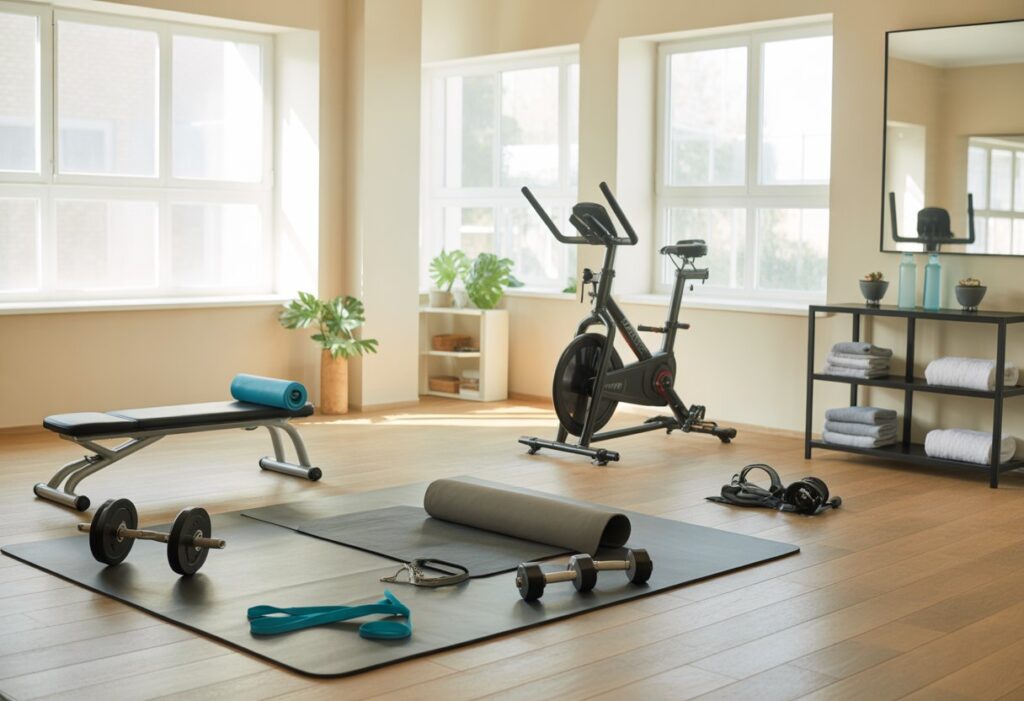
A beginner can create an effective home gym with just a few key pieces of equipment, a dedicated workout area, and a basic understanding of proper form and safety. The process starts with choosing the right space, protecting floors, and selecting versatile equipment that grows with fitness goals. Most people waste money on machines they never use when simple free weights and bodyweight exercises deliver better results.
This guide breaks down everything needed to build and use a home gym successfully. It covers smart equipment choices, layout planning, beginner workout programs[2], and strategies to stay consistent without getting bored or injured.
Table of Contents
Key Takeaways
- A functional home gym requires minimal space and can start with basic equipment like dumbbells, a bench, and resistance bands
- Proper floor protection and smart layout design prevent damage and create a safe workout environment
- Success depends on following structured routines, prioritizing safety, and gradually upgrading equipment as fitness levels improve
Why Build a Home Gym as a Beginner?
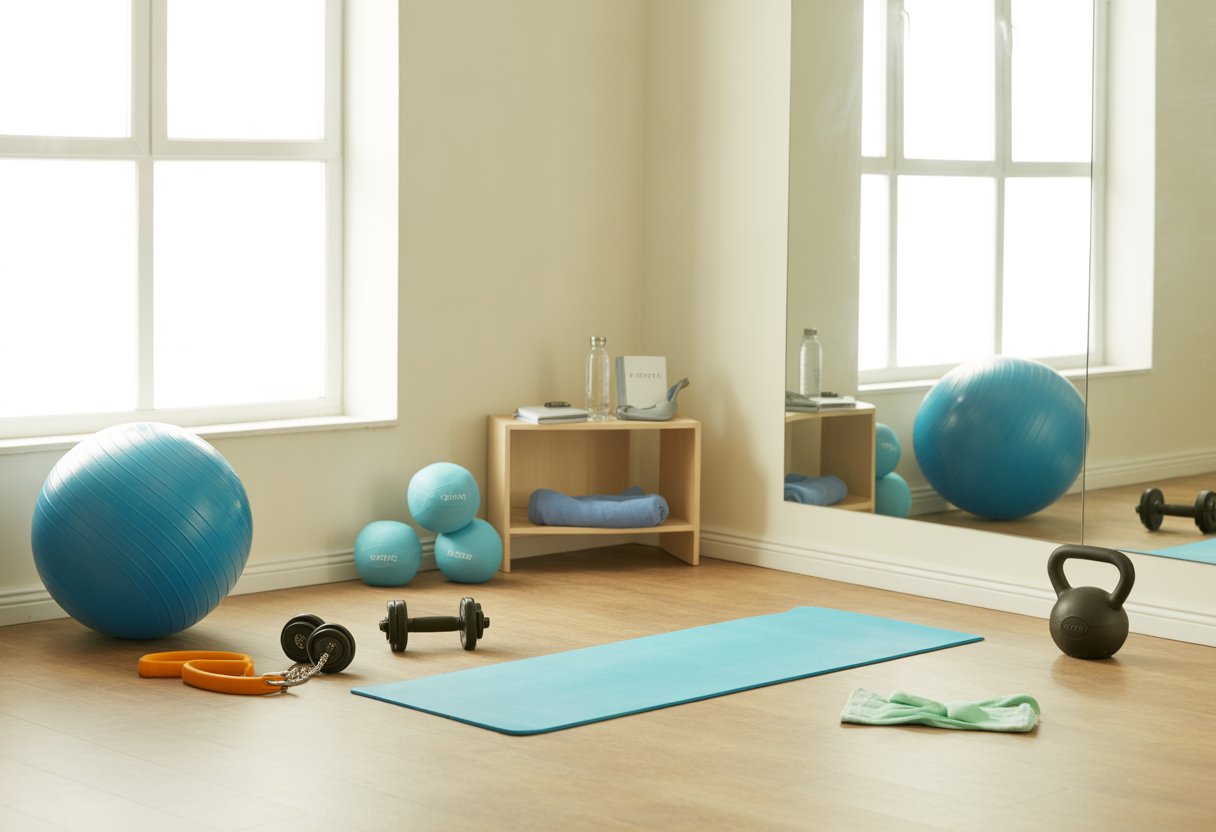
Setting up a home gym offers beginners control over their fitness environment while saving money over time. Many new exercisers find that home workouts eliminate common barriers like gym anxiety and scheduling conflicts.
Benefits Over Commercial Gyms
A home gym removes the intimidation factor that stops many beginners from starting their fitness journey. Gym anxiety affects countless people who worry about being judged or not knowing how to use equipment properly.
Working out at home means no waiting for equipment during peak hours. Beginners can take their time learning proper form without feeling rushed or watched. They can also wear whatever feels comfortable and play their own music.
Building a home gym[1] eliminates monthly membership fees that typically range from $30 to $100. After the initial equipment investment, there are no recurring costs. Many people also save time by skipping the commute to a commercial facility.
Home fitness allows for complete schedule flexibility. Early morning or late night workouts become possible without checking gym hours. Parents can exercise while children nap or play nearby.
Common Challenges and How to Overcome Them
Space limitations worry many beginners considering a garage gym or home workout area. However, a functional setup requires only 50 to 100 square feet. Foldable equipment and resistance bands maximize small spaces.
The initial cost can seem high, but beginners don’t need everything at once. Starting with basic items like dumbbells, a yoga mat, and resistance bands costs under $200. Adding equipment gradually spreads out expenses.
Staying motivated without the gym atmosphere challenges some people. Setting specific workout times creates routine and consistency. Many beginners also find success with online workout videos or virtual training sessions.
Lack of knowledge about proper form is another concern. Free YouTube tutorials and fitness apps provide guidance for most exercises. Some beginners invest in a few sessions with a personal trainer to learn basics before working out independently.
Long-Term Value and Motivation
A home gym pays for itself within 12 to 18 months compared to typical gym memberships. Quality equipment lasts for years with minimal maintenance. Resistance bands, dumbbells, and barbells can serve beginners through advanced training levels.
Home workouts build sustainable habits because convenience removes excuses. Bad weather, childcare needs, or late work hours no longer interfere with training. This accessibility helps beginners stay consistent during the critical first months.
Privacy at home allows beginners to experiment with different workout styles without judgment. They can try yoga, dance fitness, or strength training freely. This exploration helps new exercisers discover what they genuinely enjoy.
The investment in home fitness equipment creates psychological commitment to health goals. People tend to use equipment they’ve purchased rather than letting it collect dust.
Selecting the Perfect Home Gym Space
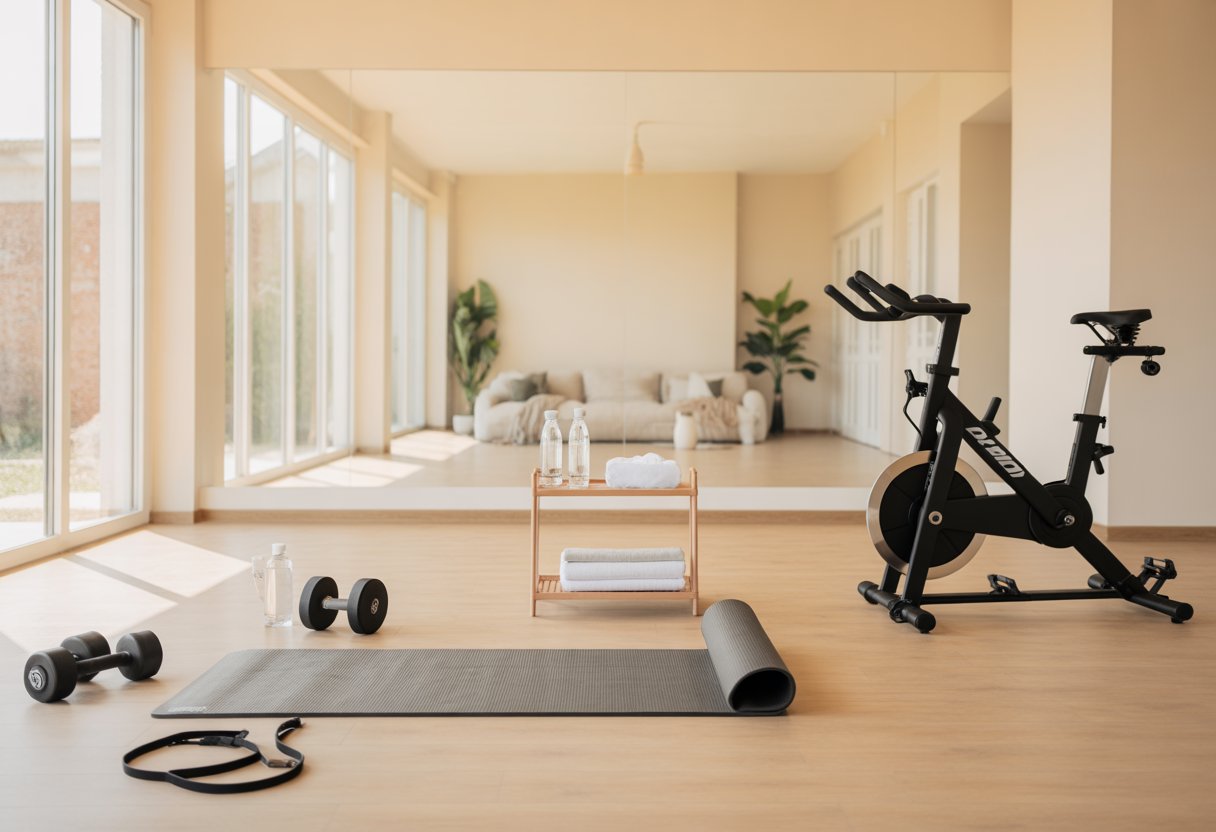
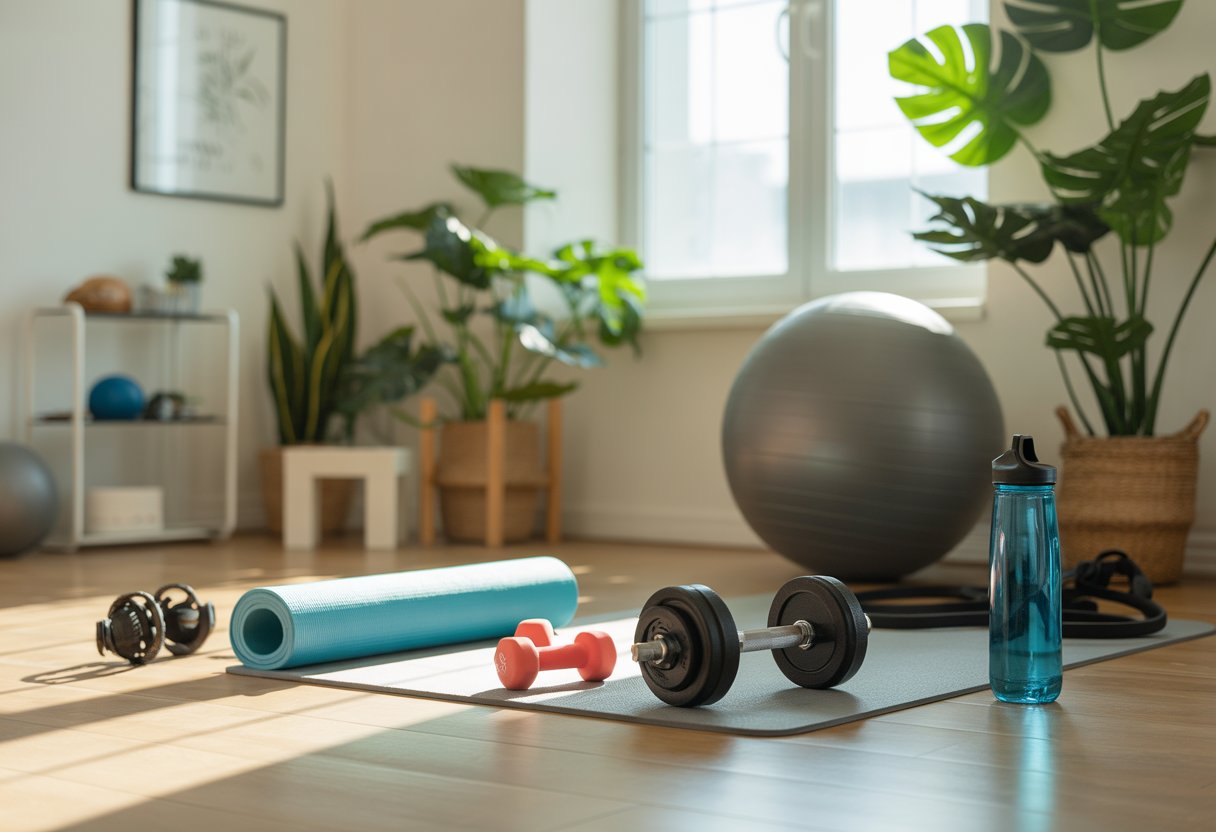
The right space makes or breaks a home gym setup. Room dimensions, air quality, and location within the home all affect workout quality and consistency.
Measuring and Assessing Your Available Area
Anyone setting up a home gym needs at least 50 to 200 square feet of floor space. A basic beginner home gym with a barbell, rack, and bench requires a minimum area of 8 feet by 6 feet.
Wall height matters just as much as floor space. Ceilings should be at least 8 feet high for overhead movements like presses and pull-ups. Someone performing barbell snatches or kipping pull-ups needs 9 to 10 feet of clearance.
Key measurements to record:
- Length and width of the available space
- Ceiling height at multiple points
- Door width for equipment delivery
- Electrical outlet locations
- Any permanent fixtures or obstacles
A garage gym often provides the most space flexibility. Basements work well but may have lower ceilings or support columns to work around. Spare bedrooms offer climate control but typically have less square footage.
Lighting, Ventilation, and Temperature Considerations
Good lighting prevents accidents and improves workout focus. Natural light from windows provides the best option during daytime hours. Overhead LED lights should produce at least 50 foot-candles of brightness for safe lifting.
Temperature control affects performance and equipment longevity. The ideal range sits between 60 and 70 degrees Fahrenheit. Garage gyms in extreme climates may need a space heater for winter or a fan for summer months.
Air circulation prevents moisture buildup and keeps the space comfortable. A basic box fan moves enough air for most home gym setups. Someone working out in a basement should consider a dehumidifier to protect equipment from rust. Opening a window or installing a vent fan helps remove stale air during intense training sessions.
Noise and Proximity to Living Areas
Dropping weights and playing music creates noise that travels through walls and floors. A first-floor location or detached garage keeps workout sounds away from bedrooms and quiet spaces. Rubber flooring and bumper plates reduce impact noise by 50 percent or more compared to metal plates on concrete.
Shared walls with neighbors require extra sound dampening. Dense foam panels on walls absorb vibrations. Working out during reasonable hours (typically 8 AM to 8 PM) shows consideration for others in the home.
Distance from living areas affects motivation differently for each person. Some people prefer their gym close to main living spaces for easy access. Others want separation to create a dedicated training environment free from household distractions.
Home Gym Flooring and Surface Protection
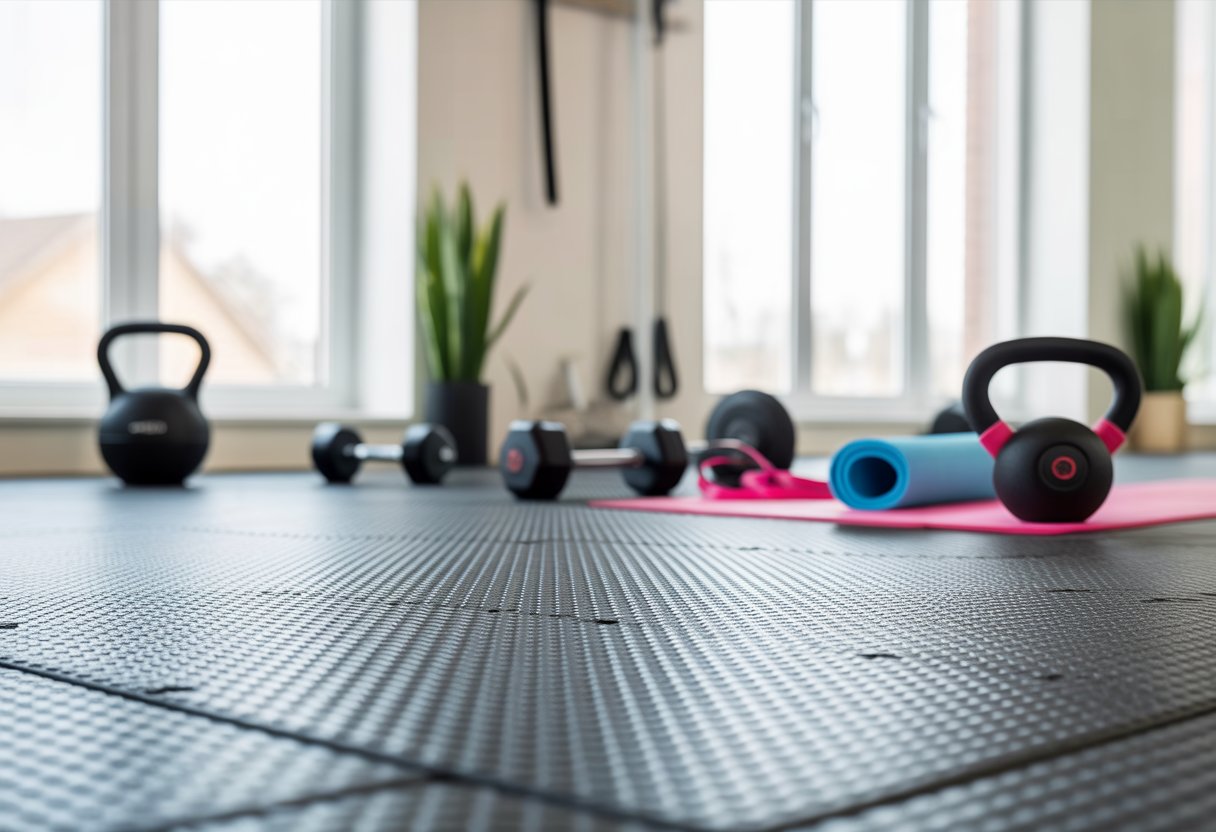
The right flooring protects both the subfloor and equipment while reducing noise and providing stable footing. Material choice, proper installation, and regular maintenance determine how well a home gym floor performs over time.
Choosing the Right Material
Rubber gym flooring stands out as the most versatile option for home gyms. It handles heavy weights, absorbs impact, and resists damage from dropped equipment. Rubber flooring rolls work well for rectangular spaces[3] and create fewer seams than tiles.
Interlocking rubber tiles offer easier installation for beginners. They snap together without tools and allow for future expansion or reconfiguration. For strength training areas, a thickness of 3/8 inch provides adequate protection for concrete subfloors.
Foam mats cost less but work only for light activities. An exercise mat or yoga mat serves stretching and bodyweight exercises but cannot withstand heavy dumbbells or barbells. EVA foam tiles dent under weight and wear out quickly in high-traffic areas.
Thickness recommendations:
- 8mm: Mixed cardio and light strength work
- 3/8 inch: Heavy strength training and kettlebells
- 1/2 inch: Frequent barbell drops and maximum noise reduction
Upstairs locations need thicker rubber mats to reduce noise transmission through floor joists. Basement installations benefit from interlocking formats that allow air circulation and prevent moisture trapping.
Installation Tips for Stability and Safety
Most rubber gym flooring installations succeed with a loose-lay approach. The weight of the material keeps it in place without adhesive. This method works especially well for garage and basement gyms where temperature and moisture levels fluctuate.
Double-sided tape at seams and perimeters tightens connections while remaining removable. Apply 2-4 inch tape strips along edges where rolls meet. This prevents shifting during workouts without permanent commitment.
Transition strips at doorways prevent tripping hazards[4] and protect flooring edges from damage. Rubber reducer ramps work for garage thresholds. Aluminum transitions suit high-traffic areas between rooms.
Power racks and heavy equipment need stable surfaces. Place extra-thick rubber mats under squat racks to create dedicated lifting zones. These areas handle repeated impact better than standard-thickness flooring.
Maintaining Cleanliness and Durability
Daily sweeping or vacuuming removes grit that scratches rubber surfaces. Small particles act like sandpaper under foot traffic and rolling equipment. A quick pass with a dust mop takes less than five minutes.
Weekly mopping with neutral-pH cleaner keeps rubber gym flooring in top condition. Avoid bleach, acids, and harsh solvents that break down rubber compounds. Mix a small amount of rubber floor cleaner with warm water and wring the mop until damp.
Wipe up sweat immediately after workouts. Salt and moisture degrade rubber over time and create slip hazards. Keep a towel nearby during sessions and do a quick wipe-down of high-contact zones.
Chalk dust requires prompt cleanup. It builds up in textured surfaces and becomes harder to remove when left sitting. A damp cloth picks up chalk better than dry sweeping, which spreads the powder around.
Essential Equipment for Beginners
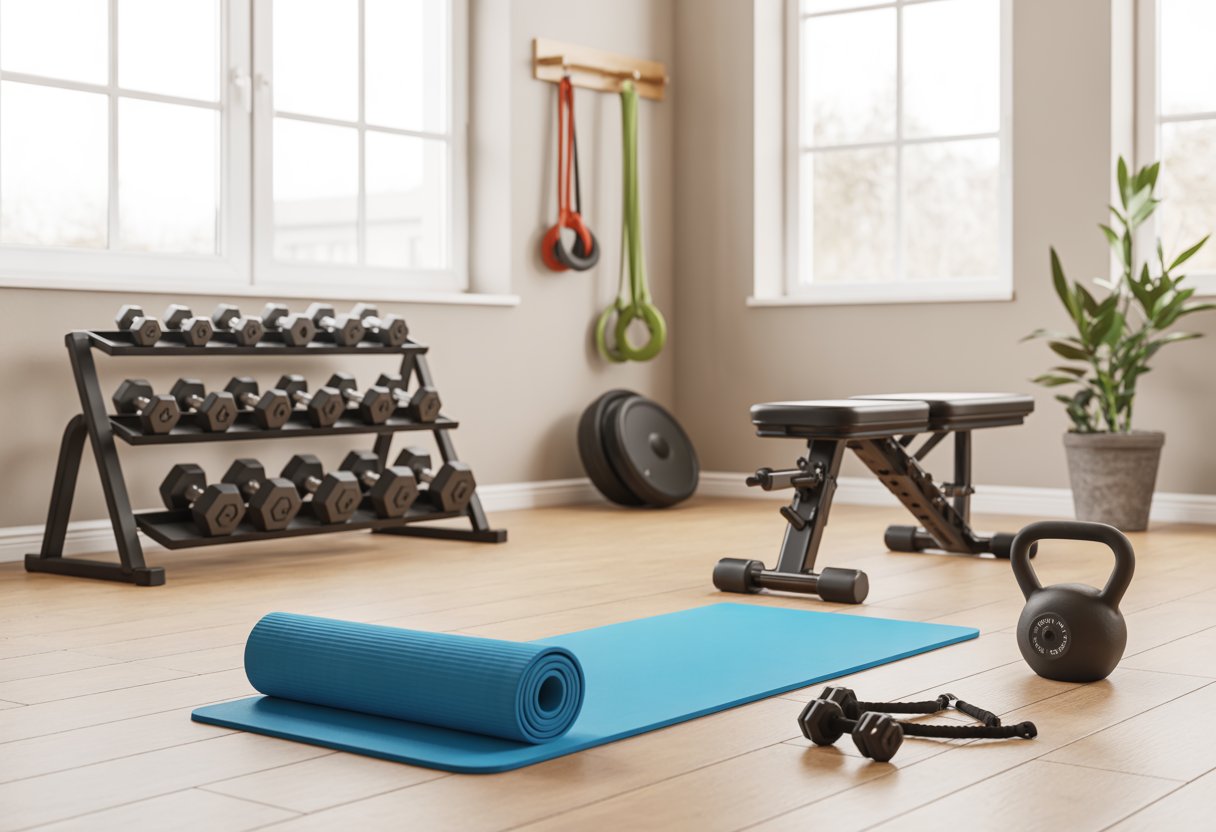
Starting with the right equipment makes home workouts effective without breaking the bank. Beginners need versatile tools that target multiple muscle groups and fitness goals while fitting into limited space.
Adjustable Dumbbells and Free Weights
Adjustable dumbbells rank as one of the smartest investments for a new home gym. They replace multiple pairs of traditional dumbbells and save significant floor space. A single set typically adjusts from 5 to 50 pounds, allowing users to increase weight as they get stronger.
Free weights build functional strength better than many machines because they require balance and coordination. Dumbbells work for exercises like bicep curls, shoulder presses, chest flies, and rows. They’re also easier to learn than barbells for most beginners.
Standard fixed-weight dumbbells are another option for those on a tight budget. Starting with three pairs (light, medium, and heavy) covers most basic exercises. Most beginners find 5, 10, and 15-pound pairs sufficient for the first few months.
Resistance Bands and Their Versatility
Resistance bands can be as effective for muscle building as free weights[5], according to medical experts. They come in different resistance levels, usually marked by color. Beginners should start with a set that includes light, medium, and heavy bands.
These bands work for upper body, lower body, and core exercises. They’re portable enough to take anywhere and cost less than most other equipment. Loop bands target legs and glutes, while bands with handles mimic dumbbell movements.
The constant tension from resistance bands activates muscles throughout the entire range of motion. They also put less stress on joints compared to heavy weights, making them ideal for people new to strength training.
Kettlebells and Medicine Balls
Kettlebells offer a unique training style that combines strength and cardio. The offset weight distribution engages stabilizer muscles and improves grip strength. A single 15 to 25-pound kettlebell works for most beginner exercises like swings, goblet squats, and Turkish get-ups.
Medicine balls add variety to core training and explosive movements. They range from 4 to 15 pounds for beginners. Slam balls, chest passes, and Russian twists all use medicine balls effectively. Some have handles for easier gripping during exercises like wood chops.
Both tools take up minimal space and last for years. They complement dumbbells and resistance bands by adding dynamic movement patterns to workouts.
Foundational Cardio Tools
A jump rope delivers intense cardio in a small package. It burns calories quickly and improves coordination. Beginners should choose a rope with adjustable length and comfortable handles. Ten minutes of jumping can match the calorie burn of a 30-minute jog.
Basic equipment can provide a comprehensive workout[5] without expensive machines. A yoga mat protects floors and provides cushioning for bodyweight exercises and stretching. Look for mats at least 6 feet long and 6mm thick for adequate padding.
Foam rollers help with recovery and flexibility. They reduce muscle soreness after workouts and cost less than massage therapy. A standard 36-inch roller works for most body parts.
Strength Training Equipment Basics
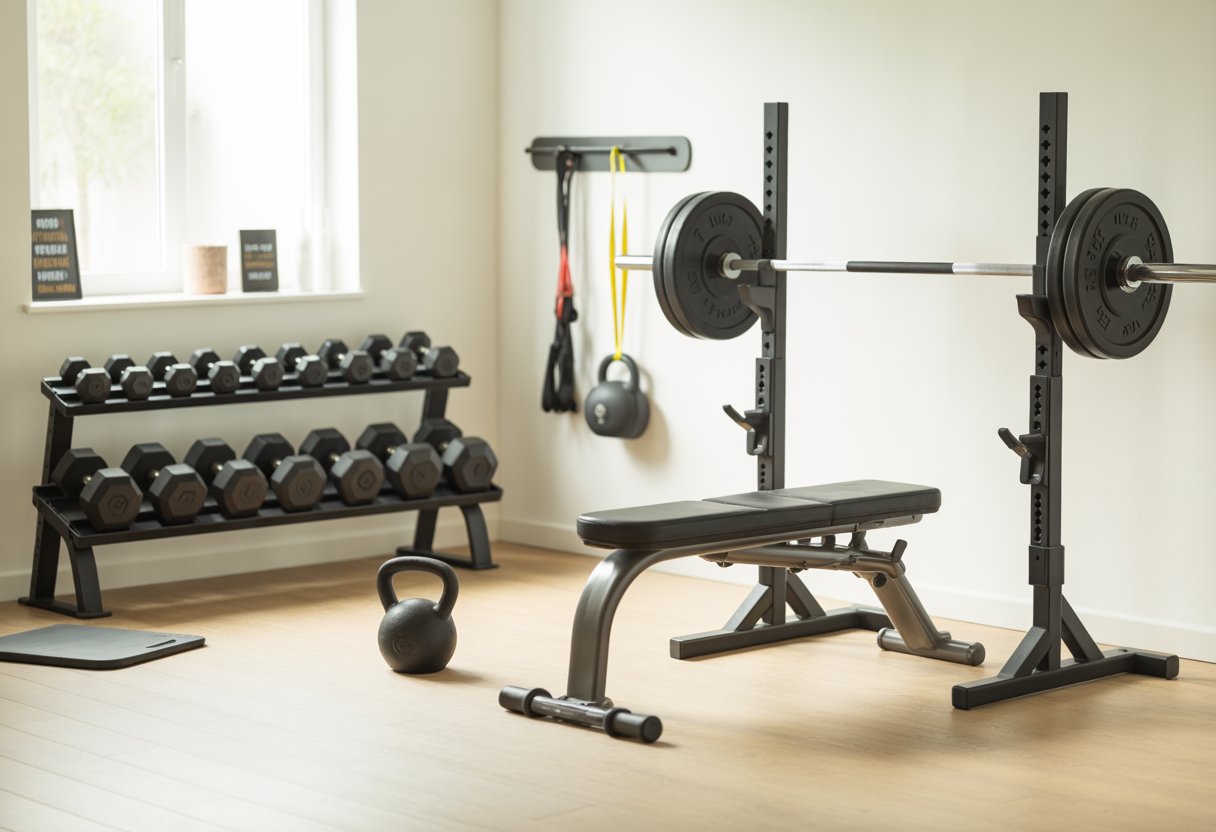
A solid strength training setup requires three core components: a stable bench for pressing movements, a rack system for barbell exercises, and equipment for vertical pulling exercises. These pieces form the foundation for building muscle and strength at home.
Weight Benches and Adjustable Benches
A weight bench serves as the base for chest presses, shoulder exercises, and supported rowing movements. Flat benches work well for basic exercises, but an adjustable weight bench offers more versatility.
An adjustable bench can move between flat, incline, and decline positions. This flexibility allows users to target different muscle groups from various angles. Incline settings work the upper chest and shoulders, while decline positions emphasize the lower chest.
When selecting an adjustable bench, users should check the weight capacity and pad width. A bench rated for at least 600 pounds handles most training needs safely. The pad should be wide enough to provide stable support without being so wide that it restricts movement during exercises like dumbbell presses.
Squat Racks, Power Racks, and Storage Solutions
A squat rack provides the safety and support needed for barbell squats, one of the most effective lower body exercises. A power rack offers even more functionality than a basic squat rack.
Power racks are built from durable steel[6] and include adjustable safety bars that catch the barbell if a lifter fails a rep. This safety feature makes them ideal for training alone at home. The four-post design also supports pull-up bars and cable attachments.
Most power racks include built-in storage solutions for weight plates and barbells. These storage racks keep equipment organized and make the most of limited floor space. Some models add J-hooks at multiple heights for exercises like bench press and overhead press.
Elevate Your Health for Just $29.99/Month
Join the Precision Wellness Subscription at My Healing 365 and get discounted services, priority coaching access, virtual care, and exclusive wellness resources to support your physical, emotional, and hormonal health.
Join for $29.99/MonthPull-Up Bar and Cable Machines
A pull-up bar develops back strength and grip through bodyweight exercises. Many power racks include an integrated pull-up bar, but standalone doorway or wall-mounted options work well too.
Cable machines add versatility to a home gym through adjustable pulley systems. They allow for smooth resistance throughout the entire range of motion on exercises like rows, tricep pushdowns, and face pulls. Cable machines can replace multiple pieces of equipment since one machine handles dozens of exercises.
Some power racks accept cable machine attachments, combining both functions in one footprint. This integration saves space while providing the benefits of both free weights and cable resistance.
Must-Have Cardio Machines and Accessories
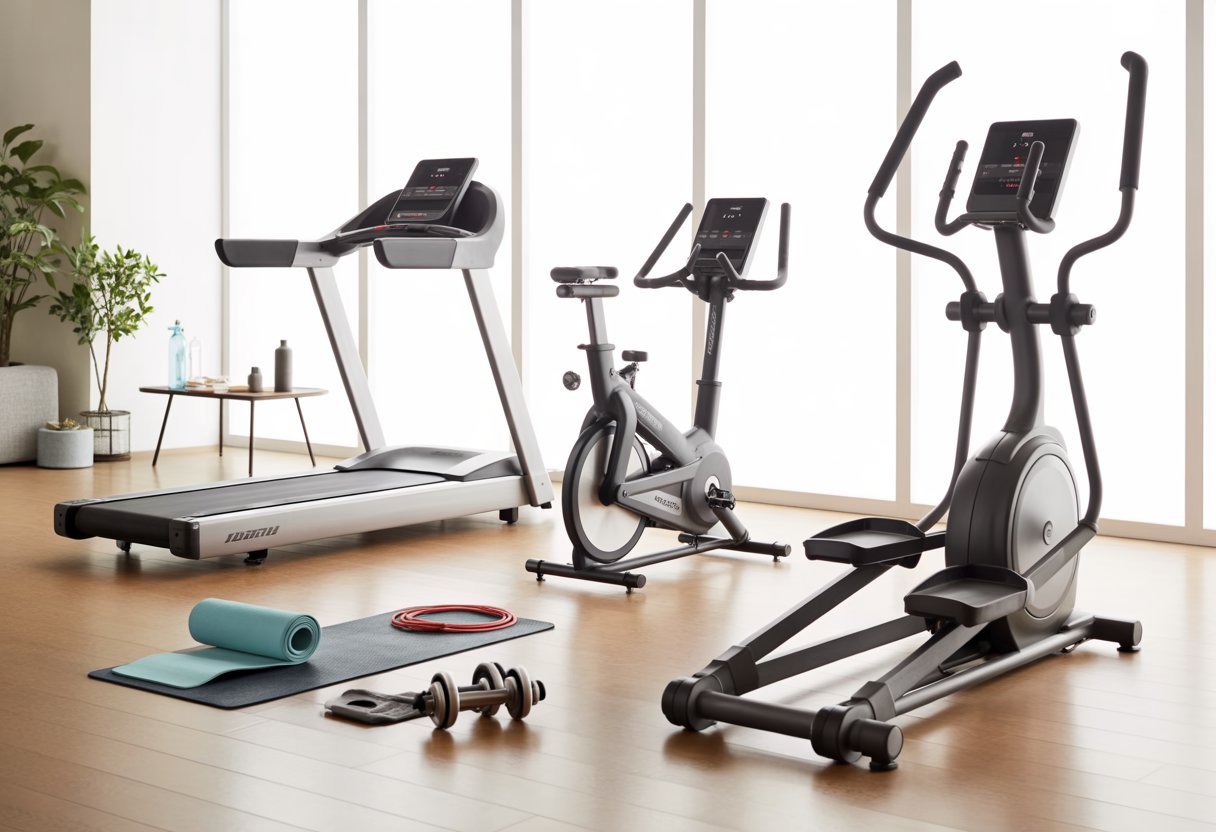
Cardio equipment helps burn calories, build endurance, and improve heart health. The right machines offer different impact levels and movement patterns to match individual fitness goals and joint health needs.
Treadmills and Stationary Bikes
A treadmill provides the most natural cardio workout since walking and running are movements people do every day. Basic models start around $300 for manual versions, while motorized options with speed and incline controls range from $500 to $2,000 for home use. Folding treadmills work well in small spaces.
A stationary bike puts less stress on the knees and hips compared to running. Upright bikes mimic outdoor cycling and engage core muscles, while recumbent bikes offer back support for those with lower back issues. Most bikes include adjustable resistance levels to increase workout intensity.
Both machines let users watch TV or read while exercising. They also track basic metrics like time, distance, and calories burned.
Rowing Machine and Elliptical Trainer
A rowing machine works the entire body in one motion. It builds strength in the legs, back, arms, and core while providing solid cardio benefits. Water rowers create a smooth, quiet resistance, while magnetic models cost less and require minimal maintenance.
An elliptical trainer combines the movements of running and stair climbing without impact on the joints. The handles move back and forth to work the upper body at the same time as the legs. This machine burns similar calories to a treadmill but feels easier on the knees and ankles. Most models allow users to pedal forward or backward to target different muscle groups.
Stair Climber and Low-Impact Cardio Options
A stair climber mimics walking up stairs and targets the glutes, hamstrings, and calves more than other cardio machines. Full-size models with rotating steps cost $1,500 and up, while mini steppers fit under a desk and start around $50. The climbing motion builds leg strength while elevating heart rate quickly.
A jump rope offers the most affordable cardio option at $10 to $30. It burns up to 10 calories per minute and improves coordination. Beginners should start with a basic beaded or PVC rope before moving to weighted versions.
Low-impact cardio options[7] also include resistance bands, yoga mats, and foam rollers that support bodyweight exercises like burpees and mountain climbers without equipment costs.
Floor Layout and Home Gym Design
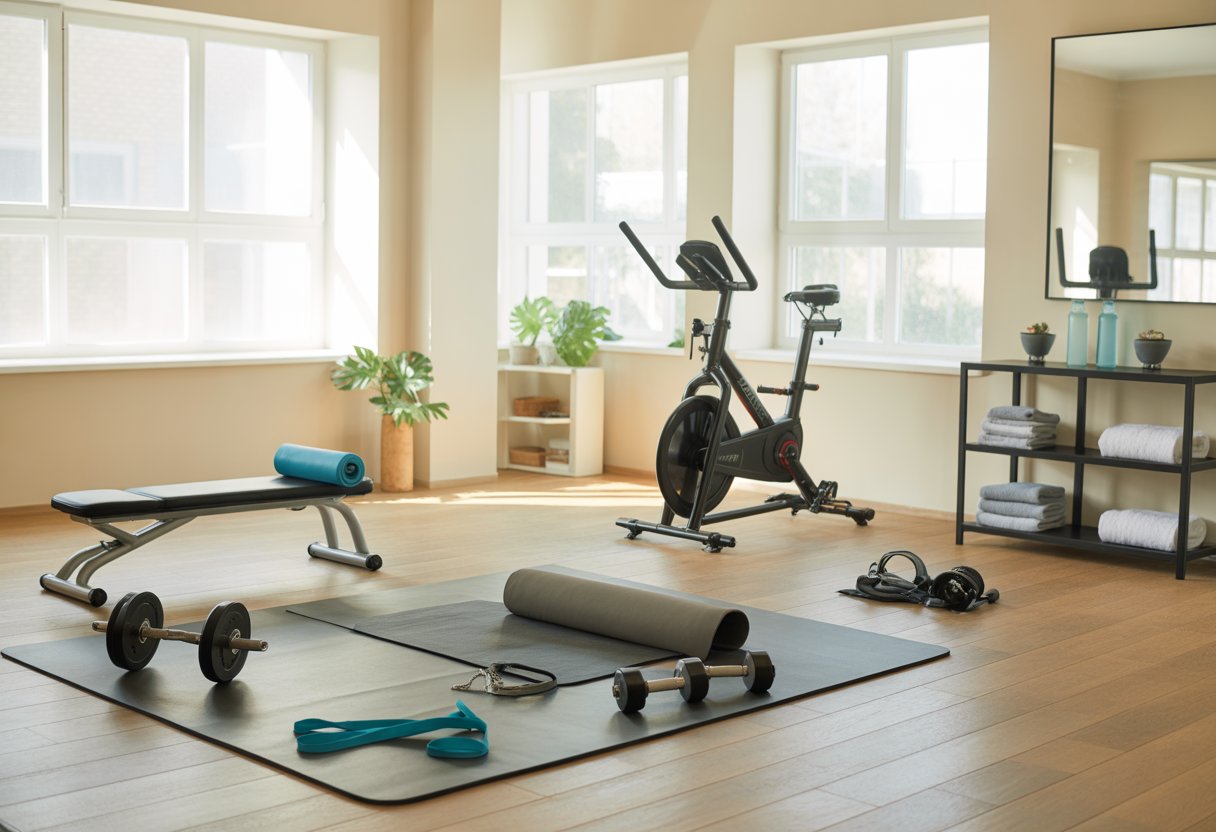
A well-planned layout maximizes workout space while keeping equipment accessible and safe. Smart storage solutions and the right atmosphere make daily training sessions more enjoyable and sustainable.
Optimizing for Movement and Safety
The home gym layout[8] should prioritize clearance around each piece of equipment. Treadmills need at least 6 feet of space behind them for emergency dismounts. Power racks require 3 feet of clearance on all sides for safe bar loading and unloading.
Weight training areas benefit from rubber flooring or interlocking foam tiles that protect floors and reduce noise. These surfaces also provide cushioning that prevents equipment damage from dropped weights.
Equipment placement matters for workflow. Cardio machines work well near windows or entertainment screens. Free weight areas should sit away from doorways where family members might walk through during lifts.
Mirrors mounted at eye level help users check their form during exercises. A single 4-foot by 6-foot mirror covers most strength training needs without overwhelming the space.
Storage and Equipment Organization
A storage rack keeps smaller items organized and prevents tripping hazards. Wall-mounted plate racks hold weight plates vertically and save floor space. Pegboards accommodate resistance bands, jump ropes, and other accessories within arm’s reach.
Dedicated bins or baskets corral yoga blocks, foam rollers, and exercise balls. Labeling these containers speeds up equipment location during workouts.
Vertical storage solutions work best in smaller spaces. Dumbbell trees stack weights upward rather than spreading them across the floor. Foldable benches can tuck against walls when not in use.
Creating an Inviting Atmosphere
Home gym design affects motivation and workout consistency. Proper lighting prevents eye strain during exercises. Bright overhead lights work for general training while adjustable lamps help with reading workout programs.
Temperature control keeps the space comfortable year-round. A portable fan provides airflow in rooms without air conditioning. Space heaters warm up cold garages during winter months.
Music speakers or a mounted screen add entertainment value. Bluetooth speakers eliminate cord tangles while delivering quality sound. A small TV or tablet mount positions screens at viewing height for follow-along workouts.
Paint colors influence mood. Energizing shades like blue or green promote focus. Neutral tones create a calm environment for yoga and stretching sessions.
Sample Full-Body Workouts and Routines
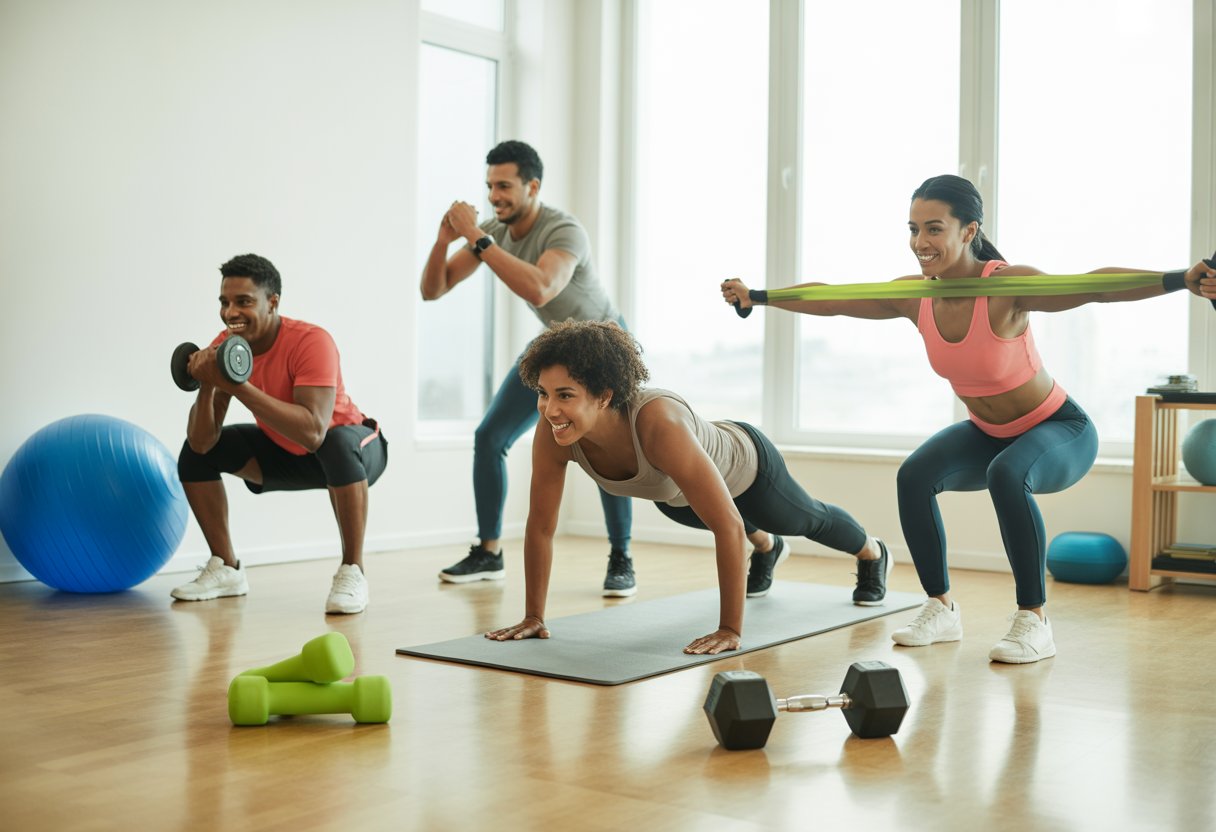
A proper warm up prepares the body for exercise while bodyweight movements build foundational strength. Adding dumbbells or kettlebells increases resistance, and finishing with cardio and core work creates a complete training session.
Warm Up and Mobility Basics
Every workout should start with 5-10 minutes of light movement to raise body temperature and prepare joints for exercise. Dynamic stretches work better than static holds before training.
Arm circles, leg swings, and hip rotations activate the major joints. Cat-cow stretches and thoracic rotations improve spine mobility. Light cardio like marching in place or jumping jacks gets blood flowing to the muscles.
Spending time on ankle circles and wrist rolls helps prevent injury during squats and pressing movements. The warm up doesn’t need to be complicated. Simple movements that mirror the upcoming exercises prepare the body effectively.
Bodyweight Exercises for Beginners
Bodyweight squats teach proper movement patterns before adding weight. Stand with feet shoulder-width apart, push hips back, and lower until thighs are parallel to the floor. Keep chest up and knees tracking over toes.
The plank builds core stability needed for all other exercises. Hold a straight line from head to heels for 20-60 seconds, keeping hips level and core tight.
Push-ups develop chest, shoulders, and triceps strength. Start on knees if needed, maintaining a straight body line throughout the movement.
Lunges work each leg independently, improving balance and leg strength. Step forward and lower the back knee toward the floor, keeping the front knee over the ankle.
These movements form the foundation for full-body workouts[9] that beginners can perform three times per week.
Dumbbell and Kettlebell Circuits
Adding weights increases muscle-building potential once bodyweight movements feel comfortable. A circuit workout involves performing exercises back-to-back with minimal rest between movements.
Goblet squats use a single dumbbell or kettlebell held at chest height. This position helps maintain an upright torso and teaches proper squat mechanics. The weight should feel challenging for 10-15 repetitions.
Dumbbell rows target the back muscles. Place one knee on a bench, hinge forward, and pull the weight toward the hip while keeping the elbow close to the body.
The dumbbell shoulder press builds overhead strength. Press weights from shoulder height to full extension overhead, keeping the core tight throughout.
A dumbbell Romanian deadlift strengthens hamstrings and lower back. Hold dumbbells in front of thighs, hinge at the hips while keeping knees slightly bent, and lower weights along the shins.
Sample circuit: 3 rounds of 10-12 goblet squats, 10-12 dumbbell rows per arm, 8-10 shoulder presses, and 12-15 Romanian deadlifts with 60-90 seconds rest between rounds.
Incorporating Cardio and Core
Cardio work improves heart health and burns additional calories. Adding 10-20 minutes after strength training maximizes results without interfering with muscle building.
Jumping jacks, high knees, or mountain climbers provide effective cardio at home. Beginners can start with 30 seconds of work followed by 30 seconds of rest for 5-10 rounds.
Core exercises finish the home workout[10] effectively. Dead bugs strengthen the core while protecting the lower back. Lie on back, extend opposite arm and leg, then switch sides for 10-12 repetitions per side.
Bicycle crunches target the obliques. Bring opposite elbow to knee in a controlled motion for 15-20 total repetitions.
Side planks build lateral core strength. Hold 20-30 seconds per side, stacking feet and keeping hips elevated.
Safety, Recovery, and Injury Prevention
Starting a home gym routine requires attention to injury prevention and recovery practices. Most workout injuries occur within the first three months[11] of beginning a new fitness program, making proper warm-up techniques, recovery tools, and correct form essential for long-term success.
Proper Warm Up, Cool Down, and Stretching
Walking straight to heavy weights or intense cardio increases injury risk significantly. Cold muscles are stiff and more prone to tears and strains, which is why spending 5-10 minutes on light cardio before workouts helps increase blood flow and prepares joints for movement.
Dynamic stretching works best before exercise. This includes leg swings, arm circles, and walking lunges that move muscles through their full range of motion. A proper warm-up on an exercise mat or yoga mat prevents the muscle strains and sprains that account for 60% of all gym injuries.
After workouts, cooling down with 5-10 minutes of light activity helps gradually lower heart rate. Static stretching during this period improves flexibility and reduces muscle tightness. Beginners should hold each stretch for 20-30 seconds without bouncing, focusing on major muscle groups worked during the session.
The difference between muscle fatigue and injury pain matters. Normal soreness appears 24-48 hours after exercise and feels like a dull ache. Sharp or shooting pain during exercise signals a problem that requires stopping immediately.
Using Foam Rollers and Recovery Tools
Foam rollers help release muscle tension and improve blood flow to sore areas. Rolling major muscle groups for 30-60 seconds each speeds recovery and reduces stiffness between training sessions. The best time to use a foam roller is after workouts or on rest days.
Beginners should start with softer foam density options before progressing to firmer rollers. Rolling too aggressively on a hard surface causes bruising instead of benefits. A yoga mat provides cushioning when foam rolling on hard home gym flooring like concrete or tile.
Focus on large muscle groups first: quadriceps, hamstrings, calves, and back muscles. Avoid rolling directly on joints, bones, or the lower back. If a spot feels particularly tender, pause on that area for 20-30 seconds while taking deep breaths.
Rest days are not optional. Muscles need 48 hours to repair and grow stronger after strength training. Light activity like walking or gentle stretching on an exercise mat promotes recovery without interfering with muscle repair.
Maintaining Good Form and Technique
Poor form puts unnecessary stress on joints and creates muscle imbalances over time. Learning proper technique from the start[11] prevents bad habits that are harder to correct later. Recording workouts on a phone helps identify form issues when playing back footage.
Starting with lighter weights allows focus on movement patterns rather than struggling with heavy loads. The 10% rule applies here: never increase workout volume by more than 10% per week. This gradual progression gives tendons, ligaments, and muscles time to adapt.
Key form principles include:
- Keep spine neutral during lifts
- Engage core muscles before each repetition
- Move through full range of motion
- Control both lifting and lowering phases
- Keep knees aligned with toes during squats
Mirrors help check form during exercises, but they are not essential. Body awareness develops through consistent practice on proper home gym flooring that provides stable footing. Rubber or foam tiles prevent slipping during movements that require balance.
Sharp pain during exercise means stopping immediately. Ice the affected area and rest for several days. Pain lasting beyond 48 hours or worsening over time requires medical attention.
Budgeting and Planning Upgrades Over Time
Starting with basic equipment and gradually adding pieces allows beginners to spread costs over months or years while learning what they actually need. Smart upgrading means buying items that directly support training goals rather than collecting equipment that sits unused.
Prioritizing Investments for Progress
The first purchase should always be a barbell, weight plates, and a basic squat rack since these items enable the most effective exercises. Building a home gym[1] starts with equipment that allows squats, deadlifts, bench presses, and overhead presses.
After covering the basics, beginners should add adjustable dumbbells within the first three to six months. These tools fill gaps that a barbell can’t address, like single-arm work and exercises that require more freedom of movement.
The next priority is a bench with adjustable positions. A flat bench works for basic pressing, but an adjustable version opens up incline and decline movements. Most people should plan to add this within six months of starting their garage gym.
When to Add More Advanced Equipment
Advanced equipment makes sense only after mastering basic movements and hitting clear strength plateaus. A beginner who can’t squat their bodyweight doesn’t need specialty bars or cable machines yet.
Power racks with pull-up bars and safety catches become valuable around the six to twelve month mark. These provide safer training for heavy lifts and add exercises like pull-ups and dips.
Cable machines offer new exercise options but cost significantly more than free weights. They make sense after 12-18 months of consistent training when someone has built a solid strength base and wants more variety. Most beginners should wait until they’ve exhausted simpler progression methods before adding cables.
Specialty items like resistance bands, landmine attachments, or additional barbells can fill specific needs as training advances. The key is identifying actual gaps in training rather than buying equipment because it looks interesting.
Buying New vs. Used Gear
Used equipment often costs 30-50% less than new gear while offering the same functionality. Beginners can find budget home gym setups[12] by shopping Craigslist, Facebook Marketplace, and local classifieds.
Iron weight plates and squat racks work as well used as new since basic steel doesn’t degrade. Barbells need closer inspection for bent shafts or damaged sleeves, but quality bars last decades even with heavy use.
Items worth buying new include adjustable dumbbells with complex mechanisms, benches with padding that might be worn, and anything with cables or moving parts that could fail. Safety equipment like J-hooks and spotter arms should also be new to ensure they meet current standards.
The smartest approach combines both strategies. A beginner might buy a used power rack and plates while purchasing a new barbell that will last a lifetime.
Staying Motivated and Maintaining Consistency
Building a home gym is just the first step. Success depends on showing up regularly and pushing through the days when motivation runs low. Research shows it takes six weeks to six months to turn exercise into a true habit.
Creating a Routine and Tracking Progress
A home gym removes travel time as an excuse, but it also eliminates the accountability that comes with leaving the house. Setting specific workout days and times creates structure. Many people find success treating their home workouts like appointments they cannot cancel.
Tracking progress provides tangible proof that effort is paying off. A simple notebook or phone app works well for recording:
- Workout dates and duration
- Exercises performed and weights used
- Body measurements or progress photos
- Energy levels and mood changes
The numbers on the scale tell only part of the story. Tracking improvements in strength, endurance, and how clothes fit provides a fuller picture. When someone notices they can lift heavier weights or complete more repetitions than last month, that becomes powerful motivation to continue.
Preparing equipment the night before reduces decision fatigue. Laying out workout clothes and having a planned routine ready eliminates the mental barriers that lead to skipped sessions.
Gym Etiquette at Home
Home fitness requires its own set of rules, even without other people around. Respecting shared living spaces keeps household members supportive of the home gym setup.
Proper equipment storage prevents accidents and damage. Weights should return to their designated spots after each use. Resistance bands and yoga mats need to be rolled or folded neatly.
Noise control matters in apartments or homes with multiple occupants. Using rubber mats under weights reduces impact sounds. Scheduling loud workouts during reasonable hours shows consideration.
Hygiene practices remain important even in a private space. Wiping down equipment after sweating on it prevents bacteria growth and keeps gear in good condition. Washing workout clothes promptly and airing out the space maintains a fresh environment that people actually want to use.
Overcoming Common Barriers
Time constraints are the most frequently cited reason for skipping home workouts. Breaking sessions into 15-20 minute blocks makes fitness more manageable on busy days. Three short workouts throughout the week build better habits than trying to fit in daily gym sessions[13].
Boredom kills consistency faster than lack of time. Rotating between different workout styles keeps things fresh. Someone might do strength training Monday, cardio Wednesday, and yoga Friday. Free online videos and apps provide endless variety without requiring a personal trainer.
Lack of immediate results discourages many beginners. Setting process goals instead of outcome goals helps. Rather than focusing solely on losing 20 pounds, celebrating four consecutive weeks of three workouts each week creates positive momentum.
Frequently Asked Questions
Starting a home gym raises common questions about equipment choices, space planning, and budget management. Most beginners can build an effective training space with just a few key pieces while staying within reasonable cost limits.
What essential equipment should a beginner buy first for a home gym?
A beginner should start with a barbell, weight plates, and a squat rack with a pullup bar. These three items allow for the most important compound exercises like squats, deadlifts, bench press, and overhead press.
Adding a set of bumper plates protects floors and allows for Olympic lifts. A basic home gym can be built for around $1,300[1] with new equipment including a quality barbell, squat stand, 260 pounds of bumper plates, and rubber floor mats.
Kettlebells and gymnastic rings make excellent additions after the basics. A 53-pound kettlebell costs about $63 and works well for swings, Turkish get-ups, and goblet squats. Gymnastic rings run around $40 and provide options for dips, rows, and upper body work.
How do I set up a basic home gym that supports full-body workouts?
A full-body home gym needs equipment that hits all major movement patterns. The squat rack serves as the foundation and should include a pullup bar for vertical pulling movements.
The barbell handles pressing, squatting, and pulling exercises. Weight plates in varied sizes allow for progressive overload across different lifts. Starting with pairs of 45-pound, 25-pound, 10-pound, and 5-pound plates covers most training needs.
Floor protection matters for equipment longevity and noise reduction. Horse stall mats from farm supply stores cost about $40 each and provide durable rubber flooring. Two mats create an 8-foot by 4-foot lifting platform.
A jump rope adds conditioning work for less than $10. This simple setup supports programs focused on strength, muscle building, or general fitness without requiring much space.
What is the best all-in-one equipment choice for a small home gym?
An adjustable dumbbell set offers the most versatility in the smallest footprint. These dumbbells replace 10 to 15 pairs of fixed weights and take up less than two square feet of floor space.
Power towers provide another space-efficient option. These units combine a pullup bar, dip station, and pushup handles in one frame. They stand about 7 feet tall and occupy roughly 4 square feet of floor space.
Suspension trainers like TRX systems attach to doors or ceiling mounts. They weigh less than two pounds and pack into a small bag when not in use. A person can perform over 300 exercises with bodyweight resistance using these straps.
Folding squat racks mount to walls and fold flat when not needed. They extend about 4 feet from the wall during use but collapse to just 5 inches deep for storage.
How can I build a home gym on a budget without sacrificing quality?
Shopping used equipment on Craigslist and Facebook Marketplace cuts costs significantly. Weight plates, benches, and racks hold their value and function well for decades. Many people sell quality equipment after barely using it.
Starting with fewer items and adding over time spreads costs across months or years. A barbell and weight plates alone support dozens of effective exercises. Additional pieces can wait until budget allows.
DIY solutions work well for certain equipment. Wooden boxes for step-ups cost $20 to $30 in materials. Sand-filled slam balls run about $15 to make at home versus $50 to $80 retail.
Budget brands like Fringe Sport and Titan Fitness offer solid equipment at lower prices than premium brands. Their barbells range from $150 to $250 compared to $300 to $400 for top-tier options. The quality difference matters less for beginners than for competitive lifters.
How should I plan and organize a functional home gym in a 10×10 space?
A 10-foot by 10-foot area provides 100 square feet, which handles basic strength training well. Wall-mounted racks maximize floor space by eliminating the footprint of a standalone squat rack.
Placing the rack on one wall leaves the center open for movements like deadlifts and Olympic lifts. Storing weight plates on vertical storage trees takes up less room than horizontal plate storage. These trees fit in corners and hold 300 to 500 pounds of plates.
The barbell can lean in a corner when not racked. Some lifters mount simple J-hooks to walls for additional barbell storage. This keeps the floor clear for movement.
Smaller items like kettlebells, jump ropes, and resistance bands store on wall-mounted shelves or pegboards. A mirror on one wall helps with form checks without taking any floor space. The beginner’s guide to building a home gym[14] covers specific layout options for compact spaces.
What are the most worthwhile equipment additions once the basics are in place?
A flat bench opens up pressing variations and step-ups. Quality benches cost $150 to $300 and support incline, decline, and seated exercises. This single addition adds 20 or more movements to a training program.
Landmine attachments turn a barbell into a versatile tool for rows, presses, and rotational work. These cost $30 to $60 and insert into weight plate holes or mount to racks. They work especially well for single-arm exercises and core training.
Resistance bands provide variable resistance and assist work for pullups. A set of bands ranging from light to heavy costs $30 to $50. They pack easily for travel and add intensity to bodyweight exercises.
A rowing machine adds serious conditioning options. Concept2 rowers represent the standard and cost around $900 new. They work the entire body and track workout data for progress monitoring. Used models sell for $600 to $700 in good condition.
Safety equipment like collars prevents plates from sliding during lifts. Spring collars run $10 to $15 per pair while quick-release collars cost $30 to $50. Chalk or liquid chalk improves grip for heavy pulls and costs less than $15.
Post Views: 4
References
- Page Not Found. https://www.garagegymreviews.com/ultimate-home-gym-guide Accessed April 19, 2026
- 30 Days to Fit: The Ultimate Beginner Home Workout Program. https://fitnessvolt.com/beginner-home-workout-program/ Accessed April 19, 2026
- Home Gym Flooring: Best Options, Thickness & Costs (2025). https://www.ironcompany.com/blog/home-gym-flooring-guide Accessed April 19, 2026
- Page Not Found. https://www.garagegymreviews.com/best-home-gym-flooring Accessed April 19, 2026
- 7 Home Gym Essentials You Need to Have (In-Depth Guide). https://totalshape.com/equipment/must-have-home-gym-equipment/ Accessed April 19, 2026
- Best Home Gym Equipment for Beginners
– REP Fitness. https://repfitness.com/blogs/guides/best-home-gym-equipment-for-beginners Accessed April 19, 2026 - Page Not Found. https://www.garagegymreviews.com/best-home-exercise-equipment-for-beginners Accessed April 19, 2026
- Smart Home Gym Layouts for Every Room Size. https://www.roomsketcher.com/blog/home-gym-layouts/ Accessed April 19, 2026
- The 3-Day Full-Body Workout Routine for Beginners. https://bonytobeastly.com/full-body-workout-guide-for-beginners/ Accessed April 19, 2026
- The Ultimate Home Gym Workout Plan (Perfect for Beginners). https://totalshape.com/equipment/home-gym-workout-plan/ Accessed April 19, 2026
- January Gym Safety: How to Prevent Common Workout Injuries When You’re Starting Out. https://www.texashealth.org/areyouawellbeing/Staying-Fit/gym-injuries-prevention-beginners Accessed April 19, 2026
- Page Not Found. https://www.garagegymreviews.com/best-budget-home-gym-setups Accessed April 19, 2026
- 8 Easy Ways to Stay Consistent with Your Fitness Goals. https://defined.com/how-to-exercise-consistently/ Accessed April 19, 2026
- How to Build a Home Gym: Step-by-Step Beginner Friendly Guide. https://www.fitnesssuperstore.com/blogs/buying-guides/how-to-build-a-home-gym-step-by-step-beginner-friendly-guide Accessed April 19, 2026