• Twenty47HealthNews
  • Health & Wellness
  • Disclaimer
    • Terms of Use
    • Privacy Policy
    • DMCA Notice
  • Twenty47HealthNews
  • Health & Wellness
  • Disclaimer
    • Terms of Use
    • Privacy Policy
    • DMCA Notice
24/7 Health News
No Result
View All Result
Home Article

New test promises to detect cancer earlier — from tiny particles in bodily fluids

April 27, 2026
in Article
New test promises to detect cancer earlier — from tiny particles in bodily fluids

Cancer claims more than 10 million lives every year globally. Research shows that detecting cancer early can greatly improve a patient’s chance of survival. And yet we lack reliable, affordable tools for early detection.

Scientists are now discovering that our bodies may carry early warning signals packaged within tiny, bubble-like particles that circulate in bodily fluids like blood.

In the Schulich School of Engineering at the University of Calgary, we are developing a new technology to capture these particles and read their signals. Our recent work suggests that the electrical signals of these particles could offer a fast, label-free way to use them for diagnostic applications.

Our goal is to develop simple and non-invasive tests for early cancer detection.

[embedded content]
Sara Hassanpour Tamrin presents an overview of her research during the Falling Walls Science Summit 2024 in Berlin.

Table of Contents

  • The challenge of early detection
  • Reading cancer’s secret language
  • A novel technology to capture these particles
  • From lab research to real-world impact

The challenge of early detection

When cancer is found earlier, physicians can start treatment sooner. This helps to save more lives and lower health-care costs for both families and health-care systems.

However, many cancers are still not diagnosed until they are at an advanced stage. This is often because patients are either asymptomatic or dismiss their symptoms because they ascribe them to less serious causes.

Physicians often use bodily fluid tests to look for hidden warning signs in people who do not yet show symptoms of disease. These tests search for special substances (called biomarkers) that cancer cells release into bodily fluids like blood. But most of these biomarkers are rare and do not last long in the body during the early stages of cancer. Because of this, simple blood or urine tests are less reliable for early cancer detection.

What is needed is a simple tool that is cost-effective and can detect new, more robust biomarkers that current tests are unable to detect. It could then be added to the slate of analyses that are routinely run on bodily fluids.

Our interest in this challenge began with a simple question: What if cancer cells were already sending us quiet hints? Messages we had not yet learned to hear? Learning to detect and interpret these signals could enable earlier detection and help change the story for cancer patients.

Reading cancer’s secret language

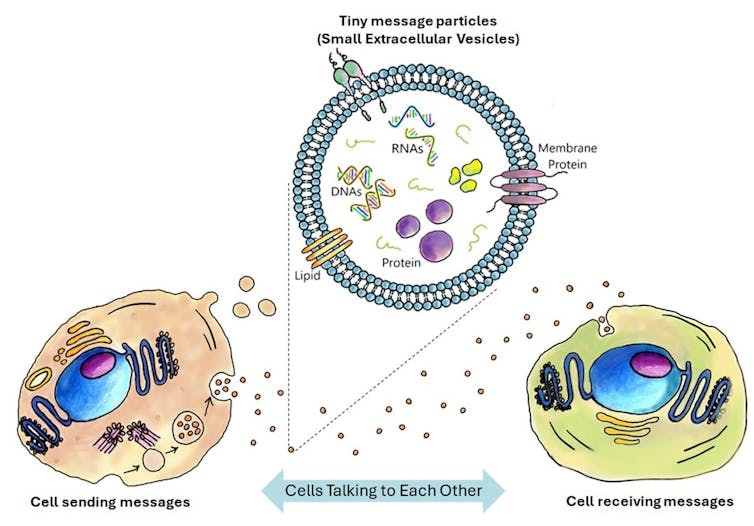
Whether they are healthy or not, cells in our bodies are constantly communicating, almost like they are “talking” to each other. One way they do this is by packaging messages into tiny, bubble-like particles known as small extracellular vesicles.

A coloured drawing of cells sending and receiving information to each other.

Cells communicate by sending tiny message particles from one cell to another.
(Sara Hassanpour Tamrin)

The messages in these particles can be in the form of genetic material and other biomolecules.

These particles are released by cells into bodily fluids, which, much like a natural postal system, carry and deliver them to target cells, which read the messages and respond to the information they’ve been given. If we can capture these tiny particles from the bodily fluids and analyze their contents, it should provide us with a snapshot of the health of the cells that made them.

When these particles are released from cancer cells, they carry disease-related information both inside them and on their surface. What makes them especially promising for early cancer detection is that they can appear in bodily fluids long before other biomarkers that have traditionally been used to detect cancer. Often this is well before symptoms begin.

This understanding led our team at the University of Calgary to explore ways to collect these tiny particles from bodily fluids and translate their messages into signals that could help physicians detect cancer sooner and make earlier, more informed treatment decisions.

A novel technology to capture these particles

Although small extracellular vesicles hold great promise for early cancer detection, finding these tiny particles in bodily fluids is not straightforward. They are extremely small, about 500 times smaller than a typical pollen grain, and are mixed with many other components in complex fluids like blood and urine.

As a result, isolating them in a reliable way, without damaging them or losing important information, has been a major scientific challenge.

A prototype device with wires, test tubes and electrical current.

A prototype device that uses gentle electrical forces to separate and purify these tiny particles from biological fluids.
(Sara Hassanpour Tamrin)

One important idea in this field is to study these particles in their natural state, without adding foreign molecules like antibodies as labels that may alter their properties. As we discussed in a review article, this kind of approach helps preserve the true signals these particles carry and allows for more accurate analysis.

Building on this, we developed a new technology that uses the natural electrical properties of these particles to capture them directly from bodily fluids.

This technology gently collects these particles using electrical force and preserves the information they carry. This represents a new direction in how we study these particles for diagnostic applications. The technology is patent pending.

From lab research to real-world impact

We are now working to bring our new technology, EXOSense, from the lab into real-world diagnostic tools.
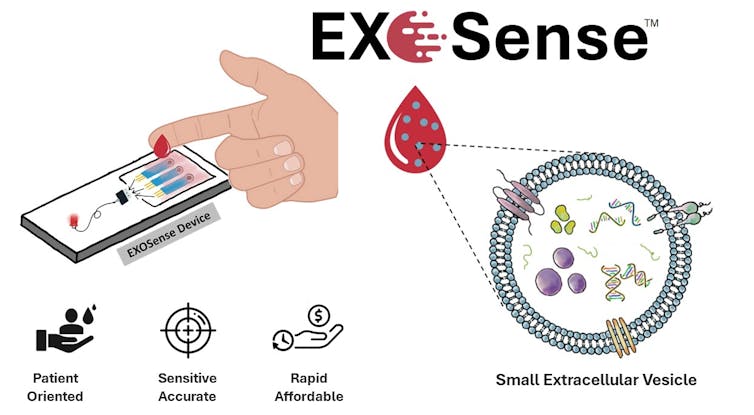
EXOSense captures tiny particles and reads their signals to help find cancer sooner.
(Sara Hassanpour Tamrin)

The EXOSense platform is still under development and needs to be tested with patient samples. It could make a meaningful difference in people’s lives through simple liquid biopsy tests. Much of our work focuses on developing miniaturized platforms, using microfluidic technology, that are both user-friendly and cost-effective.

This approach aims to improve access to diagnostic tools, particularly in under-served communities with limited laboratory infrastructure. Over time, we anticipate this work will lead to a new test that can detect cancer early using just a drop of biofluid and will contribute to reducing the burden of cancer.


ShareTweetSharePin
Next Post
EE couldn’t change pricey broadband and TV deal after my husband died

EE couldn’t change pricey broadband and TV deal after my husband died

Most Read

What causes stuttering? A speech pathology researcher explains the science and the misconceptions around this speech disorder

What causes stuttering? A speech pathology researcher explains the science and the misconceptions around this speech disorder

December 15, 2022
In war-torn Iran, air pollution from burning oil depots and bombed buildings unleashes invisible health threats

In war-torn cities, air pollution from burning oil depots and bombed buildings unleashes invisible health threats

March 25, 2026
morning back pain

Morning Again Ache Trigger Is Not the Mattress

October 11, 2021
3 women stroke prevention

Silent Stroke Symptoms in Women: What You Might Be Overlooking

February 27, 2026
lower back pain relief exercises

5 decrease again ache aid workouts

October 11, 2021

Why Circadian Rhythms Matter for Your Health

July 30, 2024

4 steps to building a healthier relationship with your phone

January 28, 2025
bleeding in gum

When The Bleeding in gum Is Severe ?

October 11, 2021
Good Night Sleep

6 Causes of Good Evening Sleep

October 11, 2021
Nasal vaccines promise to stop the COVID-19 virus before it gets to the lungs – an immunologist explains how they work

Nasal vaccines promise to stop the COVID-19 virus before it gets to the lungs – an immunologist explains how they work

December 14, 2022
3 years after legalization, we have shockingly little information about how it changed cannabis use and health harms

3 years after legalization, we have shockingly little information about how it changed cannabis use and health harms

October 15, 2021
Kick up your heels – ballroom dancing offers benefits to the aging brain and could help stave off dementia

Kick up your heels – ballroom dancing offers benefits to the aging brain and could help stave off dementia

January 3, 2023
Biden is getting prostate cancer treatment, but that’s not the best choice for all men − a cancer researcher describes how she helped her father decide

Biden is getting prostate cancer treatment, but that’s not the best choice for all men − a cancer researcher describes how she helped her father decide

May 20, 2025

COVID vaccines: how one can pace up rollout in poorer international locations

October 5, 2021
Ten small changes you can make today to prevent weight gain

Ten small changes you can make today to prevent weight gain

October 12, 2021

Maximize Your Performance – Sync with Your Circadian Rhythms

August 9, 2024
Five ways to avoid pain and injury when starting a new exercise regime

Five ways to avoid pain and injury when starting a new exercise regime

December 30, 2022

Multiple sclerosis: the link with earlier infection just got stronger – new study

October 12, 2021

This Simple Hygiene Habit Could Cut Your Risk of Stroke, New Research Reveals

February 1, 2025
Support and collaboration with health-care providers can help people make health decisions

Support and collaboration with health-care providers can help people make health decisions

December 16, 2021
Greece to make COVID vaccines mandatory for over-60s, but do vaccine mandates work?

Greece to make COVID vaccines mandatory for over-60s, but do vaccine mandates work?

December 1, 2021
GLP-1 drugs may fight addiction across every major substance, according to a study of 600,000 people

GLP-1 drugs may fight addiction across every major substance, according to a study of 600,000 people

March 6, 2026
woman covered with white blanket

Exploring the Impact of Sleep Patterns on Mental Health

August 4, 2024
News of war can impact your mental health — here’s how to cope

Binge-eating disorder is more common than many realise, yet it’s rarely discussed – here’s what you need to know

December 2, 2022
Nurses’ attitudes toward COVID-19 vaccination for their children are highly influenced by partisanship, a new study finds

Nurses’ attitudes toward COVID-19 vaccination for their children are highly influenced by partisanship, a new study finds

December 2, 2022
As viral infections skyrocket, masks are still a tried-and-true way to help keep yourself and others safe

As viral infections skyrocket, masks are still a tried-and-true way to help keep yourself and others safe

December 14, 2022
GPs don’t give useful weight-loss advice – new study

GPs don’t give useful weight-loss advice – new study

December 16, 2022
Nutrition advice is rife with misinformation − a medical education specialist explains how to tell valid health information from pseudoscience

Nutrition advice is rife with misinformation − a medical education specialist explains how to tell valid health information from pseudoscience

January 28, 2025
Why are some people faster than others? 2 exercise scientists explain the secrets of running speed

Why are some people faster than others? 2 exercise scientists explain the secrets of running speed

April 29, 2024
Backlash to transgender health care isn’t new − but the faulty science used to justify it has changed to meet the times

Backlash to transgender health care isn’t new − but the faulty science used to justify it has changed to meet the times

January 30, 2024
  • Twenty47HealthNews
  • Health & Wellness
  • Disclaimer

© 2020 DAILY HEALTH NEWS

  • Twenty47HealthNews
  • Health & Wellness
  • Disclaimer
    • Terms of Use
    • Privacy Policy
    • DMCA Notice

© 2020 DAILY HEALTH NEWS















