For decades, people have been told that their weight problems can be solved by math: Calories in, calories out. If weight were a simple math equation, more people would likely be the weight they desire. But it is much more complicated.
There are several theories as to why it is difficult to lose weight. Some focus on genetics and metabolism while others claim environmental and social factors are more important. But which of these theories is correct, if any? Are people destined to be the weight their genetics, metabolism or environment dictate?
I am a diabetologist and physician specializing in obesity medicine. Understanding what’s known and uncertain about these theories can help you potentially overcome your own biology to change your weight.
Table of Contents
Set point weight
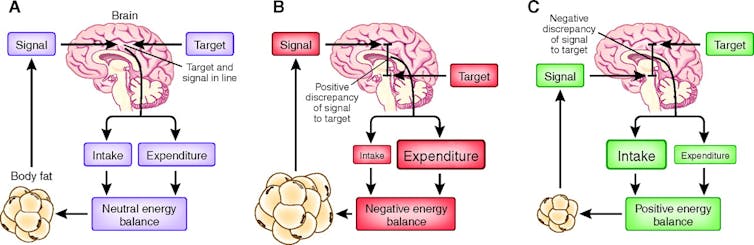
The concept of set point weight has been around since the 1950s. It suggests that the body has a regulatory system that defends a predetermined level of adipose tissue – commonly called fat – it maintains by changing hunger cues and energy expenditure. That predetermined fat level is governed by genetics, physiology and environmental factors.
This idea is supported by observations that after weight loss, appetite is increased and energy expenditure decreased until weight is restored. In theory, this process prevents the body from starving, even with significant weight loss. One study found that hormones that cause hunger remain elevated and hormones that promote fullness are suppressed for at least 62 weeks after weight loss, and even after regaining weight.
A related concept called metabolic adaptation seems to influence energy balance, although the evidence for this effect in people is less clear. This process refers to a reduction in energy expenditure beyond what is predicted by changes in body composition. In other words, as you lose weight, you burn fewer calories than expected for someone at that same weight who has not undergone recent weight loss.

Speakman et al./Disease Models and Mechanisms, CC BY-NC-SA
Metabolic adaptation manifests as an increase in appetite and a decrease in resting metabolic rate, which is the energy you burn to sustain background processes such as heartbeat, temperature regulation, respiration and digestion, even if you lie in bed all day. In metabolic adaptation, resting metabolic rate decreases after approximately 5% weight loss. The energy burned from exercise decreases after around 10% weight loss.
Elevate Your Health for Just $29.99/Month
Join the Precision Wellness Subscription at My Healing 365 and get discounted services, priority coaching access, virtual care, and exclusive wellness resources to support your physical, emotional, and hormonal health.
Join for $29.99/MonthThis means that as a person loses weight, the amount of energy used for the background processes to stay alive decreases. Furthermore, a person must increase exercise as they lose weight to see continued weight loss. So the more weight a person loses, the harder it is to lose more.
This decrease in energy expenditure may persist for years after weight loss, as was seen in a study of participants in the TV show “The Biggest Loser.” However, some studies have found metabolic adaptation to not be as significant as once thought.
There are several strategies to overcome set point weight and the metabolic adaptation expected with weight loss. Bariatric surgery – a procedure for weight loss – appears to alter set point weight, reducing hunger without decreasing energy expenditure and patients rarely become underweight. GLP-1 and similar medications may not affect metabolic adaptation while reducing weight. Nutritional strategies include increased protein intake, decreasing glycemic load and increasing high-fiber foods, although evidence for the effectiveness of these tactics varies.
Set point suggests your body has one set weight it likes to stick at and will adjust your metabolism and appetite in order to move you toward and keep you at it.
Settling point model
An alternative theory to set point weight is called settling point. This model proposes that weight regulation occurs through passive feedback without biological control. Rather than the body actively controlling weight through changes in hormones, this theory suggests that body weight is a result of your habits and surroundings.

Speakman et al./Disease Models and Mechanisms, CC BY-NC-SA
The settling point is defined as where body weight stabilizes because energy intake equals energy expenditure. This is determined by the physical and metabolic costs of maintaining body mass. People with more body mass expend more energy due to the increased energy needed to move and maintain a larger body. Therefore, people living in a larger body would have larger food intake needs.
Settling point may sound like the old “calories in, calories out” model, but it also considers environmental and societal influences. Think of it as an open window. The room may warm from the sunlight during the day, then cool down overnight. Over time, the room will tend to hover around the same temperature. The temperature isn’t fixed but will naturally settle based on the weather, insulation and airflow. It may be colder in the winter and warmer in the summer.
Now let’s apply this concept to a person. If you have a job where you are on your feet all day and eat home-cooked foods most of the time, your weight might be stable. If you switch to a desk job and start eating more calorie-dense foods and larger portions, your weight may increase until it becomes stable again. In both scenarios, your weight eventually stabilizes at different settling points based on your current set of circumstances.
However, the settling points theory fails to explain biological and genetic aspects of weight.
Dual intervention point model
The dual intervention point model integrates both set point weight and settling point. This theory proposes an upper and lower threshold that define the boundaries of each person’s “acceptable” body weight, called the zone of indifference. The lower threshold is the point where starvation is prevented while maintaining all biological and metabolic needs.
Within the zone of indifference, settling point concepts prevail: The body will adapt to energy and environment. But when body weight falls below the lower threshold, it triggers physiological mechanisms to defend against further weight loss and prevent starvation. The body’s hormonal systems increase appetite and reduce energy expenditure.

Speakman et al./Disease Models and Mechanisms, CC BY-NC-SA
When body weight rises above the upper threshold, biological mechanisms should theoretically engage to prevent further weight gain. Researchers have documented this process in numerous studies in animals, hypothesizing that this is most likely due to the increased risk of predation from weight gain. Animals with more fat are targeted or can’t get away from predators. However, this process isn’t always seen in people and there is weaker evidence supporting it.
The dual intervention point model also suggests that the zone of indifference varies widely between individuals. This would account for why some people maintain a relatively stable weight and others have greater variation over time. Some may recognize this as the old struggle of “losing the same 10 pounds over and over again.”
Additionally, the drifty gene hypothesis proposes that the upper threshold for the body to intervene has gradually drifted upward as people moved into safer, more stable environments. The evolutionary pressure to maintain a lean physique for survival, such as avoiding predators like a hungry lion, has largely disappeared.
Which theory holds the most weight?
So which theory of body weight regulation is correct? The answer is none of them fits real world experiences exactly. But there seems be to a difference between how your metabolism responds to active weight loss compared to weight maintenance, so how to approach each goal may be different.
Decreasing food intake seems to be the most beneficial for attaining weight loss. Conversely, exercise seems to be key for weight maintenance.
Overall, the big takeaway is that weight balance is complex. It isn’t a simple math problem to solve. Adequate medical care for overweight and obesity encompasses nutrition, exercise, sleep, stress and other factors that influence weight. Changes in these factors can be combined with medication or surgery to achieve a sustained reduction in weight.
Weight loss is often not linear, and plateaus are expected. Each case is individual, and one size – or theory – does not fit all.

























