Medically Reviewed
Dr. Jose Rossello, MD, PhD, MHCM
Preventive Medicine & Public Health Specialist
Last Reviewed: June 19, 2026
A workplace accident doesn’t announce itself with warnings. It happens when hazards go unidentified, risks remain uncontrolled, and safety procedures exist only on paper. Risk assessment is the systematic process of identifying workplace hazards, evaluating the likelihood and severity of potential harm, and implementing controls to protect workers before incidents occur. Organizations that treat health and safety as a checklist exercise rather than an active protection system put their workers and operations at risk every day.
The gap between what appears in HSE documentation and what happens on the shop floor can be deadly. A proper risk assessment requires more than filling out forms. It demands understanding the actual conditions where work takes place, involving the people who do the job, and maintaining controls that function in real-world situations. Understanding the risk assessment process[1] means recognizing that this tool serves as the foundation for preventing injuries, fatalities, and costly operational disruptions.
Mastering risk assessment delivers practical benefits beyond regulatory compliance. Companies that implement effective ERM practices reduce accident rates, lower insurance costs, and build a workforce that understands how to work safely. The five-step method provides a clear framework that any organization can follow to identify what can cause harm and stop it before someone gets hurt.
Table of Contents
Key Takeaways
- Risk assessment identifies hazards and evaluates the likelihood and severity of harm to implement effective controls
- The five-step process includes identifying hazards, determining who might be harmed, evaluating risks, implementing controls, and reviewing procedures regularly
- Effective risk assessments require worker involvement, regular updates when conditions change, and controls that match actual workplace conditions
Understanding Risk Assessment Fundamentals

Risk assessment serves as the foundation for workplace safety by identifying what could cause harm and determining how to prevent it. Organizations must understand the difference between hazards and risks, recognize the value of systematic evaluation, and meet their legal duties.
Hazard vs. Risk
A hazard is anything that has the potential to cause harm, such as chemicals, electricity, working at heights, or loud noise. Risk measures the likelihood that a hazard will actually cause harm and how severe that harm might be.
For example, a wet floor is a hazard. The risk depends on factors like how many people walk through the area, whether warning signs are present, and if workers wear slip-resistant shoes. Understanding this difference helps safety professionals focus on both eliminating hazards and reducing risks when elimination isn’t possible.
Many workers confuse these terms, but hazard identification[1] represents only the first part of risk assessment. After finding hazards, organizations must evaluate the actual risk level before deciding what controls to implement.
Purpose and Benefits
Risk assessment protects workers from injury and illness while helping organizations meet safety goals. It provides a structured method to spot dangers before accidents occur.
The process reduces workplace incidents, lowers insurance costs, and improves employee morale. Workers feel safer when they see their employer actively addressing potential dangers. Organizations also avoid costly downtime from accidents and equipment damage.
Key benefits include:
- Fewer workplace injuries and illnesses
- Lower workers compensation claims
- Better compliance with OSHA and other regulations
- Improved operational efficiency
- Reduced legal liability
Risk assessment also supports continuous improvement. Regular reviews help organizations adapt to new equipment, processes, or materials that could create different hazards.
Legal Obligations
Most countries require employers to conduct risk assessments by law. In the UK, the Management of Health and Safety at Work Regulations 1999 mandates that employers assess risks to workers and others affected by their activities.
OSHA requires U.S. employers to provide safe workplaces and may mandate specific assessments for certain hazards. Organizations with five or more employees must document their significant findings from risk assessment[2] activities.
Compliance risk increases when organizations skip proper assessments. Regulators can issue fines, shut down operations, or pursue criminal charges after serious incidents. Standards like ISO 45001 and ISO 31000 provide frameworks that help organizations meet these legal obligations while building effective safety management systems.
Step 1: Identifying Hazards in the Workplace
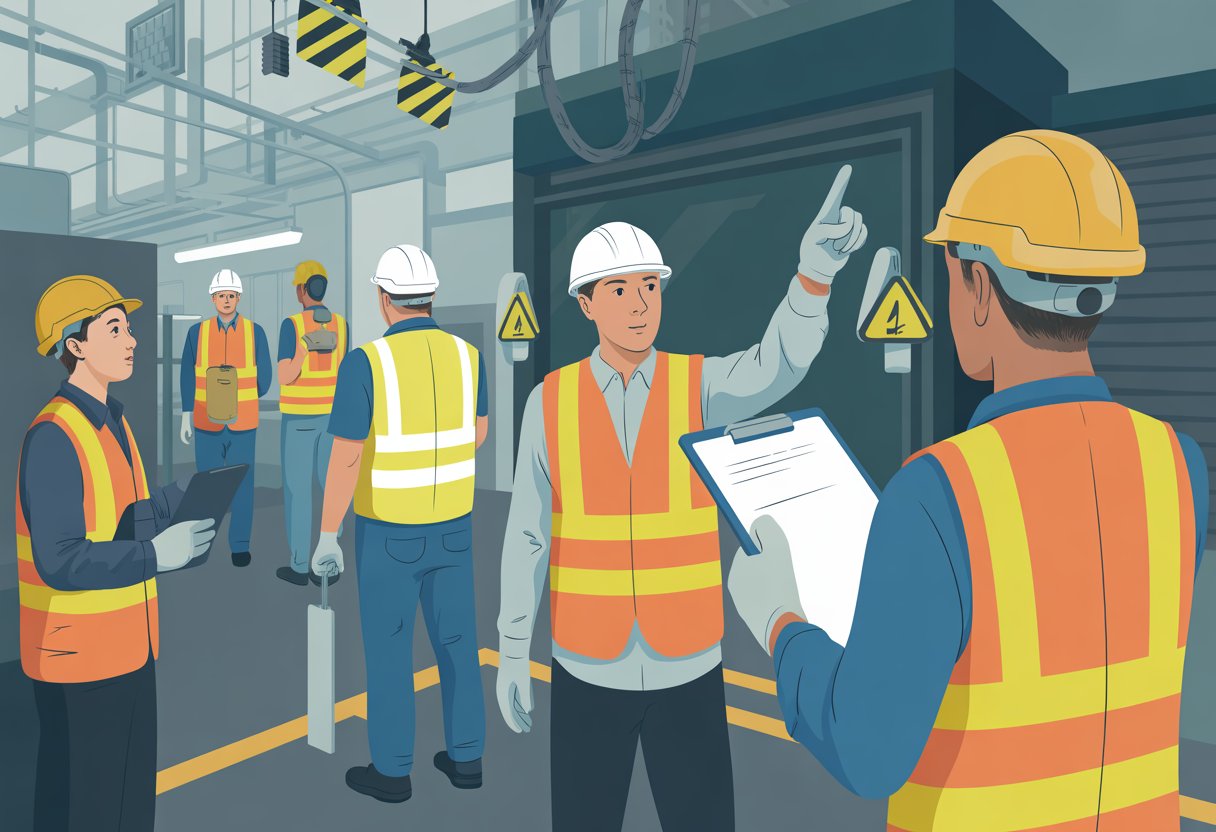
The first step in any workplace risk assessment requires collecting information about existing and potential dangers through systematic inspection and review processes. Organizations must examine multiple hazard categories and use proven identification methods to build a complete picture of workplace risks.
Categories of Common Hazards
Workplace hazards fall into several distinct categories that require different identification approaches. Physical hazards include machinery, noise, temperature extremes, and electrical equipment that can cause immediate injury. These dangers often appear in manufacturing settings where workers operate heavy equipment or work near moving parts.
Chemical hazards involve exposure to substances like welding fumes, solvents, paints, and toxic dusts. Workers handling these materials need proper local exhaust ventilation (LEV) systems to reduce airborne contaminants. Safety Data Sheets provide critical information about chemical properties and exposure limits.
Biological hazards come from infectious diseases, molds, and animal materials that cause illness or allergic reactions. Healthcare facilities and agricultural operations face the highest risk from these dangers.
Ergonomic hazards stem from manual handling tasks, repetitive motions, awkward postures, and vibration exposure. These risks develop over time and can lead to musculoskeletal disorders. Organizations should evaluate activities requiring heavy lifting or work above shoulder height.
Practical Methods for Hazard Identification
Organizations must use multiple approaches to identify the hazards effectively. Regular workplace inspections conducted by teams that include both management and workers help spot safety issues before incidents occur. These inspections should cover all areas including confined spaces, storage facilities, and contractor work zones.
Reviewing existing documentation[3] provides valuable information about known dangers. Inspection reports, injury logs, workers’ compensation records, and equipment manuals reveal patterns of recurring problems. Fire risk assessment documents and previous incident investigations highlight areas needing attention.
Worker input serves as a critical resource for hazard identification. Employees recognize dangers in their daily tasks that managers might overlook. Safety committee meetings and anonymous surveys capture this frontline knowledge.
Scenario planning helps identify risks associated with emergency situations and non-routine activities. Organizations should consider equipment failures, chemical spills, startup procedures, and maintenance tasks when conducting a thorough workplace risk assessment.
Step 2: Determining Who Might Be Harmed and How
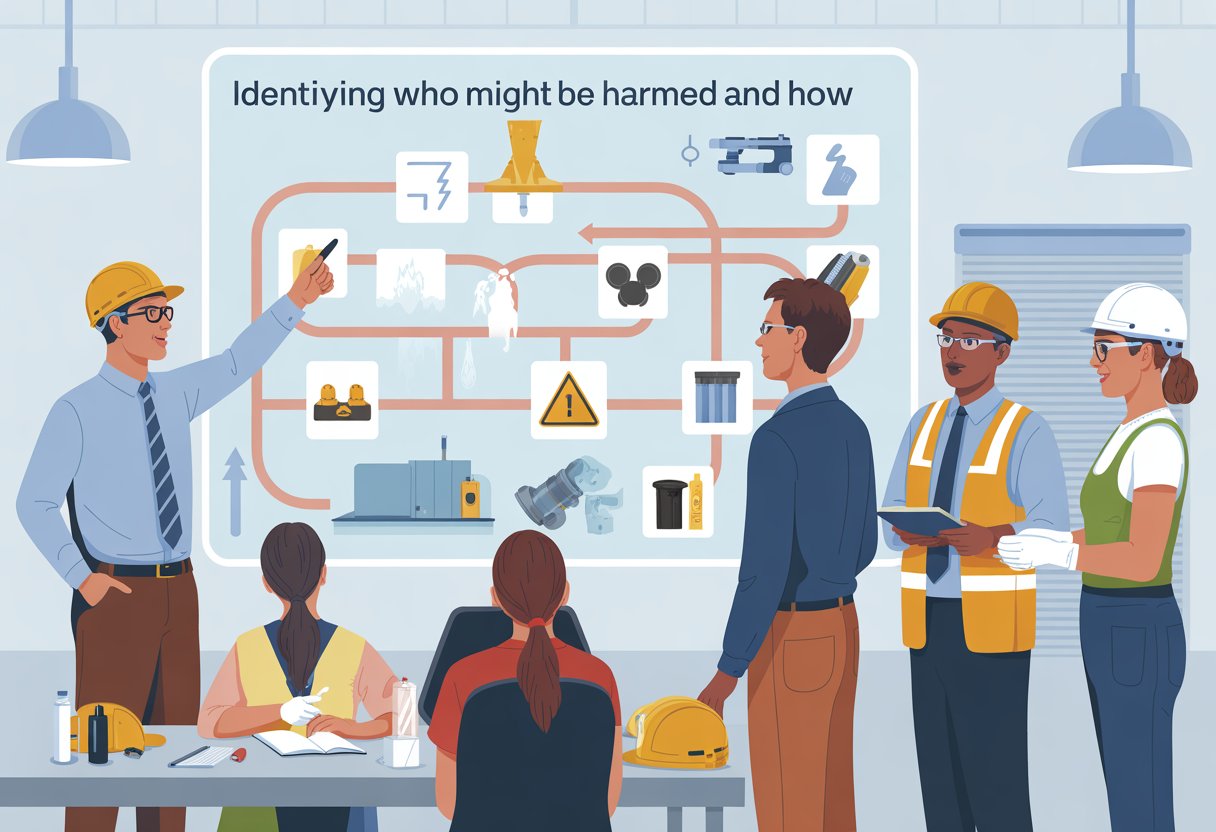
After identifying workplace hazards, the next step involves understanding which people face risk exposure and the specific ways harm could occur. This process requires examining different worker categories and tracing how hazards might affect them.
Recognizing At-Risk Groups
Every workplace contains different groups who face varying levels of risk. Employees represent the primary group, but their risk levels differ based on job roles and experience. Young workers[4] often lack experience and may not recognize hazards quickly. They need extra attention during risk assessments.
Contractors and subcontractors may not know the workplace layout or safety procedures. Visitors and members of the public can wander into dangerous areas without realizing the risks. Lone workers face unique challenges because no one is nearby to help if something goes wrong.
Some groups need special consideration. Pregnant workers may be more sensitive to certain chemicals or physical demands. People with disabilities might struggle with emergency exits or warning systems. New employees haven’t learned all the safety rules yet. Each group requires specific protective measures based on their vulnerabilities.
Mapping Risk Pathways
Understanding how hazards cause harm helps create better controls. A risk pathway shows the connection between a hazard and potential injury or illness.
Physical hazards create direct pathways. Heavy machinery can crush limbs. Wet floors lead to slips that cause broken bones. Falling objects strike workers below. Chemical hazards work differently. Toxic fumes enter through breathing. Corrosive liquids burn skin on contact. Some substances cause cancer after years of exposure.
The assessment must document these pathways clearly. For example, a forklift operator faces crushing injuries if the vehicle tips over. Workers near the forklift risk being struck if the operator can’t see them. This detail helps determine who might be harmed and how[1] effectively, which shapes the control measures needed.
Step 3: Evaluating Risks and Deciding on Controls
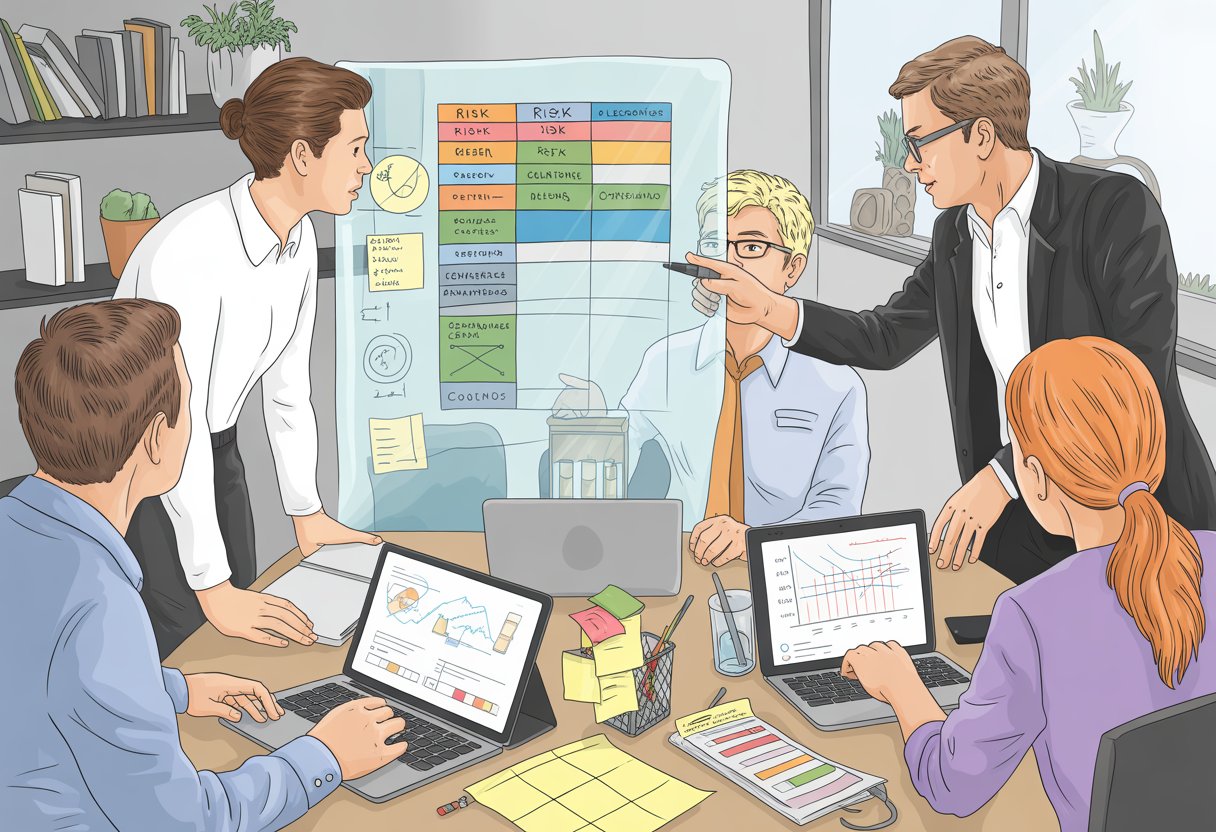
Once risks are identified and analyzed, organizations must evaluate the risks to determine which ones need immediate attention and what controls will reduce them to acceptable levels. This step uses risk matrices and scoring methods to prioritize actions based on likelihood and impact.
Risk Matrix and Risk Scoring Methods
A risk matrix provides a visual tool to evaluate risk by combining likelihood and impact into a single risk score. Most organizations use a 5×5 risk matrix that plots probability on one axis and severity on the other, creating 25 possible risk levels.
The matrix typically assigns numerical values to each factor:
| Likelihood | Value | Impact | Value |
|---|---|---|---|
| Rare | 1 | Insignificant | 1 |
| Unlikely | 2 | Minor | 2 |
| Possible | 3 | Moderate | 3 |
| Likely | 4 | Major | 4 |
| Almost Certain | 5 | Catastrophic | 5 |
The risk evaluation process[1] calculates a risk score by multiplying likelihood by impact. A risk with “Likely” probability (4) and “Major” impact (4) receives a score of 16, indicating high priority for controls.
Assessing Likelihood and Impact
To evaluate the risks accurately, teams must assess both how often something might happen and how bad the consequences would be. Likelihood considers factors like frequency of exposure, existing safeguards, and historical data from similar operations.
Impact assessment looks at potential harm to people, property, environment, and business operations. A chemical spill might have catastrophic impact if it occurs near a water source, but only moderate impact in a contained area with proper drainage.
Organizations then use risk scoring methods[5] to classify results as low, medium, high, or critical. Scores below 6 might be acceptable with current controls, while scores above 15 require immediate mitigation before work proceeds.
Step 4: Selecting and Implementing Control Measures
After identifying and evaluating workplace hazards, organizations must choose appropriate control measures to protect workers. The most effective approach follows a specific order of controls, starting with the most protective methods and working down to less effective options.
Hierarchy of Controls Approach
The hierarchy of controls[1] provides a framework for selecting the most effective risk mitigation strategies. This approach ranks control measures from most to least effective.
Elimination sits at the top of the hierarchy. This means removing the hazard completely from the workplace. For example, a company might eliminate a dangerous chemical by changing its production process entirely.
Substitution involves replacing a hazardous material or process with a less dangerous alternative. A workplace might substitute a toxic cleaning chemical with a safer product that achieves the same result.
Engineering controls physically change the work environment to reduce exposure. These include machine guards, ventilation systems, and sound barriers. Local exhaust ventilation (LEV) systems capture harmful dust, fumes, or vapors at their source before workers can breathe them in.
Administrative controls change how people work. These include rotating workers to limit exposure time, creating safety procedures, and posting warning signs.
Personal protective equipment (PPE) is the last line of defense. This includes items like gloves, safety glasses, respirators, and hearing protection. PPE should only be used when higher-level controls are not possible or as an additional layer of protection.
Engineering and Administrative Controls
Organizations should prioritize engineering controls[6] because they remove or reduce hazards without relying on worker behavior. These controls work automatically and provide consistent protection.
Common engineering controls include:
- Ventilation systems that remove contaminated air
- Machine guards that prevent contact with moving parts
- Isolation barriers that separate workers from hazards
- Automated systems that reduce manual handling
Administrative controls support risk reduction through policies and procedures. These include work permits for high-risk tasks, job rotation schedules to limit exposure, and regular safety training. Organizations must ensure workers understand and follow these controls consistently.
The most effective workplace safety programs combine multiple control types. When resources are limited, organizations should implement controls on a “worst-first” basis, addressing the highest risks first while also making quick, inexpensive safety improvements.
Step 5: Documentation, Communication, and Action Plans

Proper documentation creates a clear record of identified hazards and control measures, while action plans ensure teams implement risk controls effectively. These elements transform risk assessment from a paper exercise into a working system that protects employees and operations.
Effective Use of Risk Assessment Templates
A risk assessment template[7] provides a standardized format for recording hazards, risk levels, and control measures. Organizations should select templates that match their specific industry and workplace needs.
Essential template components include:
- Hazard identification fields
- Risk rating scales (likelihood and severity)
- Existing control measures
- Required additional controls
- Responsible parties and deadlines
Workers complete these documents before starting jobs to assess their environment, equipment, and resources. Templates should be simple enough for frontline staff to use without extensive training.
A risk register serves as a central database where organizations track all identified risks across projects and departments. This document allows management to prioritize resources and monitor risk trends over time. Regular updates to the risk register keep the risk management process current and relevant.
Action Planning and Implementation
Action plans convert risk assessment findings into specific tasks with clear owners and timelines. Each identified risk requiring additional controls needs a corresponding action item.
Effective action plans specify who will implement controls, what resources they need, and when completion is expected. Teams should prioritize high-risk items first while scheduling lower-risk improvements systematically.
Communication ensures all affected workers understand the hazards they face and the protective measures in place. Supervisors must explain controls to their teams and verify understanding through discussion or demonstration.
Organizations using governance, risk, and compliance (GRC) systems can integrate action tracking with broader business processes. This integration helps teams monitor progress and maintain accountability throughout implementation.
Continuous Review and Updating Safety Procedures
Risk assessments must change when workplace conditions change. Organizations need specific triggers that prompt immediate reviews and systems that monitor risks on an ongoing basis.
Review Triggers and Frequency
Safety managers should update risk assessments immediately after incidents[8] or when operational changes occur. The most common triggers include equipment modifications, new chemical introductions, procedural changes, or near-miss events. These situations indicate that existing controls may no longer protect workers adequately.
Annual reviews serve as a baseline requirement for stable operations. However, high-risk industries often need quarterly or monthly assessments. Management of Change (MOC) processes should automatically trigger reassessment before any significant operational shift begins.
New regulations also demand immediate attention. When exposure limits change or new safety standards emerge, teams must verify that their current controls still meet legal requirements and maintain residual risk at acceptable levels.
Continuous Improvement and Monitoring
Continuous monitoring tracks how well controls perform in real-world conditions. Supervisors should conduct regular workplace inspections to verify that physical safeguards remain functional and workers follow established procedures.
Organizations can implement several monitoring methods:
- Daily pre-shift inspections by supervisors
- Weekly safety walks by management
- Monthly control effectiveness audits
- Quarterly worker feedback sessions
Risk monitoring identifies when hazards drift from low to moderate or high levels. This early detection allows teams to strengthen existing controls before incidents occur. The goal is achieving ALARP status, where risks stay as low as reasonably practicable through proactive hazard identification and control implementation[1].
Frontline workers provide the most accurate data about control failures. Their direct experience reveals gaps that paperwork alone cannot show.
Integrating Risk Assessment With Business Operations
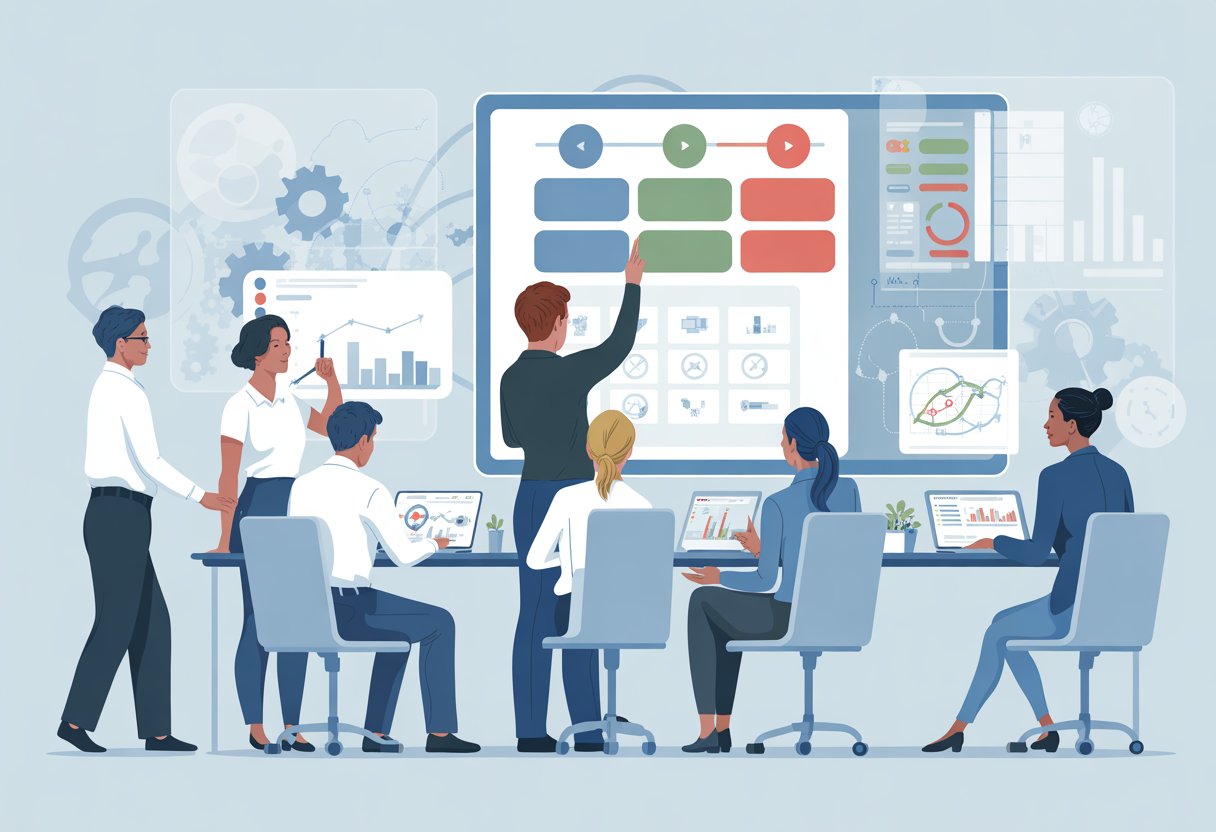
Organizations must align their risk assessment efforts with daily operations to protect assets and maintain stability. Setting clear boundaries for acceptable risk and planning for disruptions ensures the business can operate smoothly even during challenging times.
Risk Appetite and Tolerance
Risk appetite defines the amount and type of risk an organization is willing to accept to achieve its objectives. Risk tolerance specifies the acceptable variation from those risk appetite levels. These two concepts work together to guide decision-making across all business functions.
Risk appetite typically addresses broad categories:
- Strategic risk: Risks related to business objectives and competitive positioning
- Operational risk: Risks from internal processes, systems, and people
- Financial risk: Risks involving market changes, credit, and cash flow
Organizations must document their risk appetite clearly. A technology company might accept high strategic risk when launching new products but maintain low tolerance for financial risk. A manufacturing firm might tolerate moderate operational risk while avoiding any compliance risks that could result in regulatory penalties.
Risk tolerance levels help teams make practical choices. When a risk falls within tolerance, teams can proceed with standard controls. When it exceeds tolerance, they must escalate the issue and implement additional safeguards. This framework ensures consistent decision-making across departments.
Business Continuity and Strategic Risk
Business continuity planning addresses how organizations maintain operations during disruptions. This planning directly connects to strategic risk management because any major interruption threatens core business objectives.
Organizations must identify critical functions that cannot stop without serious consequences. These might include customer service systems, production lines, or payment processing. Teams then develop backup plans for each function.
Key business continuity elements include:
- Recovery time objectives for each critical process
- Alternative suppliers or backup systems
- Communication plans for employees and customers
- Regular testing of continuity procedures
Strategic risk emerges when external factors threaten long-term goals. Effective governance structures[5] help organizations track these risks through key risk indicators (KRIs). KRIs provide early warning signals that allow leadership to adjust strategy before problems escalate.
Strong governance ensures that business continuity plans align with the organization’s risk management approach[9]. Leadership must review both strategic risks and continuity plans regularly to adapt to changing conditions.
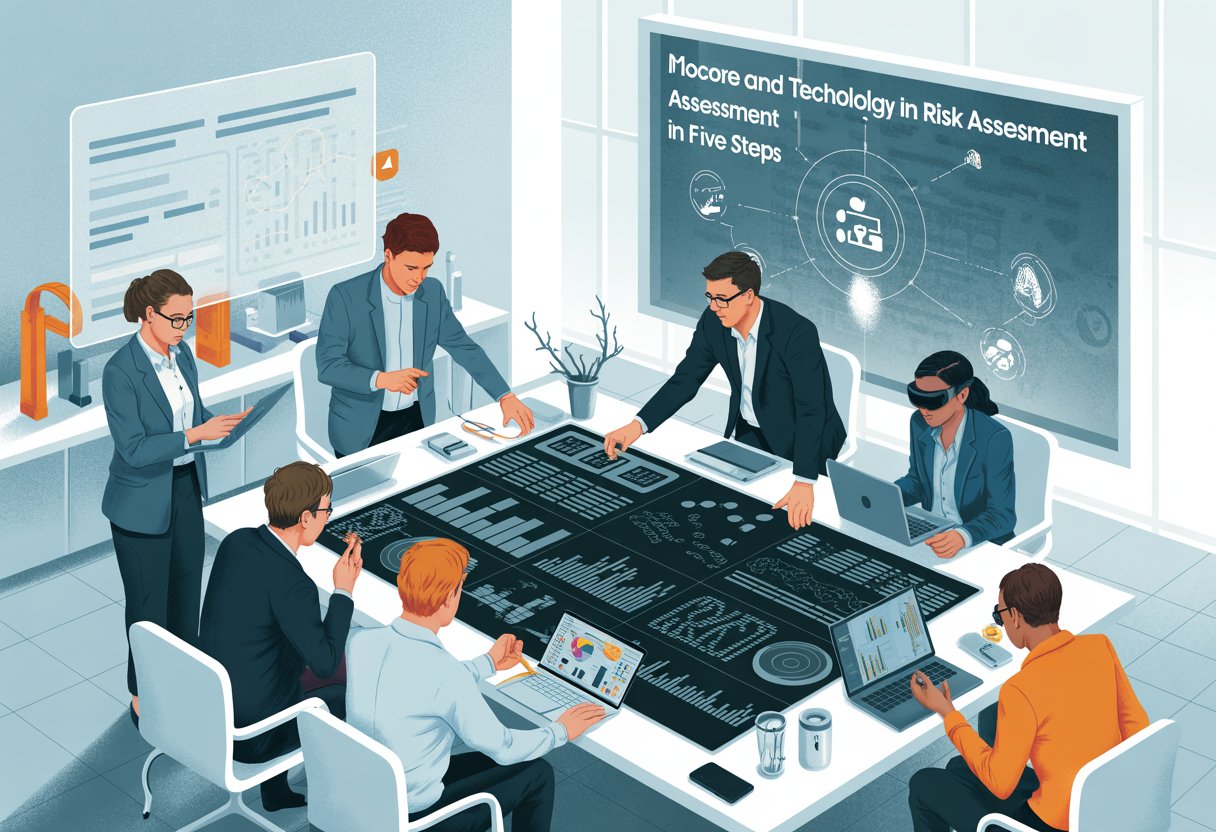
Modern technology has changed how organizations handle the risk assessment process. Software platforms now automate data collection and analysis, while advanced mathematical methods like Monte Carlo simulation provide detailed predictions of potential outcomes.
Digital Risk Assessment Software
Digital platforms streamline the entire risk assessment workflow from start to finish. These tools offer built-in risk assessment template options that standardize how teams document hazards and evaluate threats across departments.
Most software includes features for tracking control effectiveness in real time. Users can assign risk rating scores automatically based on predefined criteria, reducing human error and inconsistency. The platforms store historical data, making it easier to spot trends and compare current risks against past assessments.
Advanced systems integrate with existing business software to pull data directly from operations, finance, and compliance systems. This integration eliminates manual data entry and keeps risk information current. Teams can generate reports instantly for management review, and many platforms send automated alerts when risk levels change or controls fail.
Cloud-based solutions allow multiple stakeholders to collaborate on assessments from different locations. Access controls ensure that sensitive risk information reaches only authorized personnel while maintaining a complete audit trail of all changes.
Quantitative Methods and Monte Carlo Simulation
Monte carlo simulation represents a powerful quantitative approach for evaluating complex risks. This method runs thousands of calculations using different variables to predict a range of possible outcomes and their probabilities.
The technique proves especially useful when assessing financial risks. Organizations use it to calculate Value at Risk (VaR), which estimates potential losses over a specific time period at a given confidence level. For example, a VaR analysis might show that a company has a 95% chance of not losing more than $500,000 in a month.
Monte Carlo simulation works by randomly selecting values within defined parameters and running scenarios repeatedly. The results create a probability distribution that shows which outcomes are most likely. This approach handles uncertainty better than simple formulas because it accounts for multiple variables changing at once.
Teams can model different risk scenarios by adjusting input variables and comparing results. The method requires quality data to produce accurate predictions, but it provides far more insight than basic risk rating systems alone.
Training, Competence, and Safety Culture
Effective risk assessment depends on workers who know how to spot hazards and leaders who build a workplace where safety matters. Training programs give employees the skills they need, while strong leadership creates an environment where those skills get used every day.
Training and Awareness Programs
Organizations need structured risk assessment training[10] that teaches workers how to identify hazards, evaluate risks, and apply controls. The training should match each worker’s role and the specific dangers they face on the job.
Key training components include:
- Hazard identification methods
- Risk evaluation techniques
- Control measure selection
- Documentation procedures
- Emergency response protocols
HSE training works best when it goes beyond one-time sessions. Companies should schedule regular refreshers, conduct drills, and review real incidents to keep safety skills sharp. Digital checklists and risk matrices help workers apply what they learned during hands-on work.
Training also supports compliance with standards like ISO 45001, which requires organizations to ensure workers are competent to perform their safety duties. Managers need training in risk-based decision-making, while frontline workers need practical hazard recognition skills. Contractors and third-party personnel require site-specific training since they may not know the facility’s unique risks.
Leadership and Safety Culture
Leaders shape safety culture through their actions and decisions. When managers prioritize health and safety in daily operations, workers follow that example and take risks seriously.
A strong safety management system starts at the top. Leaders must allocate resources for training, approve safe work procedures, and hold teams accountable for following protocols. They also need to create channels where workers can report hazards without fear of punishment.
Leadership responsibilities include:
- Modeling safe behaviors
- Investigating incidents thoroughly
- Recognizing safe work practices
- Providing necessary safety equipment
- Supporting stop-work authority
Safety culture grows when everyone takes ownership of risk assessment. Supervisors bridge the gap between management policies and worker behavior by conducting toolbox talks and job safety analyses. They translate written procedures into actions that prevent injuries and keep operations running smoothly.
Frequently Asked Questions
Risk assessments raise common questions about process steps, hazard identification methods, risk evaluation techniques, and review schedules. Understanding these core elements helps organizations implement effective safety programs.
What are the five steps of a standard risk assessment process?
The five steps to a risk assessment[2] include identifying hazards, assessing the risks, controlling the risks, recording findings, and reviewing controls. Each step builds on the previous one to create a complete safety management system.
Organizations must complete all five steps to meet regulatory requirements. Skipping any step leaves gaps in workplace safety protection.
How do you identify hazards and who might be harmed during a risk assessment?
Hazard identification starts with walking through the workplace and observing what could cause harm. Workers should examine how people perform their jobs, what equipment and chemicals they use, and the overall condition of the facility.
Accident and illness records help identify less obvious hazards that might not be immediately visible. The assessment must consider all people who could be affected, including employees, contractors, visitors, and members of the public.
Special attention goes to vulnerable workers like young employees, pregnant workers, people with disabilities, and new staff members. These groups may face different or greater risks from the same hazards.
Talking to workers provides valuable information since they know the day-to-day realities of their jobs. They often spot hazards that managers might miss.
How do you evaluate and prioritize risks using likelihood and severity ratings?
Risk evaluation determines how likely someone could be harmed and how serious that harm could be. Assessors combine these two factors to establish the level of risk.
The likelihood rating considers how often workers are exposed to the hazard and the probability of an incident occurring. The severity rating looks at the potential consequences, from minor injuries to fatal accidents.
Organizations typically use a matrix that multiplies likelihood by severity to produce a risk score. Higher scores indicate priorities that need immediate attention and resources.
This scoring system helps teams decide which risks require urgent action and which ones can be addressed over time. It provides a clear framework for allocating safety budgets and staff effort.
What are effective control measures to reduce risk, and how do you choose them?
The most effective approach eliminates the hazard completely whenever possible. If elimination is not feasible, organizations must implement controls that make harm unlikely.
Control options follow a hierarchy from most to least effective. Redesigning the job, replacing dangerous materials or equipment, and organizing work to reduce exposure rank higher than personal protective equipment.
The concept of reasonably practicable means balancing the risk level against the cost, time, and effort needed to control it. Organizations must do everything reasonable to protect people but are not expected to eliminate every possible risk.
Multiple control measures often work better than relying on a single solution. Combining engineering controls with safe work procedures and training creates layers of protection.
Can you provide a practical example of a completed five-step risk assessment?
A warehouse operation might identify forklift operations as a hazard that could harm workers and visitors through collisions or crushing injuries. The assessment reveals that pedestrians and forklift operators both face risks during busy periods.
The risk evaluation shows high likelihood due to frequent forklift use and high severity because collisions could cause serious injuries or death. This combination produces a high-risk rating requiring immediate action.
Control measures include designated pedestrian walkways, barriers separating people from vehicle areas, speed limits for forklifts, mirrors at blind corners, and mandatory training for operators. Warning lights and alarms add another layer of protection.
The documentation records all hazards, affected people, existing controls, and additional measures implemented. The warehouse manager schedules quarterly reviews and assigns specific staff to monitor compliance with safety procedures.
How often should a risk assessment be reviewed and updated, and what triggers a review?
Organizations must review risk assessments regularly to verify that controls remain effective. The frequency depends on the workplace but annual reviews represent a common baseline.
Several situations require immediate review regardless of the schedule. Changes to staff, processes, substances, or equipment can introduce new risks or make existing controls inadequate.
Worker feedback about safety concerns triggers a review to investigate potential problems. Accidents, near misses, and incidents all signal that current controls may not be working properly.
Reviews must update the risk assessment documentation to reflect any changes made to hazards, controls, or workplace conditions. This keeps the assessment accurate and useful as a working safety tool.
Post Views: 4
References
- What is Risk Assessment? The 5 Steps Process Explained. https://www.hseblog.com/risk-assessment/ Accessed June 19, 2026
- Risk assessment: Steps needed to manage risk. https://www.hse.gov.uk/simple-health-safety/risk/steps-needed-to-manage-risk.htm Accessed June 19, 2026
- Safety Management. https://www.osha.gov/safety-management/hazard-Identification Accessed June 19, 2026
- Master the 5 Steps to Risk Assessment. https://www.chas.co.uk/blog/5-steps-to-risk-assessment/ Accessed June 19, 2026
- Risk Management Process: 5-Step Guide with Examples. https://www.metricstream.com/learn/risk-management-process.html Accessed June 19, 2026
- Safety Management. https://www.osha.gov/safety-management/hazard-prevention Accessed June 19, 2026
- 5 Steps to Master Risk Assessment. https://www.bigchange.com/blog/the-five-steps-to-a-successful-risk-assessment Accessed June 19, 2026
- Risk Assessment Process: 5-Step Guide for Safety Professionals. https://www.vectorsolutions.com/resources/blogs/three-phases-risk-assessment-risk-management-basics/ Accessed June 19, 2026
- The 5 Steps of Risk Management. https://kirkpatrickprice.com/blog/5-components-risk-management/ Accessed June 19, 2026
- Risk Assessment Training: A Practical Guide. https://safetyculture.com/topics/risk-assessment/risk-assessment-training Accessed June 19, 2026

Elevate Your Health for Just $29.99/Month
Join the Precision Wellness Subscription at My Healing 365 and get discounted services, priority coaching access, virtual care, and exclusive wellness resources to support your physical, emotional, and hormonal health.
Join for $29.99/MonthMedically Reviewed
Dr. Jose Rossello, MD, PhD, MHCM
Preventive Medicine & Public Health Specialist
Last Reviewed: June 19, 2026
A workplace accident doesn’t announce itself with warnings. It happens when hazards go unidentified, risks remain uncontrolled, and safety procedures exist only on paper. Risk assessment is the systematic process of identifying workplace hazards, evaluating the likelihood and severity of potential harm, and implementing controls to protect workers before incidents occur. Organizations that treat health and safety as a checklist exercise rather than an active protection system put their workers and operations at risk every day.
The gap between what appears in HSE documentation and what happens on the shop floor can be deadly. A proper risk assessment requires more than filling out forms. It demands understanding the actual conditions where work takes place, involving the people who do the job, and maintaining controls that function in real-world situations. Understanding the risk assessment process[1] means recognizing that this tool serves as the foundation for preventing injuries, fatalities, and costly operational disruptions.
Mastering risk assessment delivers practical benefits beyond regulatory compliance. Companies that implement effective ERM practices reduce accident rates, lower insurance costs, and build a workforce that understands how to work safely. The five-step method provides a clear framework that any organization can follow to identify what can cause harm and stop it before someone gets hurt.
Key Takeaways
- Risk assessment identifies hazards and evaluates the likelihood and severity of harm to implement effective controls
- The five-step process includes identifying hazards, determining who might be harmed, evaluating risks, implementing controls, and reviewing procedures regularly
- Effective risk assessments require worker involvement, regular updates when conditions change, and controls that match actual workplace conditions
Understanding Risk Assessment Fundamentals
Risk assessment serves as the foundation for workplace safety by identifying what could cause harm and determining how to prevent it. Organizations must understand the difference between hazards and risks, recognize the value of systematic evaluation, and meet their legal duties.
Hazard vs. Risk
A hazard is anything that has the potential to cause harm, such as chemicals, electricity, working at heights, or loud noise. Risk measures the likelihood that a hazard will actually cause harm and how severe that harm might be.
For example, a wet floor is a hazard. The risk depends on factors like how many people walk through the area, whether warning signs are present, and if workers wear slip-resistant shoes. Understanding this difference helps safety professionals focus on both eliminating hazards and reducing risks when elimination isn’t possible.
Many workers confuse these terms, but hazard identification[1] represents only the first part of risk assessment. After finding hazards, organizations must evaluate the actual risk level before deciding what controls to implement.
Purpose and Benefits
Risk assessment protects workers from injury and illness while helping organizations meet safety goals. It provides a structured method to spot dangers before accidents occur.
The process reduces workplace incidents, lowers insurance costs, and improves employee morale. Workers feel safer when they see their employer actively addressing potential dangers. Organizations also avoid costly downtime from accidents and equipment damage.
Key benefits include:
- Fewer workplace injuries and illnesses
- Lower workers compensation claims
- Better compliance with OSHA and other regulations
- Improved operational efficiency
- Reduced legal liability
Risk assessment also supports continuous improvement. Regular reviews help organizations adapt to new equipment, processes, or materials that could create different hazards.
Legal Obligations
Most countries require employers to conduct risk assessments by law. In the UK, the Management of Health and Safety at Work Regulations 1999 mandates that employers assess risks to workers and others affected by their activities.
OSHA requires U.S. employers to provide safe workplaces and may mandate specific assessments for certain hazards. Organizations with five or more employees must document their significant findings from risk assessment[2] activities.
Compliance risk increases when organizations skip proper assessments. Regulators can issue fines, shut down operations, or pursue criminal charges after serious incidents. Standards like ISO 45001 and ISO 31000 provide frameworks that help organizations meet these legal obligations while building effective safety management systems.
Step 1: Identifying Hazards in the Workplace
The first step in any workplace risk assessment requires collecting information about existing and potential dangers through systematic inspection and review processes. Organizations must examine multiple hazard categories and use proven identification methods to build a complete picture of workplace risks.
Categories of Common Hazards
Workplace hazards fall into several distinct categories that require different identification approaches. Physical hazards include machinery, noise, temperature extremes, and electrical equipment that can cause immediate injury. These dangers often appear in manufacturing settings where workers operate heavy equipment or work near moving parts.
Chemical hazards involve exposure to substances like welding fumes, solvents, paints, and toxic dusts. Workers handling these materials need proper local exhaust ventilation (LEV) systems to reduce airborne contaminants. Safety Data Sheets provide critical information about chemical properties and exposure limits.
Biological hazards come from infectious diseases, molds, and animal materials that cause illness or allergic reactions. Healthcare facilities and agricultural operations face the highest risk from these dangers.
Ergonomic hazards stem from manual handling tasks, repetitive motions, awkward postures, and vibration exposure. These risks develop over time and can lead to musculoskeletal disorders. Organizations should evaluate activities requiring heavy lifting or work above shoulder height.
Practical Methods for Hazard Identification
Organizations must use multiple approaches to identify the hazards effectively. Regular workplace inspections conducted by teams that include both management and workers help spot safety issues before incidents occur. These inspections should cover all areas including confined spaces, storage facilities, and contractor work zones.
Reviewing existing documentation[3] provides valuable information about known dangers. Inspection reports, injury logs, workers’ compensation records, and equipment manuals reveal patterns of recurring problems. Fire risk assessment documents and previous incident investigations highlight areas needing attention.
Worker input serves as a critical resource for hazard identification. Employees recognize dangers in their daily tasks that managers might overlook. Safety committee meetings and anonymous surveys capture this frontline knowledge.
Scenario planning helps identify risks associated with emergency situations and non-routine activities. Organizations should consider equipment failures, chemical spills, startup procedures, and maintenance tasks when conducting a thorough workplace risk assessment.
Step 2: Determining Who Might Be Harmed and How
After identifying workplace hazards, the next step involves understanding which people face risk exposure and the specific ways harm could occur. This process requires examining different worker categories and tracing how hazards might affect them.
Recognizing At-Risk Groups
Every workplace contains different groups who face varying levels of risk. Employees represent the primary group, but their risk levels differ based on job roles and experience. Young workers[4] often lack experience and may not recognize hazards quickly. They need extra attention during risk assessments.
Contractors and subcontractors may not know the workplace layout or safety procedures. Visitors and members of the public can wander into dangerous areas without realizing the risks. Lone workers face unique challenges because no one is nearby to help if something goes wrong.
Some groups need special consideration. Pregnant workers may be more sensitive to certain chemicals or physical demands. People with disabilities might struggle with emergency exits or warning systems. New employees haven’t learned all the safety rules yet. Each group requires specific protective measures based on their vulnerabilities.
Mapping Risk Pathways
Understanding how hazards cause harm helps create better controls. A risk pathway shows the connection between a hazard and potential injury or illness.
Physical hazards create direct pathways. Heavy machinery can crush limbs. Wet floors lead to slips that cause broken bones. Falling objects strike workers below. Chemical hazards work differently. Toxic fumes enter through breathing. Corrosive liquids burn skin on contact. Some substances cause cancer after years of exposure.
The assessment must document these pathways clearly. For example, a forklift operator faces crushing injuries if the vehicle tips over. Workers near the forklift risk being struck if the operator can’t see them. This detail helps determine who might be harmed and how[1] effectively, which shapes the control measures needed.
Step 3: Evaluating Risks and Deciding on Controls
Once risks are identified and analyzed, organizations must evaluate the risks to determine which ones need immediate attention and what controls will reduce them to acceptable levels. This step uses risk matrices and scoring methods to prioritize actions based on likelihood and impact.
Risk Matrix and Risk Scoring Methods
A risk matrix provides a visual tool to evaluate risk by combining likelihood and impact into a single risk score. Most organizations use a 5×5 risk matrix that plots probability on one axis and severity on the other, creating 25 possible risk levels.
The matrix typically assigns numerical values to each factor:
| Likelihood | Value | Impact | Value |
|---|---|---|---|
| Rare | 1 | Insignificant | 1 |
| Unlikely | 2 | Minor | 2 |
| Possible | 3 | Moderate | 3 |
| Likely | 4 | Major | 4 |
| Almost Certain | 5 | Catastrophic | 5 |
The risk evaluation process[1] calculates a risk score by multiplying likelihood by impact. A risk with “Likely” probability (4) and “Major” impact (4) receives a score of 16, indicating high priority for controls.
Assessing Likelihood and Impact
To evaluate the risks accurately, teams must assess both how often something might happen and how bad the consequences would be. Likelihood considers factors like frequency of exposure, existing safeguards, and historical data from similar operations.
Impact assessment looks at potential harm to people, property, environment, and business operations. A chemical spill might have catastrophic impact if it occurs near a water source, but only moderate impact in a contained area with proper drainage.
Organizations then use risk scoring methods[5] to classify results as low, medium, high, or critical. Scores below 6 might be acceptable with current controls, while scores above 15 require immediate mitigation before work proceeds.
Step 4: Selecting and Implementing Control Measures
After identifying and evaluating workplace hazards, organizations must choose appropriate control measures to protect workers. The most effective approach follows a specific order of controls, starting with the most protective methods and working down to less effective options.
Hierarchy of Controls Approach
The hierarchy of controls[1] provides a framework for selecting the most effective risk mitigation strategies. This approach ranks control measures from most to least effective.
Elimination sits at the top of the hierarchy. This means removing the hazard completely from the workplace. For example, a company might eliminate a dangerous chemical by changing its production process entirely.
Substitution involves replacing a hazardous material or process with a less dangerous alternative. A workplace might substitute a toxic cleaning chemical with a safer product that achieves the same result.
Engineering controls physically change the work environment to reduce exposure. These include machine guards, ventilation systems, and sound barriers. Local exhaust ventilation (LEV) systems capture harmful dust, fumes, or vapors at their source before workers can breathe them in.
Administrative controls change how people work. These include rotating workers to limit exposure time, creating safety procedures, and posting warning signs.
Personal protective equipment (PPE) is the last line of defense. This includes items like gloves, safety glasses, respirators, and hearing protection. PPE should only be used when higher-level controls are not possible or as an additional layer of protection.
Engineering and Administrative Controls
Organizations should prioritize engineering controls[6] because they remove or reduce hazards without relying on worker behavior. These controls work automatically and provide consistent protection.
Common engineering controls include:
- Ventilation systems that remove contaminated air
- Machine guards that prevent contact with moving parts
- Isolation barriers that separate workers from hazards
- Automated systems that reduce manual handling
Administrative controls support risk reduction through policies and procedures. These include work permits for high-risk tasks, job rotation schedules to limit exposure, and regular safety training. Organizations must ensure workers understand and follow these controls consistently.
The most effective workplace safety programs combine multiple control types. When resources are limited, organizations should implement controls on a “worst-first” basis, addressing the highest risks first while also making quick, inexpensive safety improvements.
Step 5: Documentation, Communication, and Action Plans
Proper documentation creates a clear record of identified hazards and control measures, while action plans ensure teams implement risk controls effectively. These elements transform risk assessment from a paper exercise into a working system that protects employees and operations.
Effective Use of Risk Assessment Templates
A risk assessment template[7] provides a standardized format for recording hazards, risk levels, and control measures. Organizations should select templates that match their specific industry and workplace needs.
Essential template components include:
- Hazard identification fields
- Risk rating scales (likelihood and severity)
- Existing control measures
- Required additional controls
- Responsible parties and deadlines
Workers complete these documents before starting jobs to assess their environment, equipment, and resources. Templates should be simple enough for frontline staff to use without extensive training.
A risk register serves as a central database where organizations track all identified risks across projects and departments. This document allows management to prioritize resources and monitor risk trends over time. Regular updates to the risk register keep the risk management process current and relevant.
Action Planning and Implementation
Action plans convert risk assessment findings into specific tasks with clear owners and timelines. Each identified risk requiring additional controls needs a corresponding action item.
Effective action plans specify who will implement controls, what resources they need, and when completion is expected. Teams should prioritize high-risk items first while scheduling lower-risk improvements systematically.
Communication ensures all affected workers understand the hazards they face and the protective measures in place. Supervisors must explain controls to their teams and verify understanding through discussion or demonstration.
Organizations using governance, risk, and compliance (GRC) systems can integrate action tracking with broader business processes. This integration helps teams monitor progress and maintain accountability throughout implementation.
Continuous Review and Updating Safety Procedures
Risk assessments must change when workplace conditions change. Organizations need specific triggers that prompt immediate reviews and systems that monitor risks on an ongoing basis.
Review Triggers and Frequency
Safety managers should update risk assessments immediately after incidents[8] or when operational changes occur. The most common triggers include equipment modifications, new chemical introductions, procedural changes, or near-miss events. These situations indicate that existing controls may no longer protect workers adequately.
Annual reviews serve as a baseline requirement for stable operations. However, high-risk industries often need quarterly or monthly assessments. Management of Change (MOC) processes should automatically trigger reassessment before any significant operational shift begins.
New regulations also demand immediate attention. When exposure limits change or new safety standards emerge, teams must verify that their current controls still meet legal requirements and maintain residual risk at acceptable levels.
Continuous Improvement and Monitoring
Continuous monitoring tracks how well controls perform in real-world conditions. Supervisors should conduct regular workplace inspections to verify that physical safeguards remain functional and workers follow established procedures.
Organizations can implement several monitoring methods:
- Daily pre-shift inspections by supervisors
- Weekly safety walks by management
- Monthly control effectiveness audits
- Quarterly worker feedback sessions
Risk monitoring identifies when hazards drift from low to moderate or high levels. This early detection allows teams to strengthen existing controls before incidents occur. The goal is achieving ALARP status, where risks stay as low as reasonably practicable through proactive hazard identification and control implementation[1].
Frontline workers provide the most accurate data about control failures. Their direct experience reveals gaps that paperwork alone cannot show.
Integrating Risk Assessment With Business Operations
Organizations must align their risk assessment efforts with daily operations to protect assets and maintain stability. Setting clear boundaries for acceptable risk and planning for disruptions ensures the business can operate smoothly even during challenging times.
Risk Appetite and Tolerance
Risk appetite defines the amount and type of risk an organization is willing to accept to achieve its objectives. Risk tolerance specifies the acceptable variation from those risk appetite levels. These two concepts work together to guide decision-making across all business functions.
Risk appetite typically addresses broad categories:
- Strategic risk: Risks related to business objectives and competitive positioning
- Operational risk: Risks from internal processes, systems, and people
- Financial risk: Risks involving market changes, credit, and cash flow
Organizations must document their risk appetite clearly. A technology company might accept high strategic risk when launching new products but maintain low tolerance for financial risk. A manufacturing firm might tolerate moderate operational risk while avoiding any compliance risks that could result in regulatory penalties.
Risk tolerance levels help teams make practical choices. When a risk falls within tolerance, teams can proceed with standard controls. When it exceeds tolerance, they must escalate the issue and implement additional safeguards. This framework ensures consistent decision-making across departments.
Business Continuity and Strategic Risk
Business continuity planning addresses how organizations maintain operations during disruptions. This planning directly connects to strategic risk management because any major interruption threatens core business objectives.
Organizations must identify critical functions that cannot stop without serious consequences. These might include customer service systems, production lines, or payment processing. Teams then develop backup plans for each function.
Key business continuity elements include:
- Recovery time objectives for each critical process
- Alternative suppliers or backup systems
- Communication plans for employees and customers
- Regular testing of continuity procedures
Strategic risk emerges when external factors threaten long-term goals. Effective governance structures[5] help organizations track these risks through key risk indicators (KRIs). KRIs provide early warning signals that allow leadership to adjust strategy before problems escalate.
Strong governance ensures that business continuity plans align with the organization’s risk management approach[9]. Leadership must review both strategic risks and continuity plans regularly to adapt to changing conditions.
Modern technology has changed how organizations handle the risk assessment process. Software platforms now automate data collection and analysis, while advanced mathematical methods like Monte Carlo simulation provide detailed predictions of potential outcomes.
Digital Risk Assessment Software
Digital platforms streamline the entire risk assessment workflow from start to finish. These tools offer built-in risk assessment template options that standardize how teams document hazards and evaluate threats across departments.
Most software includes features for tracking control effectiveness in real time. Users can assign risk rating scores automatically based on predefined criteria, reducing human error and inconsistency. The platforms store historical data, making it easier to spot trends and compare current risks against past assessments.
Advanced systems integrate with existing business software to pull data directly from operations, finance, and compliance systems. This integration eliminates manual data entry and keeps risk information current. Teams can generate reports instantly for management review, and many platforms send automated alerts when risk levels change or controls fail.
Cloud-based solutions allow multiple stakeholders to collaborate on assessments from different locations. Access controls ensure that sensitive risk information reaches only authorized personnel while maintaining a complete audit trail of all changes.
Quantitative Methods and Monte Carlo Simulation
Monte carlo simulation represents a powerful quantitative approach for evaluating complex risks. This method runs thousands of calculations using different variables to predict a range of possible outcomes and their probabilities.
The technique proves especially useful when assessing financial risks. Organizations use it to calculate Value at Risk (VaR), which estimates potential losses over a specific time period at a given confidence level. For example, a VaR analysis might show that a company has a 95% chance of not losing more than $500,000 in a month.
Monte Carlo simulation works by randomly selecting values within defined parameters and running scenarios repeatedly. The results create a probability distribution that shows which outcomes are most likely. This approach handles uncertainty better than simple formulas because it accounts for multiple variables changing at once.
Teams can model different risk scenarios by adjusting input variables and comparing results. The method requires quality data to produce accurate predictions, but it provides far more insight than basic risk rating systems alone.
Training, Competence, and Safety Culture
Effective risk assessment depends on workers who know how to spot hazards and leaders who build a workplace where safety matters. Training programs give employees the skills they need, while strong leadership creates an environment where those skills get used every day.
Training and Awareness Programs
Organizations need structured risk assessment training[10] that teaches workers how to identify hazards, evaluate risks, and apply controls. The training should match each worker’s role and the specific dangers they face on the job.
Key training components include:
- Hazard identification methods
- Risk evaluation techniques
- Control measure selection
- Documentation procedures
- Emergency response protocols
HSE training works best when it goes beyond one-time sessions. Companies should schedule regular refreshers, conduct drills, and review real incidents to keep safety skills sharp. Digital checklists and risk matrices help workers apply what they learned during hands-on work.
Training also supports compliance with standards like ISO 45001, which requires organizations to ensure workers are competent to perform their safety duties. Managers need training in risk-based decision-making, while frontline workers need practical hazard recognition skills. Contractors and third-party personnel require site-specific training since they may not know the facility’s unique risks.
Leadership and Safety Culture
Leaders shape safety culture through their actions and decisions. When managers prioritize health and safety in daily operations, workers follow that example and take risks seriously.
A strong safety management system starts at the top. Leaders must allocate resources for training, approve safe work procedures, and hold teams accountable for following protocols. They also need to create channels where workers can report hazards without fear of punishment.
Leadership responsibilities include:
- Modeling safe behaviors
- Investigating incidents thoroughly
- Recognizing safe work practices
- Providing necessary safety equipment
- Supporting stop-work authority
Safety culture grows when everyone takes ownership of risk assessment. Supervisors bridge the gap between management policies and worker behavior by conducting toolbox talks and job safety analyses. They translate written procedures into actions that prevent injuries and keep operations running smoothly.
Frequently Asked Questions
Risk assessments raise common questions about process steps, hazard identification methods, risk evaluation techniques, and review schedules. Understanding these core elements helps organizations implement effective safety programs.
What are the five steps of a standard risk assessment process?
The five steps to a risk assessment[2] include identifying hazards, assessing the risks, controlling the risks, recording findings, and reviewing controls. Each step builds on the previous one to create a complete safety management system.
Organizations must complete all five steps to meet regulatory requirements. Skipping any step leaves gaps in workplace safety protection.
How do you identify hazards and who might be harmed during a risk assessment?
Hazard identification starts with walking through the workplace and observing what could cause harm. Workers should examine how people perform their jobs, what equipment and chemicals they use, and the overall condition of the facility.
Accident and illness records help identify less obvious hazards that might not be immediately visible. The assessment must consider all people who could be affected, including employees, contractors, visitors, and members of the public.
Special attention goes to vulnerable workers like young employees, pregnant workers, people with disabilities, and new staff members. These groups may face different or greater risks from the same hazards.
Talking to workers provides valuable information since they know the day-to-day realities of their jobs. They often spot hazards that managers might miss.
How do you evaluate and prioritize risks using likelihood and severity ratings?
Risk evaluation determines how likely someone could be harmed and how serious that harm could be. Assessors combine these two factors to establish the level of risk.
The likelihood rating considers how often workers are exposed to the hazard and the probability of an incident occurring. The severity rating looks at the potential consequences, from minor injuries to fatal accidents.
Organizations typically use a matrix that multiplies likelihood by severity to produce a risk score. Higher scores indicate priorities that need immediate attention and resources.
This scoring system helps teams decide which risks require urgent action and which ones can be addressed over time. It provides a clear framework for allocating safety budgets and staff effort.
What are effective control measures to reduce risk, and how do you choose them?
The most effective approach eliminates the hazard completely whenever possible. If elimination is not feasible, organizations must implement controls that make harm unlikely.
Control options follow a hierarchy from most to least effective. Redesigning the job, replacing dangerous materials or equipment, and organizing work to reduce exposure rank higher than personal protective equipment.
The concept of reasonably practicable means balancing the risk level against the cost, time, and effort needed to control it. Organizations must do everything reasonable to protect people but are not expected to eliminate every possible risk.
Multiple control measures often work better than relying on a single solution. Combining engineering controls with safe work procedures and training creates layers of protection.
Can you provide a practical example of a completed five-step risk assessment?
A warehouse operation might identify forklift operations as a hazard that could harm workers and visitors through collisions or crushing injuries. The assessment reveals that pedestrians and forklift operators both face risks during busy periods.
The risk evaluation shows high likelihood due to frequent forklift use and high severity because collisions could cause serious injuries or death. This combination produces a high-risk rating requiring immediate action.
Control measures include designated pedestrian walkways, barriers separating people from vehicle areas, speed limits for forklifts, mirrors at blind corners, and mandatory training for operators. Warning lights and alarms add another layer of protection.
The documentation records all hazards, affected people, existing controls, and additional measures implemented. The warehouse manager schedules quarterly reviews and assigns specific staff to monitor compliance with safety procedures.
How often should a risk assessment be reviewed and updated, and what triggers a review?
Organizations must review risk assessments regularly to verify that controls remain effective. The frequency depends on the workplace but annual reviews represent a common baseline.
Several situations require immediate review regardless of the schedule. Changes to staff, processes, substances, or equipment can introduce new risks or make existing controls inadequate.
Worker feedback about safety concerns triggers a review to investigate potential problems. Accidents, near misses, and incidents all signal that current controls may not be working properly.
Reviews must update the risk assessment documentation to reflect any changes made to hazards, controls, or workplace conditions. This keeps the assessment accurate and useful as a working safety tool.
Post Views: 4
References
- What is Risk Assessment? The 5 Steps Process Explained. https://www.hseblog.com/risk-assessment/ Accessed June 19, 2026
- Risk assessment: Steps needed to manage risk. https://www.hse.gov.uk/simple-health-safety/risk/steps-needed-to-manage-risk.htm Accessed June 19, 2026
- Safety Management. https://www.osha.gov/safety-management/hazard-Identification Accessed June 19, 2026
- Master the 5 Steps to Risk Assessment. https://www.chas.co.uk/blog/5-steps-to-risk-assessment/ Accessed June 19, 2026
- Risk Management Process: 5-Step Guide with Examples. https://www.metricstream.com/learn/risk-management-process.html Accessed June 19, 2026
- Safety Management. https://www.osha.gov/safety-management/hazard-prevention Accessed June 19, 2026
- 5 Steps to Master Risk Assessment. https://www.bigchange.com/blog/the-five-steps-to-a-successful-risk-assessment Accessed June 19, 2026
- Risk Assessment Process: 5-Step Guide for Safety Professionals. https://www.vectorsolutions.com/resources/blogs/three-phases-risk-assessment-risk-management-basics/ Accessed June 19, 2026
- The 5 Steps of Risk Management. https://kirkpatrickprice.com/blog/5-components-risk-management/ Accessed June 19, 2026
- Risk Assessment Training: A Practical Guide. https://safetyculture.com/topics/risk-assessment/risk-assessment-training Accessed June 19, 2026

























