Medically Reviewed
Dr. Jose Rossello, MD, PhD, MHCM
Preventive Medicine & Public Health Specialist
Last Reviewed: April 18, 2026
Missing the gym doesn’t have to derail fitness goals. Creating a home gym[1] eliminates travel time, saves money on monthly memberships, and provides 24/7 access to exercise whenever it fits into a schedule. Whether someone lives in a small apartment or has a spare room to dedicate, the right setup makes consistent at-home workouts possible without expensive equipment or complicated routines.
Building an effective home workout space doesn’t require a huge budget or fancy machines. Simple equipment like resistance bands, household items, and bodyweight exercises can deliver real results. The key is understanding how to design workouts that match current fitness levels and knowing which exercises build strength and muscle over time.
This guide walks through everything needed to stop making excuses and start training at home. From choosing the right space to designing versatile workout routines[2] that progress over time, readers will learn practical strategies for home workouts that actually work.
Table of Contents
Key Takeaways
- A home gym saves time and money while providing convenient access to exercise any time of day
- Effective at-home workouts can be built using bodyweight exercises, resistance bands, and common household items
- Proper workout design with progressive challenges and consistent tracking leads to real strength and muscle gains
Essential Benefits of Exercising at Home
Home workouts offer real advantages that go beyond simple convenience. They save money, provide complete privacy, and work for people at any fitness level.
Convenience and Flexibility
Working out at home[3] eliminates travel time to and from the gym. People can exercise whenever their schedule allows, whether that’s early morning, during lunch breaks, or late at night.
There’s no need to wait for equipment or adjust workout times around gym hours. A person can complete a session in 15 minutes between meetings or fit in an hour-long routine after putting kids to bed. This flexibility makes it easier to stick with regular exercise.
Home workouts also mean no commute in bad weather. Rain, snow, or extreme heat won’t interfere with training plans.
Cost Savings Compared to Gym Memberships
Building a home gym costs less than years of gym membership fees. A basic setup requires minimal investment compared to monthly or annual gym payments.
Common gym membership costs:
- Budget gyms: $10-$30 per month
- Mid-range facilities: $30-$80 per month
- Premium gyms: $100-$200+ per month
Many effective exercises require zero equipment. Bodyweight exercises like push-ups, squats, lunges, and planks build strength without any purchase. A few resistance bands, dumbbells, or a yoga mat can create a complete home workout routine for under $100.
Over time, these one-time purchases cost far less than recurring gym fees. A person who spends $50 monthly on a gym membership pays $600 per year and $3,000 over five years.
Privacy and Comfort
Home workouts provide complete privacy for people who feel self-conscious exercising around others. They can try new movements, make mistakes, and learn proper form without worrying about judgment.
People can wear whatever feels comfortable without concern for gym dress codes or social norms. They control the temperature, music volume, and environment completely.
This comfort level often helps beginners start a home workout plan without intimidation. Someone can follow along with instructional videos, pause when needed, and repeat sections until movements feel natural.
Inclusivity for All Fitness Levels
Home exercise works for complete beginners through advanced athletes. A person can modify any movement to match their current abilities without external pressure.
Someone new to fitness can start with basic bodyweight exercises and progress at their own pace. They can research proper form, watch demonstrations multiple times, and practice movements slowly.
Parents with young children can exercise while kids play nearby. Older adults can work out at comfortable intensity levels. People recovering from injuries can follow modified routines their physical therapist recommends.
A home workout routine adapts to individual needs rather than forcing people to adapt to gym equipment or class schedules. Everyone controls their own progression and intensity.
Setting Up Your Ideal Home Gym Space
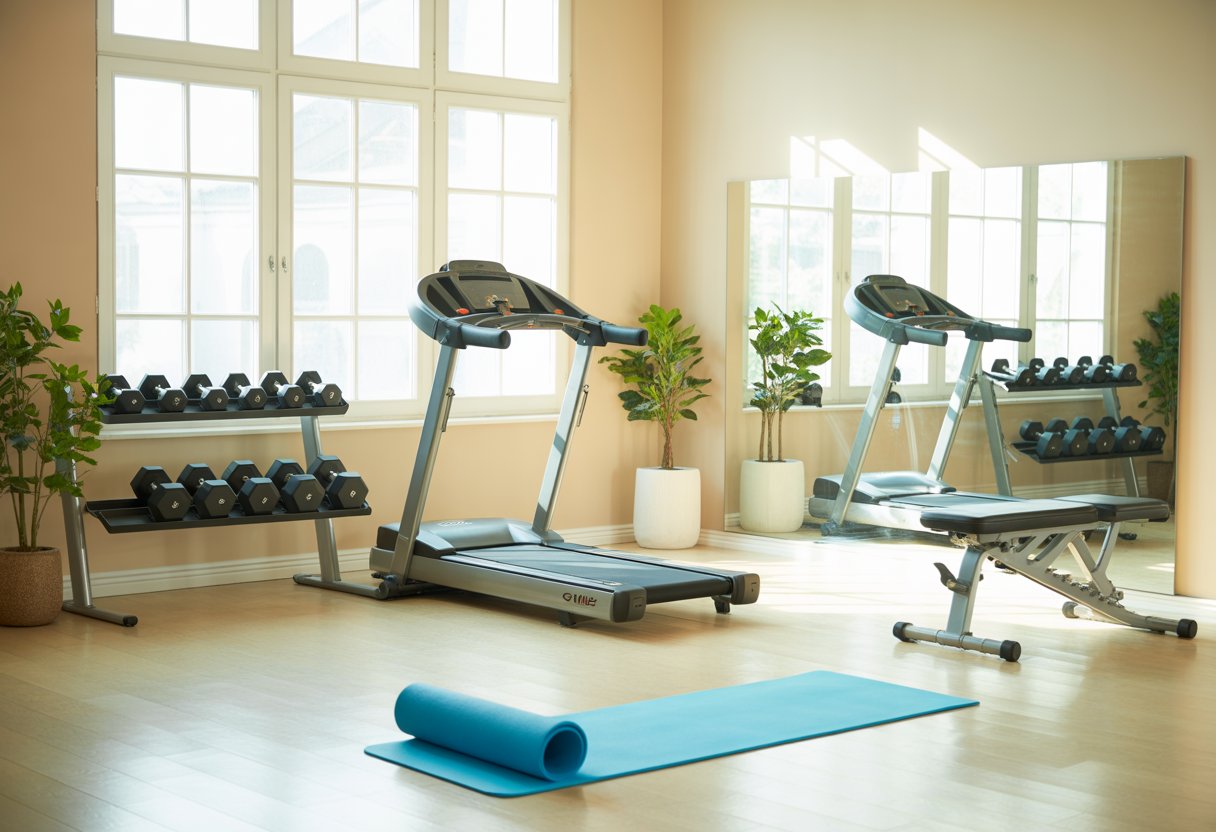
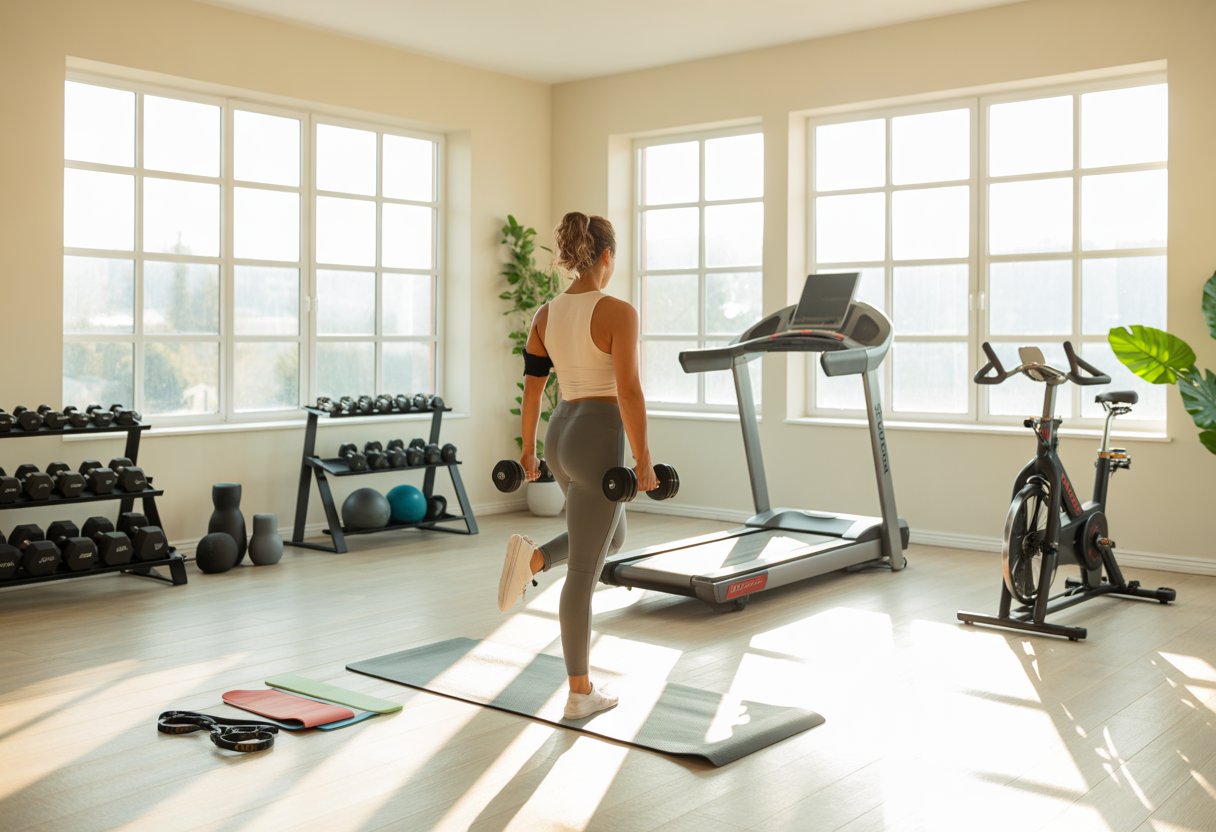
The right space makes working out at home easier and more enjoyable. A good home gym needs enough room for movement, smart storage to keep equipment organized, and the right tools that match your fitness goals and budget.
Choosing the Right Area
Pick a spot with enough space to move freely in all directions. A person needs at least 6 feet by 6 feet for bodyweight training and calisthenics movements like burpees, jumping jacks, and lunges.
Basements, spare bedrooms, and garages work well for home gyms. These areas offer privacy and enough room for equipment. The space should have good lighting so someone can see their form in a mirror. Proper ventilation keeps the area comfortable during intense workouts.
Consider the flooring before starting. Hard surfaces like concrete or wood can hurt joints during high-impact movements. A simple yoga mat costs $20 to $100 and provides cushioning for floor exercises. Rubber flooring tiles protect the floor from dropped weights and reduce noise for neighbors or family members below.
Storage Solutions for Small Spaces
Wall-mounted racks keep resistance bands, jump ropes, and yoga mats off the floor. Hooks and pegboards cost less than $30 and turn unused wall space into organized storage.
Adjustable dumbbells replace multiple weight sets and save significant floor space. These systems range from $180 to $700 but eliminate the need for a full dumbbell rack. One set can replace 10 to 15 individual pairs of weights.
Vertical storage works best in tight areas. A corner of a bedroom can hold a stability ball, foam roller, and resistance bands when stored vertically. Collapsible equipment like resistance tubes and stretching straps fit in drawers or small bins when not in use.
Essential Equipment and Alternatives
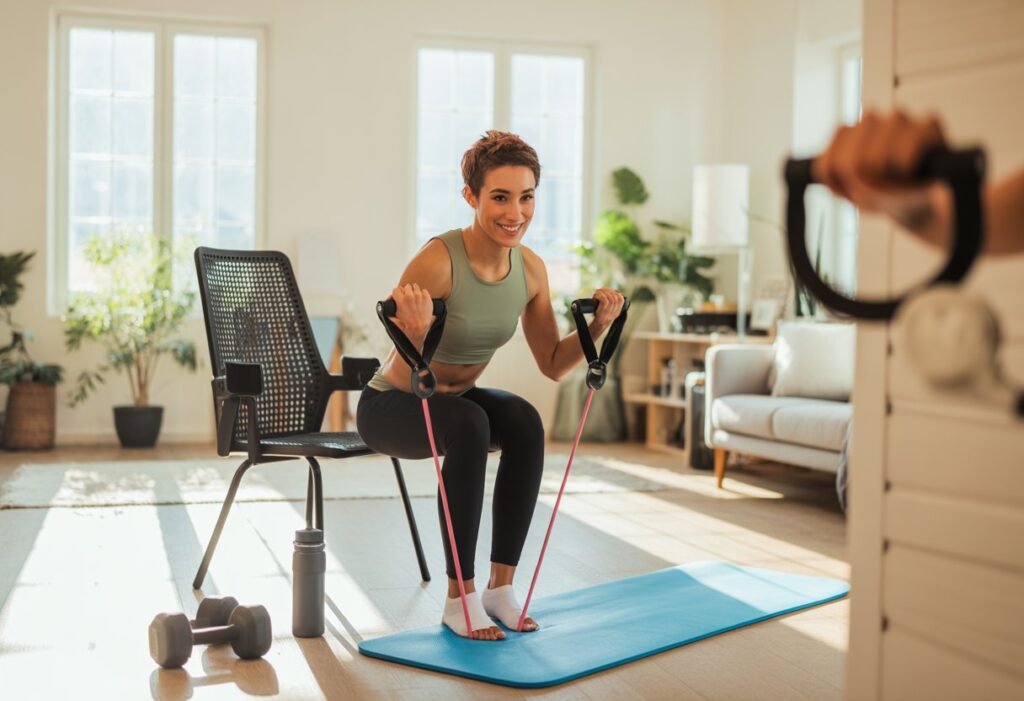
Starting with basic strength and cardio tools costs less than $200[4]. Resistance bands provide different difficulty levels for around $18 and work for both strength training and physical therapy movements. A stability ball at $30 functions as a weight bench and helps with core exercises.
Bodyweight training requires no equipment at all. Push-ups, squats, planks, and lunges build strength using only body resistance. A balance pad adds instability to these movements for $27, engaging more core muscles.
For cardio without machines, a ropeless jump rope costs $10 and burns about 12 calories per minute. Jumping jacks and marching in place provide free alternatives. Someone can complete a full workout using just calisthenics movements and a mat for stretching afterward.
Creating an Effective Home Workout Plan
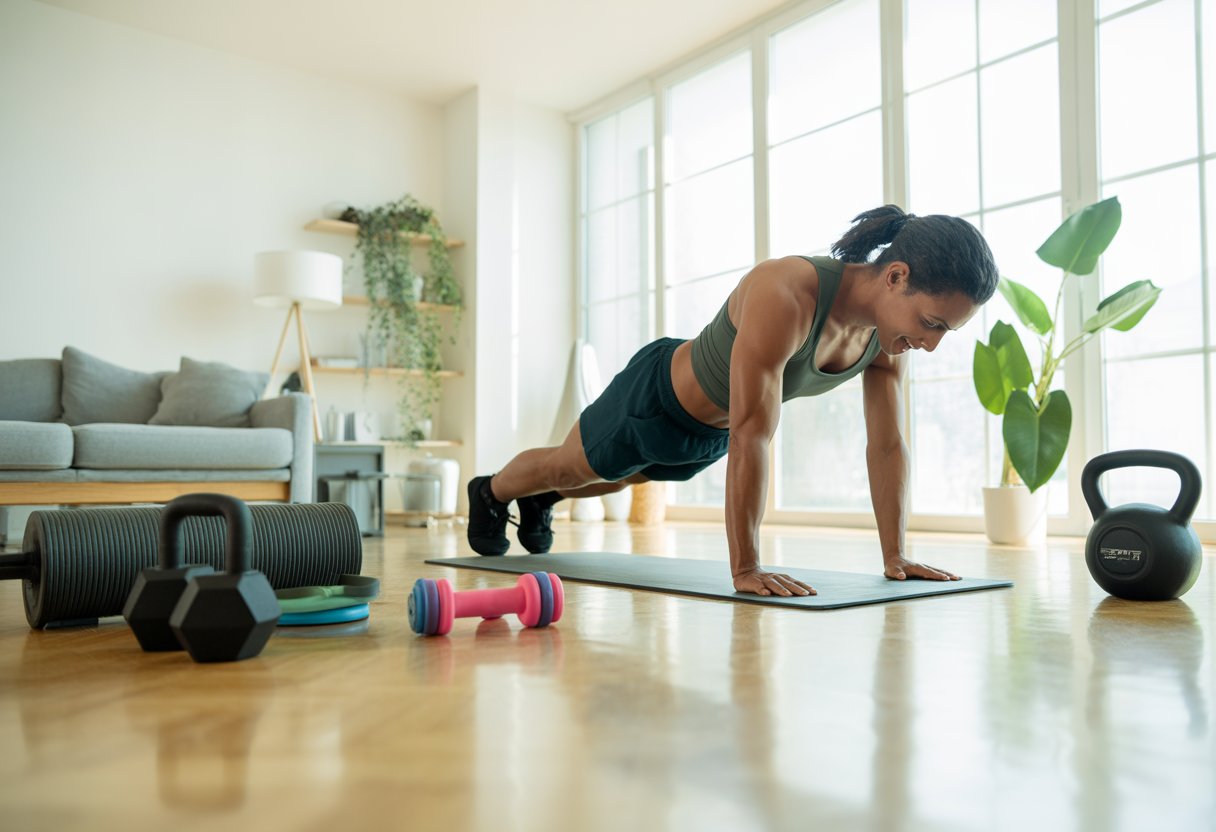
A successful home workout plan requires clear goals, a structured weekly schedule, and a strategy for increasing difficulty over time. These three elements work together to create sustainable progress and prevent plateaus.
Defining Your Goals
The first step in building a home workout routine is deciding what to achieve. Someone focused on fat loss should aim for 15 reps per set with shorter rest periods. A person wanting to build muscle mass should target 8-10 reps per set with heavier resistance.
Different goals require different approaches. Weight loss demands a mix of cardio and strength training with higher rep ranges. Muscle building needs progressive resistance and lower reps. Body recomposition combines both strategies.
Specific goals lead to better results. Instead of “get fit,” a person should aim for “complete 10 push-ups” or “lose 15 pounds in 12 weeks.” This clarity helps when selecting exercises and tracking progress. Combining cardio and strength training[5] creates well-rounded fitness improvements for most people starting their exercise at home journey.
Planning Your Weekly Schedule
A balanced home workout plan typically includes 4-5 training days per week. This allows adequate recovery time between sessions while maintaining consistency.
Sample Weekly Structure:
- Day 1: Upper body strength
- Day 2: Lower body strength
- Day 3: Cardio or active recovery
- Day 4: Full body HIIT
- Day 5: Core and flexibility
- Days 6-7: Rest or light activity
Each workout session should last 30-60 minutes depending on fitness level. A beginner workout might start with 20-30 minutes and gradually extend. Rest days are essential for muscle recovery and growth. Scheduling workouts at the same time each day builds habit and improves adherence rates.
Progression and Adaptation
Exercise progressions prevent plateaus and ensure continuous improvement. A person should increase difficulty every 2-4 weeks to keep challenging their body.
Progressive Overload Methods:
- Add more reps to each set
- Increase resistance or weight
- Reduce rest time between sets
- Perform more challenging exercise variations
- Add an extra set to each exercise
A beginner might start with knee push-ups and progress to standard push-ups, then decline push-ups. Squats can advance from bodyweight to weighted versions. These exercise progressions match growing strength levels. When a person completes all planned sets comfortably for two consecutive workouts, it’s time to increase the challenge. Tracking workouts in a notebook or app makes it easier to identify when progression is needed.
Dynamic Warm-Ups and Safe Stretching
Getting your body ready before exercise raises your body temperature, increases blood flow to your muscles, and reduces injury risk. The right warm-up routine prepares joints and muscles for the work ahead while improving your range of motion.
Dynamic Warm-Up Moves
A dynamic warm-up uses movement-based exercises rather than holding still. These exercises that require movement[6] like arm circles and butt kicks activate the right muscles before lifting or cardio work.
Essential movements include:
- Arm circles – Start small and gradually increase the size
- Leg swings – Front to back and side to side for hip mobility
- Walking lunges – Engage the lower body while moving forward
- High knees – Activate hip flexors and increase heart rate
- Butt kicks – Warm up hamstrings and quadriceps
Trainers recommend dynamic stretching[6] before every workout to prepare muscles for action. The movements should mimic what you plan to do during your session. Spend five to ten minutes on these exercises to get your blood moving and joints ready.
Effective Stretching Techniques
Static stretching works best after exercise when muscles are warm. Holding stretches for 15 to 30 seconds helps improve flexibility over time. Focus on major muscle groups you used during your workout.
Active stretching involves holding positions using muscle strength alone. This approach builds both flexibility and stability. Examples include holding your leg extended in front of you or reaching overhead while standing.
Never bounce during stretches. This can cause small tears in muscle fibers. Instead, ease into each position until you feel mild tension. Breathe normally and relax into the stretch.
Active Recovery Strategies
Active recovery means doing light movement on rest days instead of complete inactivity. This approach keeps blood flowing to muscles and helps reduce soreness. Walking, swimming, or gentle yoga sessions work well for recovery days.
Foam rolling targets tight spots in muscles. Roll slowly over each area for 30 to 60 seconds. This technique helps break up knots and improve blood flow.
Light stretching between workout days maintains the flexibility gains you made. Spend 10 to 15 minutes on easy movements that don’t strain your muscles. This keeps your body ready for the next training session without adding extra stress.
Top Bodyweight Exercises for Home Workouts
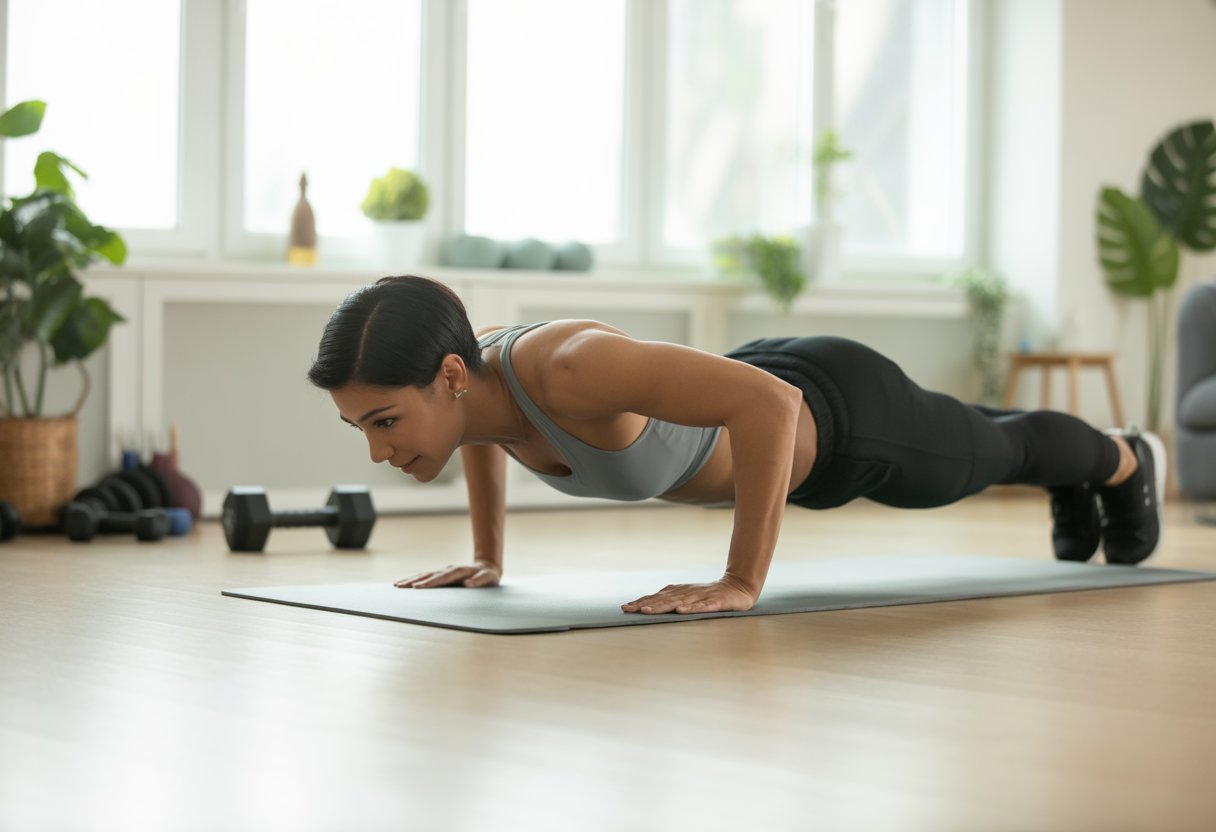
Mastering foundational bodyweight movements builds strength, improves mobility, and creates endless workout possibilities without equipment. These four exercise categories target every major muscle group and scale from beginner to advanced levels.
Bodyweight Squats and Squat Variations
The bodyweight squat forms the foundation of all lower body training. It strengthens the quads, glutes, and hamstrings while improving hip mobility and ankle flexibility. Proper form requires feet shoulder-width apart, chest up, and weight distributed through the entire foot as the hips drop back and down.
Beginners should start with assisted bodyweight squats using a chair or counter for support. Once comfortable, standard bodyweight squats become the go-to movement for building leg strength.
Advanced variations add new challenges. The pistol squat requires balancing on one leg while squatting down, demanding exceptional strength and stability. The Bulgarian split squat elevates the rear foot on a chair or bench, creating intense single-leg work that builds muscle and corrects imbalances. Jump squats add explosive power by launching off the ground at the top of each rep.
Glute bridges complement squats by targeting the posterior chain. Lying face-up with knees bent, lifters drive through their heels to lift their hips toward the ceiling, squeezing the glutes at the top.
Push-Ups and Push-Up Variations
Push-ups build chest, shoulder, and tricep strength while engaging the core for stability. The standard push-up starts in a high plank position with hands slightly wider than shoulder-width, lowering the body until the chest nearly touches the floor, then pressing back up.
Knee push-ups reduce the load for beginners by keeping the knees on the ground. Elevated push-ups with hands on a bench or counter further decrease difficulty. These modifications allow anyone to start building upper body strength regardless of current fitness level.
The diamond push-up[7] positions the hands close together forming a diamond shape, shifting emphasis to the triceps. Wide-grip push-ups place hands farther apart to target the chest more intensely. Decline push-ups elevate the feet on a surface, increasing difficulty by loading more bodyweight onto the upper chest and shoulders.
Pike push-ups prepare athletes for handstand work by creating an inverted V-shape with the hips high and hands and feet on the ground. This variation hammers the shoulders and builds overhead pressing strength.
Lunges and Split Squats
Lunges develop single-leg strength, balance, and coordination while targeting the quads, glutes, and hamstrings. The basic lunge involves stepping forward with one leg, lowering the back knee toward the ground, then driving through the front heel to return to standing.
Elevate Your Health for Just $29.99/Month
Join the Precision Wellness Subscription at My Healing 365 and get discounted services, priority coaching access, virtual care, and exclusive wellness resources to support your physical, emotional, and hormonal health.
Join for $29.99/MonthThe reverse lunge steps backward instead of forward, reducing knee stress and making it easier to maintain balance. Walking lunges move forward with each rep, covering distance while building leg endurance. Split squats hold a static lunge position and perform reps without stepping, concentrating effort on one leg at a time.
Bulgarian split squats elevate the rear foot on a bench 12-24 inches high. This creates a greater range of motion and dramatically increases the load on the front leg. The movement builds serious lower body strength and exposes muscle imbalances that bilateral exercises might hide.
Step-ups on a sturdy box or bench provide another single-leg option. Stepping up and down repeatedly builds quad and glute strength while improving cardiovascular fitness when performed at higher speeds.
Planks and Core Progressions
Planks strengthen the entire core by requiring sustained tension in the abs, obliques, and lower back. The forearm plank starts face-down with forearms on the ground, elbows under shoulders, and body forming a straight line from head to heels. Beginners should hold this plank hold for 20-30 seconds, gradually increasing duration.
The high plank uses straight arms with hands on the ground instead of forearms. Side planks rotate the body 90 degrees, balancing on one forearm while stacking the feet and lifting the hips. This variation targets the obliques and builds lateral core strength.
Plank variations add movement and challenge. Plank shoulder taps involve touching the opposite shoulder while maintaining a stable core. Mountain climbers drive the knees toward the chest in alternating fashion, adding cardio intensity. Plank jacks jump the feet in and out like jumping jacks while holding the plank position.
Crunches and reverse crunches provide direct ab work but should complement planks rather than replace them. Burpees combine multiple movements into one exercise, dropping into a plank, performing a push-up, jumping the feet forward, and exploding upward. This full-body movement builds strength and conditioning simultaneously.
Advanced Movements and Exercise Progressions
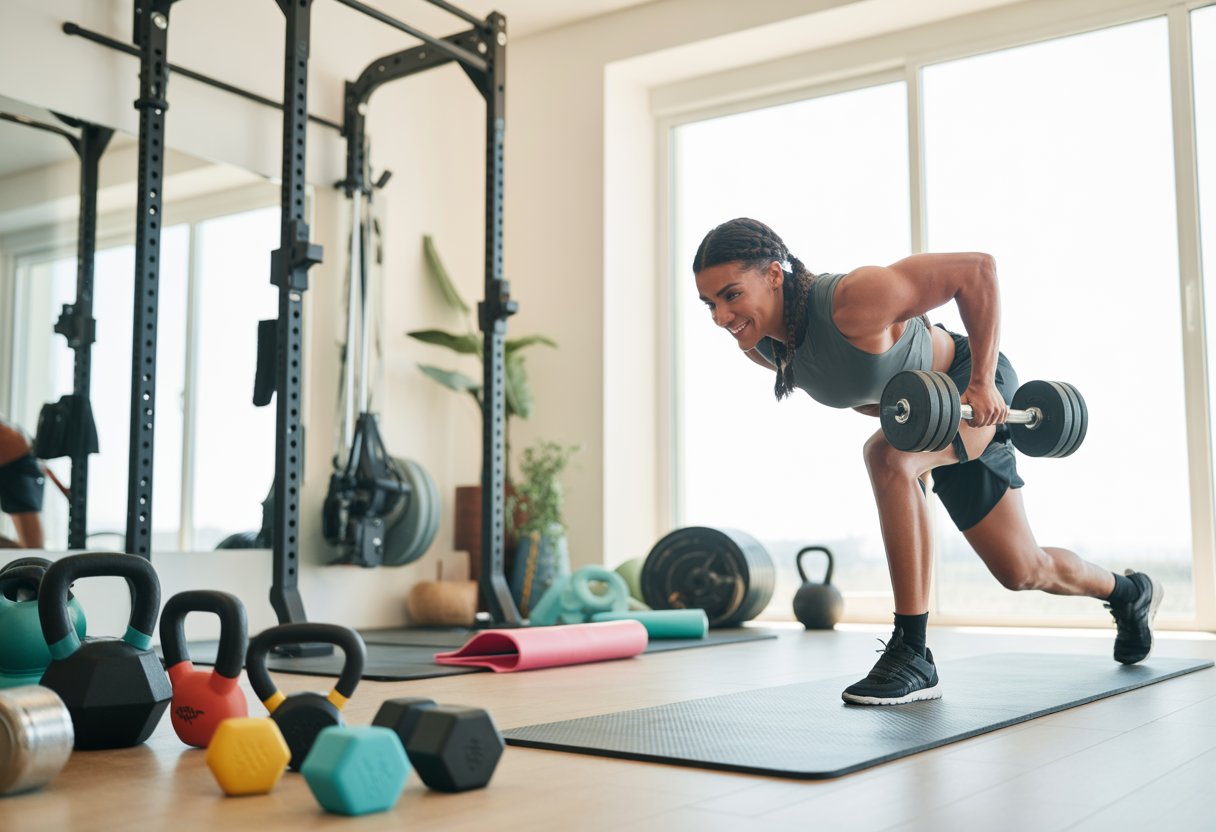
Once basic movements feel manageable, lifters can introduce more complex exercises that demand greater stability, coordination, and strength. These movements create higher mechanical tension and challenge multiple muscle groups simultaneously, supporting continued hypertrophy and overall athletic development.
Overhead Squats at Home
The overhead squat requires exceptional mobility through the shoulders, thoracic spine, and ankles while building strength throughout the entire body. A lifter holds weight overhead with arms locked out while performing a full-depth squat, which forces the core to stabilize against the load above.
Beginners should start with a PVC pipe or broomstick to practice the movement pattern before adding weight. The arms stay active and pushed upward throughout the entire range of motion. The chest remains upright, and the weight tracks directly over the midfoot.
Common issues include limited shoulder mobility and tight hip flexors. Wall-facing overhead squats help correct form by preventing the torso from leaning too far forward. Athletes position themselves a few inches from a wall and squat without letting their knees or face touch it.
This exercise builds muscle growth across the quads, glutes, shoulders, and core while improving balance and body awareness for other compound lifts.
Single-Leg and Unilateral Exercises
Single-leg movements address strength imbalances between limbs and increase core stabilization demands[8] beyond bilateral exercises. Bulgarian split squats, pistol squats, and single-leg deadlifts force each leg to support the full working load independently.
Bulgarian split squats involve placing the rear foot on a bench while the front leg performs the squat. This creates significant mechanical tension in the working leg’s quadriceps and glutes. Pistol squats require holding one leg extended while squatting on the other, demanding both strength and flexibility.
Single-leg deadlifts develop hamstring and glute strength while challenging balance. The lifter hinges at the hip on one leg while the other extends behind for counterbalance. Dumbbells or kettlebells add resistance as strength improves.
These movements also reduce joint stress compared to heavy bilateral lifts while still providing adequate stimulus for hypertrophy.
Combining Strength and Cardio
Circuit training merges resistance exercises with cardiovascular intervals to maximize efficiency in limited workout time. A lifter might perform squats, push-ups, and rows in succession with minimal rest, elevating heart rate while maintaining muscle-building stimulus.
Complexes involve performing multiple exercises with the same piece of equipment without setting it down. A barbell complex could include deadlifts, rows, cleans, presses, and squats for a predetermined number of reps each. This approach builds work capacity and burns calories while preserving strength gains.
Metabolic conditioning workouts like EMOMs (every minute on the minute) or AMRAPs (as many rounds as possible) create structured intensity. These formats push conditioning without sacrificing the mechanical tension needed for muscle growth when exercises are chosen appropriately.
Incorporating Resistance Bands and Household Items
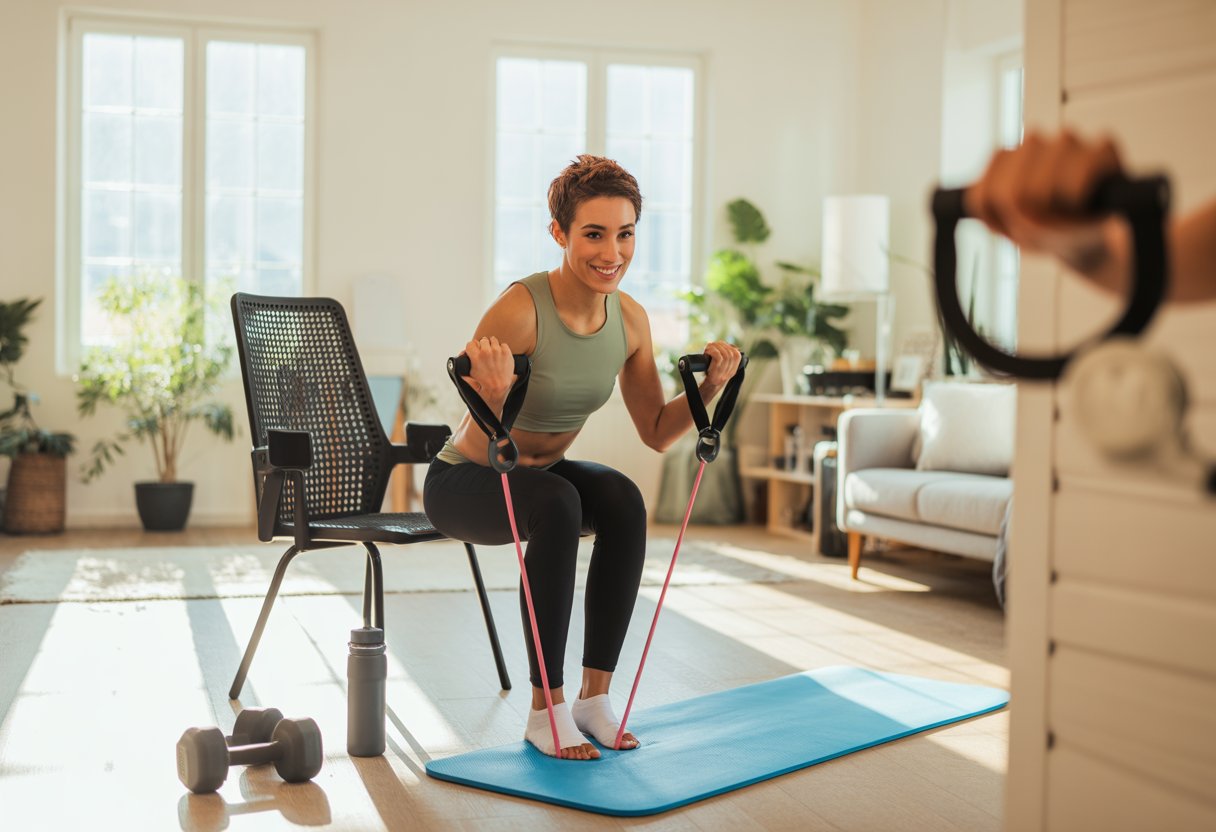
Resistance bands provide variable tension that challenges muscles differently than free weights, while common household objects can replace expensive equipment. These tools work together to create effective full-body workouts without requiring a gym membership.
Utilizing Resistance Bands for Full-Body Training
Resistance bands create accommodating resistance[9] that increases as the band stretches. This means muscles work harder at the end of each movement, unlike dumbbells that become easier near the top of exercises like bicep curls.
A complete band workout should include three movement types: pushing, pulling, and leg exercises. Face pulls target the back and shoulders by anchoring the band at face height and pulling it toward the face with elbows at shoulder level. The Pallof press challenges core stability by resisting rotational forces when extending arms away from the body.
Upper Body Movements:
- Band rows for back development
- Chest flies when anchored behind the body
- Tricep extensions from overhead positions
- Bicep curls standing on the band center
Lower Body Options:
- Lateral walks with mini bands above knees
- Squats with bands around thighs
- Glute bridges with band resistance
Bands fit in any backpack and provide workout options anywhere. They complement bodyweight training by adding external load to movements that might otherwise lack sufficient challenge.
Making Use of Everyday Objects
Household items transform into functional fitness equipment[10] without spending money. Water bottles filled to different levels create adjustable weights for arm exercises. A sturdy chair supports elevated push-ups, tricep dips, and step-ups.
Backpacks loaded with books serve as weighted vests for squats and lunges. Towels work for slider exercises on smooth floors or as grip tools for pulling movements. Stairs provide built-in cardio equipment and platforms for calf raises.
Furniture edges enable incline and decline variations of bodyweight training exercises. A couch or bed frame offers anchor points similar to cable machines when combined with resistance bands.
When and How to Add External Resistance
External resistance becomes necessary when bodyweight training no longer creates muscle fatigue within 12-15 repetitions. Someone completing 20 push-ups easily should add band resistance across the back or elevate feet to increase difficulty.
Start with the lightest resistance band and master proper form before progressing. Poor technique with added load increases injury risk and reduces effectiveness. Each exercise should feel challenging during the last three repetitions while maintaining control.
Add resistance gradually using this progression:
- Perfect bodyweight form for 3 sets of 12 reps
- Introduce light band resistance
- Increase band thickness or tension
- Combine bands with household weights
Progressive overload requires consistent increases in resistance, volume, or difficulty every 2-3 weeks. Track workouts to ensure advancement rather than repeating the same routine indefinitely.
A well-structured home workout plan adapts to current fitness levels and provides clear paths for exercise progression. Starting with basic movements and gradually adding complexity ensures safe development of strength and endurance.
Beginner Home Workout Structure
A beginner workout should focus on fundamental movement patterns that build stability and core strength. The most effective beginner home workouts[11] require no equipment and target large muscle groups.
The foundation includes four essential exercises: push-ups, lunges, squats, and planks. Beginners should aim for 2-3 sets of 10-12 repetitions per exercise. If someone can only complete four to six reps initially, that’s acceptable.
The key is performing each movement until slightly shaky on the final rep without compromising form. Each week, the goal is adding more repetitions until reaching three sets of 12.
Push-ups can start with knees on the floor for support. Lunges may use a wall or chair for balance. Squats should keep feet hip-distance apart with hips sinking back as if sitting in a chair. Planks begin at 15 seconds and progress to 30 seconds, then 90 seconds over time.
Intermediate Circuit Examples
Intermediate training adds resistance and variety to continue building muscle. This level incorporates dumbbells or household items like soup cans as weights.
Effective exercises include biceps curls, lateral raises, triceps dips, bent-over rows, wall squats, and overhead presses. Each movement targets specific muscle groups for balanced development. Biceps curls require standing with feet hip-distance apart while raising and lowering weights by bending at the elbow.
Lateral raises involve lifting straight arms to shoulder height with palms facing inward. Wall squats challenge endurance by holding a seated position against a wall for 20-60 seconds. The overhead press can be performed standing or seated, pressing weights overhead without locking elbows.
Athletes should complete 2-3 sets of 10-12 reps for most exercises. When completing sets becomes easy, it’s time to increase weight or progress to the next level.
Advanced Training Tips for Progress
Advanced training introduces instability and resistance tools to challenge the body further. Strength training exercises at home[12] at this level require resistance bands and an exercise ball.
Stability ball push-ups elevate difficulty by placing the lower body on the ball. Beginners to this exercise start with the ball under knees, then move it toward feet as strength improves. Banded side steps work lateral movement by stepping on a resistance band and moving five steps right, then five steps left for multiple sets.
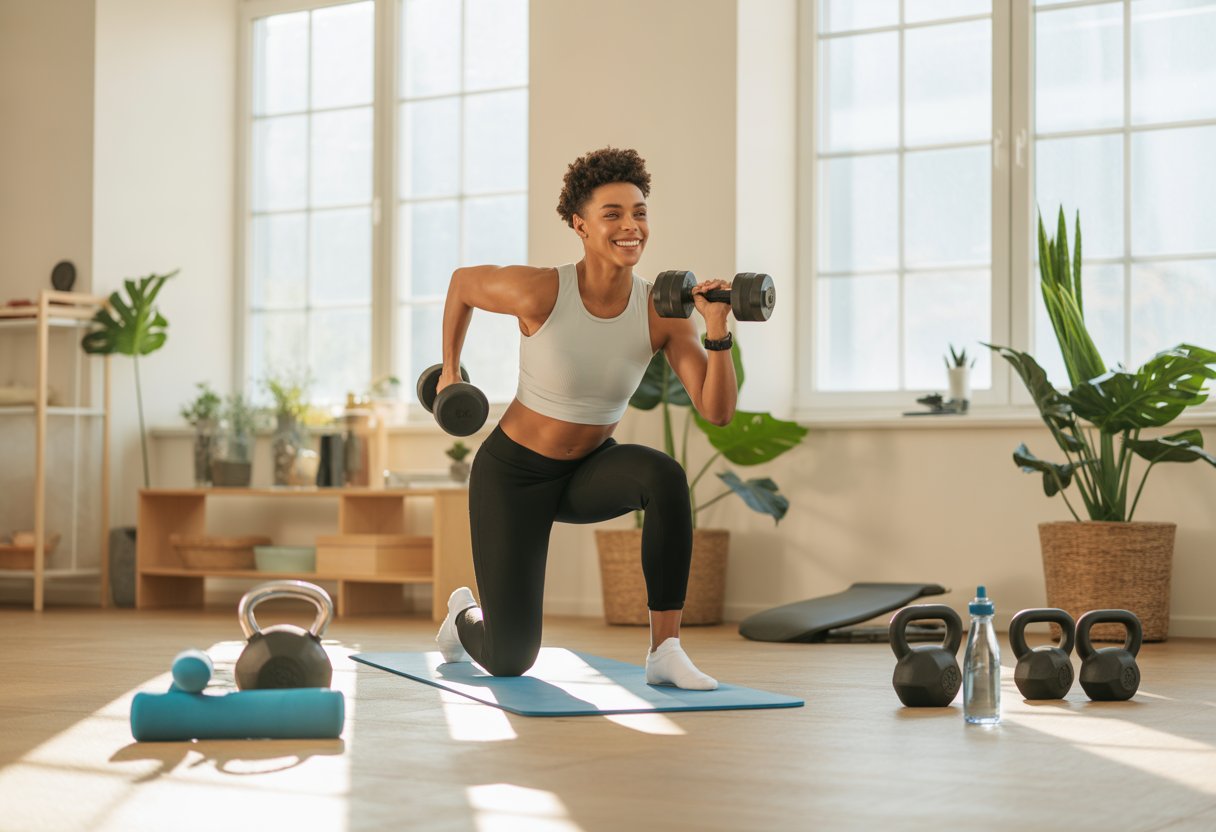
Lunges with overhead extension combine lower body work with shoulder pressing using dumbbells or a medicine ball. Lat pulldowns at home use a resistance band hitched to a door, pulling handles down until elbows press fully to the sides.
Exercise progressions at this level focus on time under tension and control rather than speed. Weight may increase slightly as muscle mass builds, so progress should be measured by how clothes fit and energy levels feel rather than scale numbers alone.
Maximizing Results: Principles for Muscle and Strength Gains
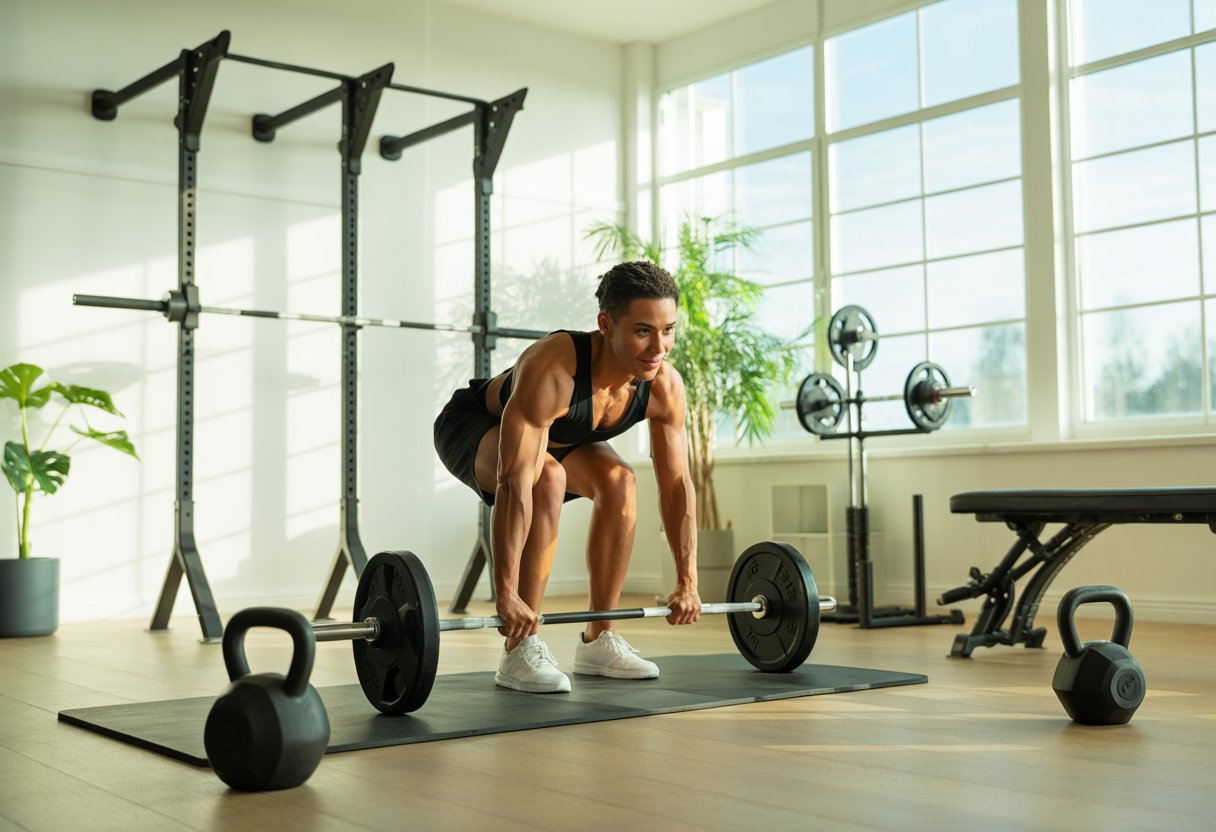
Building muscle at home requires understanding how your muscles actually grow and applying specific techniques that create the right stimulus. The key lies in creating enough mechanical tension and controlling your rep speed to maximize every movement.
Time Under Tension Strategies
Time under tension refers to how long your muscles work during each set. Slower reps keep muscles engaged longer, which drives growth.
A good approach is taking three seconds to lower the weight during each rep. This controlled lowering phase, called the eccentric portion, creates significant muscle damage that leads to growth. Rushing through reps cuts this benefit short.
For bodyweight exercises at home, slowing down becomes even more critical. A pushup that takes six seconds total (three up, three down) provides much more stimulus than a one-second rep. This technique turns simple movements into serious muscle-building workouts[13].
Lifters should aim for 40-70 seconds of total time under tension per set. For example, 10 reps at 5 seconds each hits this range perfectly. Once sets become too easy, adding pauses at the bottom of movements extends tension without needing heavier weights.
Emphasizing Mechanical Tension
Mechanical tension happens when muscles generate force against resistance. This tension signals the body to build new muscle tissue.
The stretched position of any exercise creates the most growth-promoting tension. Research shows that tension in the lengthened position[14] drives more hypertrophy than the contracted position. At home, this means selecting exercises where muscles stretch fully under load.
Deep pushups on handles, Bulgarian split squats, and deficit lunges all maximize this stretched position. The bottom portion is where growth happens most. Someone doing pushups should lower their chest below hand level rather than stopping at parallel.
Full range of motion matters tremendously. Half reps might feel easier, but they waste time. Every rep should move through complete extension and contraction. This approach recruits more muscle fibers and creates superior gains compared to partial movements.
Hypertrophy Techniques Without Equipment
Bodyweight training can build serious muscle when using the right intensity techniques. The challenge is creating enough stimulus without adding weight.
Rest-pause sets work exceptionally well at home. Someone does pushups to failure, rests 15 seconds, then continues for more reps. They repeat this process until hitting their target rep count. This method allows for high total volume with lighter loads.
Drop sets adapt easily to bodyweight work. After failing at regular pushups, immediately switch to knee pushups and continue to failure again. Then finish with wall pushups.
Tempo variations include:
- 3-second eccentric, 1-second pause, 1-second concentric
- 4-second eccentric, explosive concentric
- Isometric holds at the hardest position for 20-30 seconds
Training to failure drives adaptation. The body responds by building new tissue when pushed to its limits. Home workouts demand this intensity since resistance options are limited.
Staying Motivated and Tracking Your Progress
Working out at home requires self-discipline and a clear plan to see results. Success comes from setting achievable targets, creating consistent routines, and monitoring improvements over time.
Setting Realistic Fitness Goals
SMART goals[15] help people stay focused during home workouts. This approach makes objectives specific, measurable, actionable, realistic, and time-bound.
Instead of vague aims like “get stronger,” a person might set a goal to “complete 20 push-ups without stopping by June 1st.” This gives them something concrete to work toward. Breaking down larger ambitions into smaller milestones keeps motivation high.
Someone new to exercise shouldn’t expect to match the performance of experienced athletes. Starting with manageable targets like exercising three times per week for 15 minutes prevents burnout and injury. As fitness improves, they can increase duration, intensity, or frequency.
Writing goals down and placing them somewhere visible serves as a daily reminder. People should celebrate each achievement, no matter how small, and adjust targets as needed based on progress.
Building Healthy Habits
Making a home workout schedule turns exercise into an automatic routine. Morning sessions work well because decision fatigue hasn’t set in yet, and healthy habits become automatic at a higher rate when performed early in the day[15].
Creating a pre-exercise routine helps trigger the habit. This might include changing into workout clothes, filling a water bottle, and setting up equipment in the same order each time. The specific steps matter less than consistency.
Key strategies include:
- Blocking time on a calendar for workouts
- Setting phone reminders to work out at home
- Choosing activities that are genuinely enjoyable
- Starting with just 2-5 minutes if needed
- Avoiding all-or-nothing thinking
Pairing exercise with something enjoyable, like a favorite podcast or show, creates positive associations. Reserving certain entertainment only for workout time provides extra incentive to get moving.
Measuring Improvement at Home
Tracking progress keeps people accountable and shows what’s working. Several tools make monitoring easier:
| Tracking Method | Best For |
|---|---|
| Fitness apps | Recording workouts and calories |
| Notebook | Writing how exercises felt |
| Smartwatch | Monitoring heart rate and steps |
| Progress photos | Seeing physical changes |
| Measurements | Tracking inches lost or gained |
Recording each home workout session helps identify patterns. A person might notice they have more energy on days when they exercise in the morning or that certain movements get easier over time.
Measurements beyond weight matter more for home exercisers. Tracking how many reps they can complete, how long they can hold a plank, or how their clothes fit provides real evidence of improvement. These markers often change before the scale does.
Reviewing progress weekly or monthly allows for adjustments. If gains have stalled, it might be time to increase difficulty or try new exercises. If someone feels constantly exhausted, they may need more recovery time.
Common Challenges and How to Overcome Them
Building a home gym comes with unique obstacles that can slow progress or lead to frustration. Understanding how to handle plateaus, prevent injuries, and work within space constraints helps people maintain effective at-home workouts for the long term.
Dealing with Plateaus and Stagnation
Progress naturally slows when the body adapts to the same routines. People who exercise at home often repeat identical workouts because they lack the variety available at commercial gyms.
Changing one training variable every 4-6 weeks prevents stagnation. Someone can increase resistance, add repetitions, reduce rest periods, or switch exercise variations. A person doing bodyweight squats might progress to goblet squats, then split squats, then Bulgarian split squats.
Progressive overload strategies include:
- Adding 5-10 pounds to exercises weekly
- Increasing workout volume by 10-15% monthly
- Performing exercises with slower tempo
- Reducing rest time between sets
Tracking workouts in a notebook or app reveals when progress stops. This data shows exactly which exercises need adjustment. People should change their routine when they complete the same weight and reps for three consecutive sessions without difficulty.
Staying Safe and Preventing Injuries
Home workouts carry injury risks when people skip proper preparation or use incorrect form. Without trainers nearby to correct mistakes, individuals must take extra precautions.
A 5-10 minute warmup increases blood flow and reduces injury risk. Dynamic stretches like leg swings, arm circles, and bodyweight movements prepare muscles better than static stretching before exercise.
- Check equipment for wear or damage before each session
- Secure weight collars on barbells and dumbbells
- Use safety bars or spotter arms on squat racks
- Maintain clear floor space around exercise areas
- Keep proper form even when fatigued
People should stop exercising if they feel sharp pain, dizziness, or unusual discomfort. Learning correct technique through video tutorials or online coaching prevents bad habits. Starting with lighter weights and mastering form before adding load builds a foundation for safe progression.
Adapting to Limited Space or Equipment
Space constraints force creativity but don’t eliminate effective training options. A 6×6 foot area provides enough room for most home workouts when organized properly.
Space-saving equipment choices:
| Equipment | Space Required | Exercises Available |
|---|---|---|
| Resistance bands | Minimal | 50+ full-body movements |
| Adjustable dumbbells | 2×2 feet | Upper and lower body training |
| Suspension trainer | Door mount | Bodyweight resistance work |
| Foldable bench | 2×5 feet | Pressing and rowing variations |
Vertical storage maximizes floor space. Wall-mounted racks, pegboards, or overhead storage keeps equipment accessible without cluttering workout areas. People can also use furniture like sturdy chairs for dips, step-ups, or elevated push-ups.
Compound movements deliver better results in small spaces than isolation exercises. Squats, push-ups, rows, and lunges work multiple muscle groups simultaneously. Someone with just resistance bands can build strength and muscle by focusing on these fundamental patterns rather than requiring specialized machines.
Frequently Asked Questions
Building muscle at home is possible with bodyweight exercises, and beginners can start with simple routines that require no equipment while learning how to create consistent workout schedules in limited space.
Can I build muscle effectively at home without any equipment?
A person can build muscle at home using only bodyweight exercises. Push-ups, squats, lunges, and planks create enough resistance to stimulate muscle growth, especially for beginners.
Progressive overload remains important even without weights. This means increasing repetitions, slowing down movements, or trying harder variations of exercises over time.
Bodyweight training works best when someone focuses on proper form and pushes their muscles close to failure. Pull-ups and dips become options when using sturdy furniture or installing a doorway bar.
What is a simple full-body workout routine I can do at home as a beginner?
A basic routine includes squats, push-ups, lunges, planks, and glute bridges. These exercises target all major muscle groups in about 20 to 30 minutes.
Beginners should start with 2 to 3 sets of 8 to 12 repetitions for each exercise. Rest for 60 to 90 seconds between sets.
This workout can be performed 3 times per week with at least one rest day between sessions. The body needs recovery time to build strength and avoid injury.
Which no-equipment exercises should I do every day for overall fitness?
Daily movement should focus on different areas to avoid overtraining the same muscles. Light exercises like walking, stretching, and mobility work can be done every day safely.
A rotation system works well for strength exercises. Someone might do upper body push-ups and planks one day, then lower body squats and lunges the next day.
Core exercises like dead bugs and bird dogs can be included most days since the core recovers quickly. Dynamic stretching in the morning and static stretching at night help maintain flexibility.
How can I create a consistent daily at-home workout schedule and stick to it?
Setting a specific time each day makes exercise a habit rather than a decision. Morning workouts often have fewer interruptions than evening sessions.
Convenience ranks as a top reason[1] why people succeed with home workouts since they eliminate travel time to a gym. Starting with just 15 to 20 minutes makes the commitment feel manageable.
Tracking workouts in a calendar or app provides visual proof of progress. Setting out workout clothes the night before removes one more barrier to getting started.
What are the most space-efficient pieces of equipment to start a home workout area?
Resistance bands take up almost no space and provide dozens of exercise options. Starting with a set of resistance bands[16] offers the most important piece of equipment for versatility.
Adjustable dumbbells replace an entire rack of weights while fitting under a bed or in a closet. A yoga mat protects floors and defines the workout space.
A pull-up bar that mounts in a doorway requires no floor space when not in use. These three items create enough variety for years of progressive training in a small area.
How do I stop skipping workouts and stay motivated long term?
Motivation fades, so building systems and habits matters more than relying on willpower. Scheduling workouts like appointments and setting phone reminders creates external accountability.
Finding enjoyable exercises makes consistency easier since people naturally repeat activities they like. Someone who hates running should try dancing, bodyweight circuits, or resistance training instead.
Progress tracking through photos, measurements, or strength gains provides concrete evidence of improvement. Joining online communities or working out with household members adds social support that helps people stick with their routines.
Koala AI – The Best AI Writer and Chatbot
Post Views: 4
References
- How to Create a Home Gym You’ll Use. https://magazine.clevelandclinic.org/2024-fall/how-to-create-a-home-gym-youll-use Accessed April 18, 2026
- How to Build a Home Gym? (Step-By-Step Guide). https://totalshape.com/equipment/how-to-make-a-home-gym/ Accessed April 18, 2026
- Everything You Need to Know About Working Out at Home. https://www.everydayhealth.com/fitness/everything-you-need-to-know-about-working-out-at-home/ Accessed April 18, 2026
- How to Set Up Your Ideal Home Gym. https://www.consumerreports.org/health/exercise-fitness/how-to-set-up-your-ideal-home-gym-a1233110764/ Accessed April 18, 2026
- The Ultimate Home Gym Workout Plan (Perfect for Beginners). https://totalshape.com/equipment/home-gym-workout-plan/ Accessed April 18, 2026
- parade.com. https://parade.com/health/dynamic-stretching Accessed April 18, 2026
- 44 Best Bodyweight Exercises (for Each Muscle Group). https://www.nerdfitness.com/blog/the-42-best-bodyweight-exercises-the-ultimate-guide-for-working-out-anywhere/ Accessed April 18, 2026
- The Complete List of Calisthenics Exercises [Beginner to Advanced]. https://whitecoattrainer.com/blog/bodyweight-training Accessed April 18, 2026
- Resistance bands create accommodating resistance. https://www.menshealth.com/uk/building-muscle/a64630613/resistance-band-workouts/ Accessed April 18, 2026
- Just a moment…. https://rollingout.com/2025/05/11/home-gym-using-what-you-already-have/ Accessed April 18, 2026
- The 10 Best at Home Workouts (No-Equipment!). https://www.nerdfitness.com/blog/the-7-best-at-home-workout-routines-the-ultimate-guide-for-training-without-a-gym/ Accessed April 18, 2026
- Strength training exercises at home. https://www.verywellfit.com/best-home-workouts-3495490/ Accessed April 18, 2026
- muscle-building workouts. https://www.menshealth.com/fitness/a64019050/muscle-building-workout-principles/ Accessed April 18, 2026
- Strength Training 101: Proven Principles, Core Lifts, and Workout Programs To Build Real Strength. https://www.muscleandfitness.com/workouts/workout-tips/strength-training-101-proven-principles-core-lifts-and-workout-programs-to-build-real-strength/ Accessed April 18, 2026
- SMART goals. https://www.verywellhealth.com/exercise-motivation-8773952 Accessed April 18, 2026
- How to build a home gym: from a set of resistance bands to a full gym (and everything in between). https://www.karinainkster.com/post/how-to-build-a-home-gym Accessed April 18, 2026

























