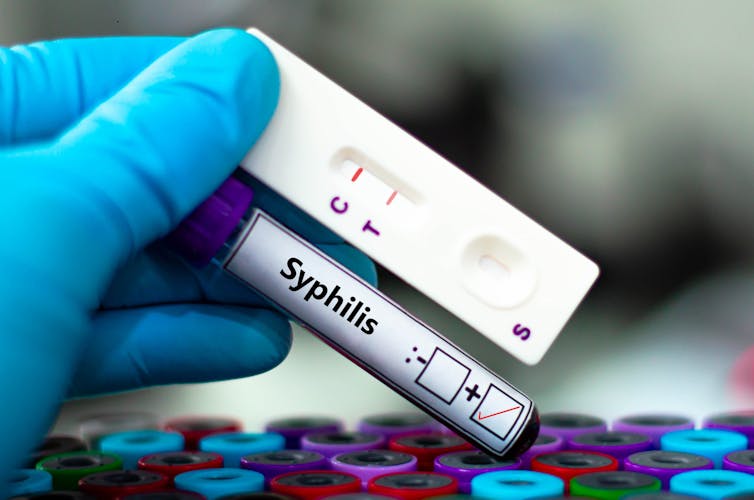
Syphilis is a sexually transmitted infection caused by the bacteria Treponema pallidum.
During pregnancy, this bacteria can pass from a mother with untreated syphilis, known as maternal syphilis, to her child in utero, causing the fetus to contract congenital syphilis.
In January 2026, the U.S. Centers for Disease Control and Prevention reported that the rate of maternal syphilis rose by 28% from 2022 to 2024, from just over 280 to nearly 360 cases per 100,000 births.
I’m a public health researcher and infectious disease nurse practitioner. I study disparities in sexually transmitted infections, or STIs, and I’m currently conducting a study on syphilis in pregnancy.
Table of Contents
A perfect storm of factors behind the rise
Two factors in particular have to be taken into consideration to understand the steep rise in cases.
One is the rise in syphilis cases in the general population – which naturally leads to an increase in maternal syphilis – and the other is the specific variables such as funding and access to care barriers that affect pregnant women when it comes to the spread of this disease.
The overall trend of increasing syphilis rates is the result of what I would describe as a perfect storm of factors, from lack of funding to COVID-19. The rate of syphilis infections in the U.S. has been steadily increasing since 2000.
In 2018, there was a sharp increase in this rate, as the group predominantly affected by this STI shifted from men who have sex with men to the general population of both men and women.
This shift caused an increase in rates of maternal syphilis, which has led to a 700% increase in congenital syphilis cases since 2015.
Public health funding for all sexually transmitted infections, excluding HIV, has been stagnant for decades, at about US$160 million annually. When accounting for inflation and rising costs, this has resulted in a 40% reduction in spending power today.
Unfortunately, each year Congress suggests cutting funding to both STI and healthcare access programs. These cuts have largely not been implemented in the final appropriations packages.
But each year, further steep cuts are proposed. The 2026 appropriations recommend combining three programs – HIV, STI and tuberculosis – and cutting $70 million from the combined programs.

Kitsawet Saethao/iStock via Getty Images Plus
On top of this funding shortfall, the COVID-19 pandemic exacerbated many of the underlying barriers to healthcare access that allowed the steadily increasing syphilis rates to increase faster. During the pandemic, safety-net clinic staffing and hours were reduced, which limited the availability of screening and treatment services.
Another factor driving the increase in syphilis cases has been a change in sexual behaviors over the past 25 years. During the early days of the HIV epidemic in the 1980s, sexual behaviors that led to HIV rapidly changed, leading to safer sex habits. However, by the early 2000s, improved HIV treatments meant that HIV was no longer a death sentence, but a manageable chronic condition.
While this was, of course, good news, it also meant that safer sexual behaviors began to decline, resulting in increased chances of exposure to HIV and other STIs, including syphilis.
The role of stigma
Social stigma and biases from both healthcare providers and patients themselves can affect whether someone gets tested or seeks treatment for symptoms.
While this affects all patients, it is particularly problematic for pregnant patients. Pregnant people are supposed to be screened for syphilis in the first and third trimesters. But a healthcare provider may assume it’s unnecessary to ask questions about a patient’s sexual behaviors or to order the necessary tests, especially in the case of longtime patients known to be in monogamous relationships.
Furthermore, the patient may hesitate to admit to risky sexual behaviors, or may not realize they have been exposed through a partner’s infidelity.
Barriers to care
Another driver of the increase in maternal syphilis is the difficulty in accessing prenatal care: 1 in 4 pregnant people do not have access to prenatal care in their first trimester.
Barriers to accessing healthcare vary based on race and ethnicity, availability of transportation, economic status, rural or urban location and insurance status. Most of these factors exist across all health conditions, but for pregnancy, insurance status offers a particular obstacle. Pregnancy is a qualifier for enrolling in Medicaid if income requirements are met. However, this enrollment can sometimes take months, and some prenatal care clinics will not see patients until coverage is approved.
This means patients are beyond the first trimester before their syphilis screening is done. But that first-trimester screening and intervention has the greatest potential to reduce the risk of congenital syphilis
Knowing the symptoms
Syphilis is characterized by different symptoms in each of the four stages of the disease. During the primary stage, within a few days to a few weeks of infection, most patients develop a painless ulcer at the site of exposure. This sore may go unnoticed and resolve on its own. However, the infection remains.
The secondary stage occurs 3 to 6 months after exposure. Patients commonly have flu-like symptoms, possibly some weight loss, swollen lymph nodes and a rash that covers the chest and back. This rash doesn’t itch, and it can spread to the palms of the hands or soles of the feet. Other symptoms include hair loss, mouth lesions, hearing loss and vision changes, but these symptoms may not all appear. This phase typically lasts a few weeks and then resolves with or without treatment.
The disease then enters the latent phase, when the bacteria can still be active in the body without causing acute symptoms and can last for decades.
Finally, 40% to 60% of patients with untreated syphilis will progress to a tertiary phase of the disease that can lead to any number of negative outcomes, including seizures, heart defects, bone growths, skin growths, confusion and dementia.
Transmission and treatments
The syphilis bacteria can spread easily through the placenta as part of the shared blood supply between mother and fetus. This is more likely to happen within the first year that a person is infected with syphilis, although the syphilis bacteria can spread to a fetus at any stage of infection, causing the unborn baby to develop what’s known as congenital syphilis.
Elevate Your Health for Just $29.99/Month
Join the Precision Wellness Subscription at My Healing 365 and get discounted services, priority coaching access, virtual care, and exclusive wellness resources to support your physical, emotional, and hormonal health.
Join for $29.99/MonthCongenital syphilis can result in a range of negative outcomes, the most serious of which is miscarriage or stillbirth. If the fetus survives, long-term developmental delays, blindness, hearing loss, permanent teeth and bone malformation, heart defects and rashes can occur. Symptoms of congenital syphilis can happen immediately at birth, or they may not be recognized until the child is over 2 years old, when molars erupt, or as bones grow and the changes become more pronounced.
Congenital syphilis is treatable with antibiotics, which will stop progression of the disease but cannot reverse any negative outcomes that have already occurred.
Luckily, syphilis is easily treated with antibiotics such as a long-acting penicillin injection into a muscle. Unfortunately, the long-acting intramuscular injection is in short supply. But anyone who is not pregnant and does not have neurological symptoms – which require intravenous penicillin – can be cured with a course of another antibiotic, doxycycline, for 14-28 days.
Preventing maternal syphilis
The mainstay of prevention is to use a condom when sexually active, or to ensure sexual partners have tested negative for all sexually transmitted infections and are exclusively having sex with each other. In some cases, a person might take doxycycline post-exposure prophylaxis, also called doxy PEP, within 72 hours of sexual activity to prevent syphilis, similar to the way Plan B can be taken to prevent pregnancy.
The most effective prevention method for congenital syphilis is universal screening of all pregnancies at three points: during the first trimester, the third trimester and at delivery.
However, some published studies and a paper currently under review show that only 80% to 90% of pregnancies with private healthcare insurance and [56% to 90% of those on Medicaid] are screened for syphilis at least one time during the entire pregnancy.

























