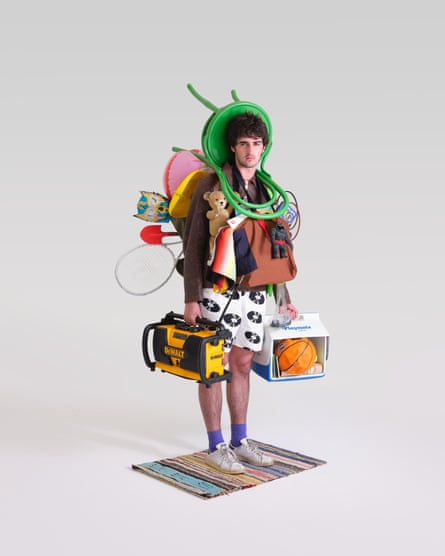
Most of us have a complicated relationship with our stuff. There’s the endless collection of chargers and wires, the overflowing “everything drawer” in the kitchen, the tote bag of tote bags. Clutter is not a character flaw. It is, more often than not, a conversation your home is having with you about something deeper.
As an integrative therapist, I regularly hear that conversation. Clutter rarely arrives as just a tidying problem. It carries anxiety, grief, identity, shame and transition. Understanding what lies beneath is often the first step to being free of it.
The first thing to establish: clutter is not hoarding. “With hoarding, you have a lot of depth,” says Dr Joseph Ferrari, a psychologist at DePaul University who has spent decades studying clutter. “Toilet paper, toilet paper, toilet paper – it’s deep. With clutter, its breadth. It’s a lot of different stuff all over the place. So while hoarders are clutterers, clutterers are not necessarily hoarders.” Hoarding disorder is a clinical diagnosis. Most of us sit somewhere in the vast, ordinary middle ground.
That distinction matters because our homes function, just about, but carry an undertone of unease. A stack of post you will “deal with later”. A wardrobe full of clothes that do not fit your body or your life any more. As homes shrink while being asked to do more, the pressure intensifies: the living room becomes a home office, a homework station, a gym. Clutter stops being cosmetic; it becomes logistical.
Table of Contents
When does it become a problem?
Ferrari and his collaborator Dr Catherine Roster, marketing professor at the University of New Mexico, define clutter as “an overabundance of possessions that creates a chaotic and disorganised living space”. But, as professional organiser and researcher Caroline Rogers adds: “My clutter is not yours.” Two homes can look similarly full and yet feel entirely different to the people inside them.
Ferrari’s Clutter Quality of Life Scale offers a practical measure: does it affect the livability of your space? The dining table is never used because it is buried under papers, books and items without a home. Does it cause emotional distress? The low-grade anxiety of a home you are embarrassed for others to see. Does it strain your relationships or finances? The arguments over the mess, the late-payment charges from mislaying bills. Clutter becomes a problem when it starts shrinking your life. The research agrees: a 2021 study by Rogers and Dr Rona Hart, associate professor in psychology at the University of Sussex, found clutter to be one of the strongest predictors of reduced wellbeing.
Why we hold on
Clutter is rarely one thing. In my work as an integrative therapist and in my research for this piece, the same drivers keep coming up. Recognising your own pattern is the beginning of changing it.
Elevate Your Health for Just $29.99/Month
Join the Precision Wellness Subscription at My Healing 365 and get discounted services, priority coaching access, virtual care, and exclusive wellness resources to support your physical, emotional, and hormonal health.
Join for $29.99/MonthGrief and held memory
Keeping a loved one’s belongings is one of the most universal forms of clutter, and one of the most tender. The object is not the point; the connection is. To throw away a parent’s favourite mug can feel, at a visceral level, like throwing away the parent. Children’s clothes held long past their usefulness, clothes bought for babies who never made it into our lives: these objects carry loss not only of a person but of futures we had imagined.
“In our industry, we talk a lot about hidden grief,” says Rogers. She has watched people cling to what looks like rubbish: an old backpack that is actually a talisman from a Himalayan trek they took in their 20s, when their limbs worked differently. The fear is not of mess; it is of erasure. As she puts it: “If I get rid of this thing, does it mean that bit of my life is no longer true?” It does not. The memory lives in you, not in the object.
Nadia Vidal, a counsellor at Hoarding UK, frames it simply: letting go of a loved one’s belongings is part of the mourning process; by its nature, mourning cannot be rushed.
Sentimentality
This is, in Jenn Jordan’s experience, the single biggest driver of clutter. Jordan, the founder of the professional organising practice Orjenise, sees it everywhere. “The more sentimental someone is, the more stuff they will have.” Birthday cards are the classic example: each one feels harmless until you have boxes of them. “We tell ourselves we are keeping love,” Jordan says. “Sometimes we are just keeping paper.” The goal is not to stop feeling sentimental, but to ask whether you need every physical token to honour it.
Procrastination and avoidance
Ferrari is direct: procrastination has “nothing to do with laziness, nothing to do with bad time management”. At its core, it is about avoidance, and avoidance is about emotion. Sometimes clutter accumulates when we delay. Sometimes it then triggers more delay, because every pile is a reminder of something unfinished, which creates overwhelm, which creates more avoidance. Jordan calls the usual response “tickle the top”: a quick surface tidy, a bag by the door that stays there for weeks. Tidying rearranges what exists. Decluttering requires something different: the emotional labour of actually deciding what stays and what goes.
Ancestry
Some clutter comes from ancestry. In my own life and client work, I see how migration, class and generational scarcity shape what people keep and why. If things were hard to come by when you were growing up, or if your family survived displacement or war, holding on is not a habit, it’s an inheritance. The object becomes insurance. This helps explain why the minimalist aesthetic can feel actively shaming in certain communities: it is a standard built by those who have always had the luxury of assuming they could replace what they lost. The goal for families who have experienced hardship was never a showroom; it’s security.
Identity
Jordan identifies three common patterns: the “aspirational self” keeps gym equipment and untouched language course textbooks, proof of who we intend to become; the “sunk-cost self” holds on because too much money was spent; and the “nostalgic self” holds on to what Jordan calls “spirit tokens”, objects kept as proof of a former self. Men and CD collections are her go-to example. The Radiohead album isn’t really about music; it is about the person who knew about Radiohead before everyone else.
Underneath the spirit token is the fear of losing a self you once recognised. That is not trivial. But awareness of it creates a choice: do you want to keep living in a museum of who you were, or make room for who you are?
The shame of clutter
One reason clutter stays stuck is shame, and the pressure to maintain a perfect home, amplified by social media, falls disproportionately on women. Yet Ferrari’s research shows no significant gender difference in clutter itself. The gap is in how it is labelled. “Women have ‘clutter’. With men, it’s their ‘toys’. It’s their ‘stuff’.” Secrecy allows shame to thrive. It is why people blur their Zoom backgrounds or say “I’m just really busy” instead of “I’m stuck”. Understanding that your clutter is connected to something real, whether loss, identity, anxiety or history, is not an excuse to stay stuck. It is the compassionate starting point for change.
If you live with someone whose clutter overwhelms you, Ferrari’s research offers a useful caution: pressure backfires. The moment a choice becomes a demand, resistance kicks in. Tell someone to get rid of their stuff and you are no longer talking about clutter; you are threatening their sense of control over their own life. Vidal, who sees this at the acute end, is clear: lasting change has to come from within. Force might clear a room, but without getting to the root, the pattern repeats.
So what actually helps?
Rogers asks clients: what do you want to do in this room? How do you want to feel? Without clarity on that, every object feels equally important and decisions become impossible. Jordan warns that lots of plastic boxes are not the answer. Storage is not a cure; it is a prettier delay.
Often people need to narrate an object before they can release it: to say what it meant, who it came from and what chapter of life it represents. A client kept a cup that their mother had drunk from every day, dusty, tucked in a corner, never used. Telling the story of it, saying out loud what it held, was the thing that made letting go imaginable. “Sometimes telling the story is enough,” as both Rogers and Vidal independently told me. Once the meaning is witnessed and honoured, the stuff can go. The love, the memory: those travel with you.
The difficulty of letting go is not just emotional. It is physical, too. There is a reason retailers want you to touch the merchandise: consumer psychology shows that physical contact with an object increases your sense of ownership and attachment to it. The same mechanism works in reverse when you are trying to let go. Ferrari advises getting someone else to hold the item while you make the decision. Remove the touch and you remove the memory loop it triggers.
When the emotional roots run deeper, through unprocessed grief, anxiety that feels unmanageable or a nagging sense that no amount of clearing ever quite relieves the weight, therapy can help. A counsellor can offer space to explore the attachments that decluttering alone cannot touch. For practical support, the Association of Professional Declutterers & Organisers connects people in the UK with accredited professionals who focus on chronic disorganisation, not aesthetic tidying.
A different question to ask
Sentimentality, love, loyalty to a former self: these are not weaknesses. The goal is to stop outsourcing those feelings to the things piling up around us. To honour what something meant and then imagine it going to someone who will use it, need it, love it – that is not loss, it is generosity.
Rogers calls this tenderness: a refusal to reduce a person to their clutter. The question to start with is not “Why can’t I just get rid of it?” It is “What am I really holding on to?”