Disclosure: This site contains some affiliate links. We might receive a small commission at no additional cost to you.
Medically Reviewed
Dr. Jose Rossello, MD, PhD, MHCM
Preventive Medicine & Public Health Specialist
Last Reviewed: May 28, 2026
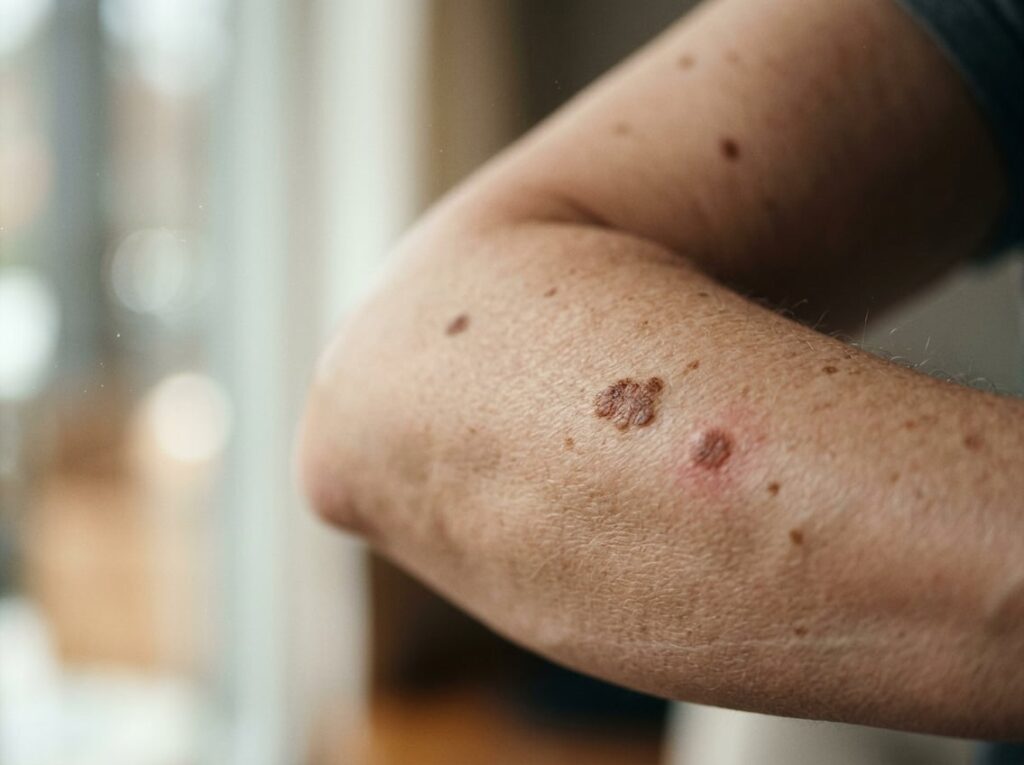
Most moles and skin spots are entirely harmless, but some change over time in ways that make a professional evaluation worthwhile. Knowing what features to pay attention to—and what to ask your clinician or dermatologist—can help you approach skin changes with useful awareness rather than either panic or dismissal. This article explains the landscape of skin spots in plain terms, what the American Academy of Dermatology and American Cancer Society recommend, and the questions worth raising at your next appointment.
Table of Contents
What Changing Skin Spots Are in Plain Language
The skin continuously regenerates, and many people develop new spots over a lifetime—sunspots (also called solar lentigines), seborrheic keratoses, dermatofibromas, and ordinary moles (nevi) are all very common and typically benign. The clinical concern arises when a spot exhibits features that distinguish it from a stable, harmless lesion.
Melanoma is the most serious form of skin cancer. While less common than basal cell and squamous cell carcinomas, it carries a higher risk of spreading to other parts of the body if not caught early. The American Academy of Dermatology (AAD)[1] notes that most moles are harmless, but the ABCDE rule provides an educational framework for recognizing features associated with melanoma. Critically, the ABCDE rule is a tool for awareness and prompting conversation with a clinician—it is not a self-diagnostic checklist, and a dermatologist’s evaluation is necessary for any definitive assessment.
Basal cell and squamous cell carcinomas—the more common, less aggressive skin cancers—often appear as persistent sores that do not heal, rough or scaly patches, or raised growths, usually in sun-exposed areas.
Why It Matters: What Guidelines Say
The AAD is the leading professional body for dermatology in the United States. It urges everyone to examine their skin regularly[2] and to seek evaluation for any new, changing, or unusual spots. The AAD’s free skin cancer check program has conducted more than 2.9 million skin checks since 1985, detecting more than 33,700 suspected melanomas.
The American Cancer Society (ACS)[3] does not have a formal skin cancer screening guideline for the general population but notes that regular skin self-exams and clinician exams are especially important for people at higher risk, including those with prior skin cancer, many moles, fair skin, or a strong family history.
The USPSTF has not issued a recommendation for routine skin cancer screening in asymptomatic adults, but notes that evidence for the benefit of clinician screening is still being evaluated.
The core message across these bodies is consistent: pay attention to changes, know your skin’s baseline, and see a dermatologist promptly for spots that concern you—particularly if they evolve quickly.
Common Drivers and Causes at the Population Level
Not all changing skin spots are caused by cancer. Many are benign, but the following factors are known to increase the risk of skin cancer at the population level:
Ultraviolet (UV) light exposure: Cumulative sun exposure over a lifetime and episodes of severe sunburns—especially in childhood—are the strongest modifiable risk factors for melanoma and other skin cancers.
Indoor tanning: The use of tanning beds is associated with significantly elevated melanoma risk.
Fair skin, light hair, and light eyes: These characteristics correlate with greater UV sensitivity and higher melanoma risk.
Number and type of moles: Having more than 50 ordinary moles, or having atypical (dysplastic) moles, increases melanoma risk. Atypical moles are larger, irregularly shaped, and may have uneven color.
Family history: Approximately 10% of people with melanoma have a family history of the disease, according to the ACS[3]. First-degree relatives with melanoma substantially raise personal risk.
Personal history of skin cancer: Having had melanoma or another skin cancer previously increases the likelihood of a subsequent occurrence.
Immune suppression: People with weakened immune systems due to medications or medical conditions face higher skin cancer risk.
Male sex over 50: The AAD notes[4] that men over 50 have an increased risk of developing melanoma compared to the general population.
What Follow-Up Evaluation May Be Considered
This section is general education only. Decisions about evaluation depend entirely on your clinician’s assessment of your individual history and skin findings.
When you see a dermatologist or primary care clinician for a changing skin spot, they will typically:
- Ask about when you first noticed the spot, how it has changed, and whether it itches, bleeds, or has crusted
- Ask about your sun exposure history, tanning bed use, personal and family history of skin cancer, and any relevant medications
- Examine the spot visually and assess its size, shape, border, and color variation
- Use a dermoscope (a handheld instrument that provides magnified, illuminated visualization beneath the skin surface) for more detailed assessment
- Examine nearby lymph nodes if there is concern about spread
If a spot appears suspicious after clinical and dermoscopic evaluation, a skin biopsy may be recommended—this is the only way to obtain a definitive diagnosis. A biopsy involves removing a small sample of tissue for laboratory analysis under a microscope.
Many spots that look concerning clinically turn out to be benign under pathology. Conversely, some melanomas can look innocuous to the naked eye, which is one reason professional evaluation matters.
Regular full-body skin exams by a board-certified dermatologist are recommended by the AAD for people at elevated risk—though practices vary by individual risk level.
Lifestyle and Prevention Factors the Evidence Supports
Primary prevention of skin cancer centers on reducing UV exposure:
- Sun protection: Broad-spectrum sunscreen with SPF 30 or higher, applied generously and reapplied every two hours during outdoor activity, is the most widely recommended sun protection measure.
- Protective clothing, hats, and shade: Physical barriers—long sleeves, wide-brimmed hats, and seeking shade during peak UV hours (typically 10 a.m. to 4 p.m.)—reduce UV exposure.
- Avoiding tanning beds: Indoor UV tanning significantly raises melanoma risk, particularly with use before age 35.
- Regular skin self-exams: The AAD provides a body mole map to help track spots over time. Knowing what is normal on your skin makes changes more noticeable.
- Dermatologist exams: People at elevated risk benefit from regular professional skin exams on a schedule determined with their clinician.
At the population level, consistent sun protection starting in childhood and sustained across the lifespan is associated with reduced skin cancer incidence.
The ABCDE Rule: An Educational Framework
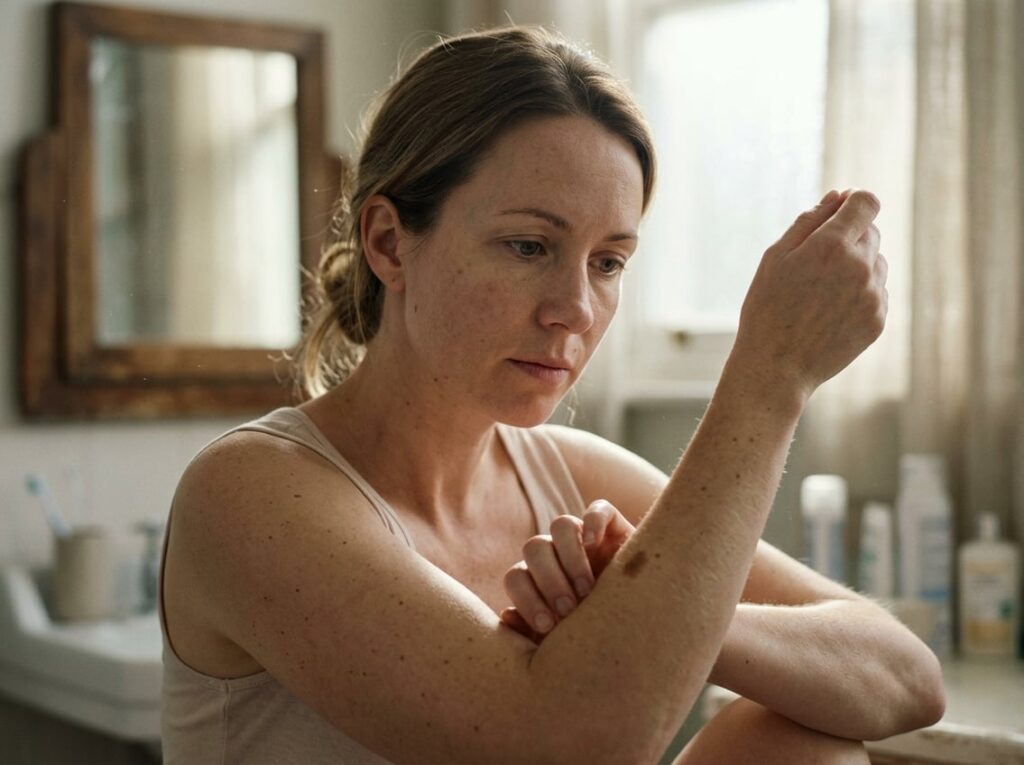
The AAD’s ABCDE rule[1] is an educational tool intended to help individuals recognize features that may warrant clinician evaluation. It is not a diagnostic checklist—a dermatologist assesses many factors beyond these five letters.
- A – Asymmetry: One half of the spot does not match the other half.
- B – Border: The edges are irregular, ragged, or poorly defined.
- C – Color: The spot has multiple colors or shades within it—tan, brown, black, white, red, or blue.
- D – Diameter: Melanomas are often larger than 6 millimeters (about the size of a pencil eraser) when diagnosed, though they can be smaller.
- E – Evolving: Any spot that is changing in size, shape, color, or texture—or developing new symptoms such as itching or bleeding.
The “E” for evolving is often considered the most important feature: a spot that is clearly changing deserves prompt evaluation regardless of whether it meets the other criteria.
Cleveland Clinic’s patient education on the ABCDEs[5] notes: “If you notice any of the ABCDEs of skin cancer, call your provider right away. An early diagnosis and treatment improve outcomes.”
Questions to Bring to Your Appointment
Choose the questions most relevant to your situation:
- Is this spot something I should have biopsied, or does it look clinically benign?
- Does this spot meet any of the ABCDE criteria that concern you?
- What characteristics are you looking for when deciding whether to biopsy?
- Based on my skin type, mole count, and sun exposure history, am I at elevated risk for melanoma?
- How often should I have a full-body skin check given my risk level?
- Should I take photos of spots I’m watching so we can track changes over time?
- What would prompt an urgent referral to a dermatologist?
- Are there spots elsewhere on my body that you noticed during the exam that I should monitor?
- What does a biopsy involve, and how long does it take to get results?
- What changes in my lifestyle around sun exposure are most evidence-supported for skin cancer prevention?
- How do I perform a skin self-exam effectively at home?
- If a spot turns out to be melanoma, what would the next steps generally involve?
Red Flags Warranting Prompter Follow-Up
While most new skin spots are benign and can be evaluated at a routine appointment, certain features deserve timelier attention:
- A spot that is bleeding, oozing, or crusting without injury
- A sore that has not healed over several weeks
- A spot that has grown noticeably in a short period—weeks rather than months
- Rapid color changes, especially darkening or development of multiple colors in a single lesion
- A pink or red raised growth, particularly in a sun-exposed area, that has appeared over weeks
- Any lesion that concerns you significantly, especially if you have prior personal or family history of melanoma
Do not wait for your annual appointment if a spot is changing rapidly—earlier evaluation is always an option.
Key Takeaways
- Most changing skin spots are benign, but some require evaluation; distinguishing between them requires professional assessment.
- The AAD’s ABCDE rule is an educational framework to help identify spots worth showing a clinician—it is not a self-diagnostic tool.
- The “E” for evolving is often the most important criterion: any spot that is clearly changing deserves evaluation.
- Risk factors for melanoma include UV exposure, tanning bed use, fair skin, many or atypical moles, family history, and prior skin cancer.
- Sun protection—sunscreen, protective clothing, and avoiding tanning beds—is the primary evidence-based prevention strategy.
- A dermatologist evaluation including dermoscopy is the appropriate path for any spot that raises concern; biopsy is the only way to obtain a definitive diagnosis.
- Regular full-body skin exams by a dermatologist are particularly important for people at elevated risk.
Disclaimer: This content is for general educational purposes only and is not medical advice. It does not create a doctor-patient relationship. Always talk to your licensed healthcare professional about your specific situation.
Post Views: 5
Elevate Your Health for Just $29.99/Month
Join the Precision Wellness Subscription at My Healing 365 and get discounted services, priority coaching access, virtual care, and exclusive wellness resources to support your physical, emotional, and hormonal health.
Join for $29.99/MonthDisclosure: This site contains some affiliate links. We might receive a small commission at no additional cost to you.
Medically Reviewed
Dr. Jose Rossello, MD, PhD, MHCM
Preventive Medicine & Public Health Specialist
Last Reviewed: May 28, 2026
Most moles and skin spots are entirely harmless, but some change over time in ways that make a professional evaluation worthwhile. Knowing what features to pay attention to—and what to ask your clinician or dermatologist—can help you approach skin changes with useful awareness rather than either panic or dismissal. This article explains the landscape of skin spots in plain terms, what the American Academy of Dermatology and American Cancer Society recommend, and the questions worth raising at your next appointment.
What Changing Skin Spots Are in Plain Language
The skin continuously regenerates, and many people develop new spots over a lifetime—sunspots (also called solar lentigines), seborrheic keratoses, dermatofibromas, and ordinary moles (nevi) are all very common and typically benign. The clinical concern arises when a spot exhibits features that distinguish it from a stable, harmless lesion.
Melanoma is the most serious form of skin cancer. While less common than basal cell and squamous cell carcinomas, it carries a higher risk of spreading to other parts of the body if not caught early. The American Academy of Dermatology (AAD)[1] notes that most moles are harmless, but the ABCDE rule provides an educational framework for recognizing features associated with melanoma. Critically, the ABCDE rule is a tool for awareness and prompting conversation with a clinician—it is not a self-diagnostic checklist, and a dermatologist’s evaluation is necessary for any definitive assessment.
Basal cell and squamous cell carcinomas—the more common, less aggressive skin cancers—often appear as persistent sores that do not heal, rough or scaly patches, or raised growths, usually in sun-exposed areas.
Why It Matters: What Guidelines Say
The AAD is the leading professional body for dermatology in the United States. It urges everyone to examine their skin regularly[2] and to seek evaluation for any new, changing, or unusual spots. The AAD’s free skin cancer check program has conducted more than 2.9 million skin checks since 1985, detecting more than 33,700 suspected melanomas.
The American Cancer Society (ACS)[3] does not have a formal skin cancer screening guideline for the general population but notes that regular skin self-exams and clinician exams are especially important for people at higher risk, including those with prior skin cancer, many moles, fair skin, or a strong family history.
The USPSTF has not issued a recommendation for routine skin cancer screening in asymptomatic adults, but notes that evidence for the benefit of clinician screening is still being evaluated.
The core message across these bodies is consistent: pay attention to changes, know your skin’s baseline, and see a dermatologist promptly for spots that concern you—particularly if they evolve quickly.
Common Drivers and Causes at the Population Level
Not all changing skin spots are caused by cancer. Many are benign, but the following factors are known to increase the risk of skin cancer at the population level:
Ultraviolet (UV) light exposure: Cumulative sun exposure over a lifetime and episodes of severe sunburns—especially in childhood—are the strongest modifiable risk factors for melanoma and other skin cancers.
Indoor tanning: The use of tanning beds is associated with significantly elevated melanoma risk.
Fair skin, light hair, and light eyes: These characteristics correlate with greater UV sensitivity and higher melanoma risk.
Number and type of moles: Having more than 50 ordinary moles, or having atypical (dysplastic) moles, increases melanoma risk. Atypical moles are larger, irregularly shaped, and may have uneven color.
Family history: Approximately 10% of people with melanoma have a family history of the disease, according to the ACS[3]. First-degree relatives with melanoma substantially raise personal risk.
Personal history of skin cancer: Having had melanoma or another skin cancer previously increases the likelihood of a subsequent occurrence.
Immune suppression: People with weakened immune systems due to medications or medical conditions face higher skin cancer risk.
Male sex over 50: The AAD notes[4] that men over 50 have an increased risk of developing melanoma compared to the general population.
What Follow-Up Evaluation May Be Considered
This section is general education only. Decisions about evaluation depend entirely on your clinician’s assessment of your individual history and skin findings.
When you see a dermatologist or primary care clinician for a changing skin spot, they will typically:
- Ask about when you first noticed the spot, how it has changed, and whether it itches, bleeds, or has crusted
- Ask about your sun exposure history, tanning bed use, personal and family history of skin cancer, and any relevant medications
- Examine the spot visually and assess its size, shape, border, and color variation
- Use a dermoscope (a handheld instrument that provides magnified, illuminated visualization beneath the skin surface) for more detailed assessment
- Examine nearby lymph nodes if there is concern about spread
If a spot appears suspicious after clinical and dermoscopic evaluation, a skin biopsy may be recommended—this is the only way to obtain a definitive diagnosis. A biopsy involves removing a small sample of tissue for laboratory analysis under a microscope.
Many spots that look concerning clinically turn out to be benign under pathology. Conversely, some melanomas can look innocuous to the naked eye, which is one reason professional evaluation matters.
Regular full-body skin exams by a board-certified dermatologist are recommended by the AAD for people at elevated risk—though practices vary by individual risk level.
Lifestyle and Prevention Factors the Evidence Supports
Primary prevention of skin cancer centers on reducing UV exposure:
- Sun protection: Broad-spectrum sunscreen with SPF 30 or higher, applied generously and reapplied every two hours during outdoor activity, is the most widely recommended sun protection measure.
- Protective clothing, hats, and shade: Physical barriers—long sleeves, wide-brimmed hats, and seeking shade during peak UV hours (typically 10 a.m. to 4 p.m.)—reduce UV exposure.
- Avoiding tanning beds: Indoor UV tanning significantly raises melanoma risk, particularly with use before age 35.
- Regular skin self-exams: The AAD provides a body mole map to help track spots over time. Knowing what is normal on your skin makes changes more noticeable.
- Dermatologist exams: People at elevated risk benefit from regular professional skin exams on a schedule determined with their clinician.
At the population level, consistent sun protection starting in childhood and sustained across the lifespan is associated with reduced skin cancer incidence.
The ABCDE Rule: An Educational Framework
The AAD’s ABCDE rule[1] is an educational tool intended to help individuals recognize features that may warrant clinician evaluation. It is not a diagnostic checklist—a dermatologist assesses many factors beyond these five letters.
- A – Asymmetry: One half of the spot does not match the other half.
- B – Border: The edges are irregular, ragged, or poorly defined.
- C – Color: The spot has multiple colors or shades within it—tan, brown, black, white, red, or blue.
- D – Diameter: Melanomas are often larger than 6 millimeters (about the size of a pencil eraser) when diagnosed, though they can be smaller.
- E – Evolving: Any spot that is changing in size, shape, color, or texture—or developing new symptoms such as itching or bleeding.
The “E” for evolving is often considered the most important feature: a spot that is clearly changing deserves prompt evaluation regardless of whether it meets the other criteria.
Cleveland Clinic’s patient education on the ABCDEs[5] notes: “If you notice any of the ABCDEs of skin cancer, call your provider right away. An early diagnosis and treatment improve outcomes.”
Questions to Bring to Your Appointment
Choose the questions most relevant to your situation:
- Is this spot something I should have biopsied, or does it look clinically benign?
- Does this spot meet any of the ABCDE criteria that concern you?
- What characteristics are you looking for when deciding whether to biopsy?
- Based on my skin type, mole count, and sun exposure history, am I at elevated risk for melanoma?
- How often should I have a full-body skin check given my risk level?
- Should I take photos of spots I’m watching so we can track changes over time?
- What would prompt an urgent referral to a dermatologist?
- Are there spots elsewhere on my body that you noticed during the exam that I should monitor?
- What does a biopsy involve, and how long does it take to get results?
- What changes in my lifestyle around sun exposure are most evidence-supported for skin cancer prevention?
- How do I perform a skin self-exam effectively at home?
- If a spot turns out to be melanoma, what would the next steps generally involve?
Red Flags Warranting Prompter Follow-Up
While most new skin spots are benign and can be evaluated at a routine appointment, certain features deserve timelier attention:
- A spot that is bleeding, oozing, or crusting without injury
- A sore that has not healed over several weeks
- A spot that has grown noticeably in a short period—weeks rather than months
- Rapid color changes, especially darkening or development of multiple colors in a single lesion
- A pink or red raised growth, particularly in a sun-exposed area, that has appeared over weeks
- Any lesion that concerns you significantly, especially if you have prior personal or family history of melanoma
Do not wait for your annual appointment if a spot is changing rapidly—earlier evaluation is always an option.
Key Takeaways
- Most changing skin spots are benign, but some require evaluation; distinguishing between them requires professional assessment.
- The AAD’s ABCDE rule is an educational framework to help identify spots worth showing a clinician—it is not a self-diagnostic tool.
- The “E” for evolving is often the most important criterion: any spot that is clearly changing deserves evaluation.
- Risk factors for melanoma include UV exposure, tanning bed use, fair skin, many or atypical moles, family history, and prior skin cancer.
- Sun protection—sunscreen, protective clothing, and avoiding tanning beds—is the primary evidence-based prevention strategy.
- A dermatologist evaluation including dermoscopy is the appropriate path for any spot that raises concern; biopsy is the only way to obtain a definitive diagnosis.
- Regular full-body skin exams by a dermatologist are particularly important for people at elevated risk.
Disclaimer: This content is for general educational purposes only and is not medical advice. It does not create a doctor-patient relationship. Always talk to your licensed healthcare professional about your specific situation.
Post Views: 5

























