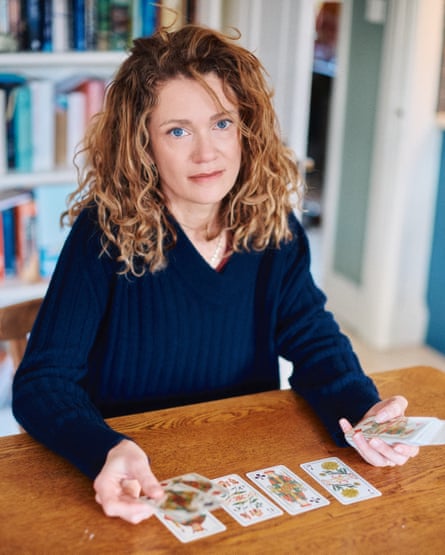
I’m not psychic. During the six months I spent working as a telephone psychic, my only supernatural gift was the ability to sound fascinated by a stranger’s love life at 2.17am. Yet for hundreds of billable hours, I sat on my living room floor wearing plaid pyjamas and a telemarketing headset, charging callers by the minute for insights into their lives. Perhaps this made me a con artist, but I wasn’t a dangerous one.
When it started, I’d recently quit my job as an editor at a publishing company to write a novel while doing telemarketing shifts from my kitchen table. Instead of knocking off a bestseller, I found myself cold-calling strangers about energy bills while gripped by writer’s block and an inconvenient yearning to have a baby.
“Work from home!” an ad popped up one day among remote data entry and content moderation jobs. “Use your intuition to help others find clarity!” The phone psychic description claimed there was a rigorous application process and demonstration of skill was required. I lay awake that night wondering how a psychic job interview would play out. Did candidates need to commune with the interviewer’s dead relatives? When I sent in the application, I was probably looking for meaning just like the people who called the hotlines.
My psychic interview the next day was a two-minute conversation with a man in accounts who asked if I had fast wifi, then sent me a contract to sign. There was no trial call, certainly no verification of skill or communion with the dead. Almost as an afterthought, he did ask which method of clairvoyance I would be using. It was not entirely a lie when I claimed a decade of experience reading tarot: but I bought the tarot cards age 12 at Waterstones on Hampstead High Street.
I logged on the next morning, nervous about any confusion that may arise from selling magical prophecies and economical energy packages simultaneously. I needn’t have worried. With no testimonials and a stock photo of the moon as my psychic profile photo, for a fortnight nobody called and I continued telemarketing. I can only imagine that the first caller did so by mistake, probably because I was the only psychic stupid enough to be working at 9am on a Monday – I later learned that psychics mostly log in after dark.
This first call lasted less than a minute, routed through their system to my headset so I never saw a phone number and nobody saw mine. A man on the other end apologised for calling, said he didn’t know why he was, then mumbled that he hated his job but didn’t know if he should quit or not. “I’m sensing that you’re not … completely satisfied where you are?” I said, insightfully.
He rang off before I even finished the sentence. Far from feeling bad that I had pretended to be a psychic, I felt bad that I hadn’t pretended better. This might have been a budget telephone psychic company with a small-print disclaimer that said “for entertainment purposes only”, but this poor man obviously deserved better than being the first psychic outing of a depressed literary editor with writer’s block and baby fever.
I got my second caller a week later, this time in the evening. A woman wanted to know whether she ought to give her ex another chance. My teenage years, spent hogging the family landline doing magazine quizzes with school friends while analysing the microexpressions of each other’s crushes, were all the training I needed for that conversation.
She just wanted to chat. She lived in a small northern town and couldn’t talk to her friends because they all hated her ex. She couldn’t talk to her mum because her mum went to the same church as her ex’s mum. The obvious choice was a stranger on the internet and there I was, anonymous and eager. In person she would maybe have been disappointed by my pyjamas, but all she had to go on was my voice and I barely got a word in between her outpouring of grievances. She was only nominally interested in actual divination, but approved when the “cards” told me that she needed to focus on “nurturing and self-care”. She gave me my first five-star review and called me six more times over the next few months.
The pay was 20p a minute, 25p if you kept people on the line for more than 14 minutes. If you worked more than 10 hours in a week, the pay went up slightly, but if you were “online” and didn’t pick up the call, £1.50 was docked from your pay. It was difficult, if not impossible, to make minimum wage, so it wasn’t a con with a great return on time invested – although the accounts department claimed the site’s star employee, Luna, made excellent money. She could astrally project.
I started getting one or two calls every evening shift, increasing in number each week as my testimonials grew. More than half of the calls opened with, “I don’t know why I’m calling” or something similarly hesitant, frayed and embarrassed. Most people didn’t seem to be looking for magic at all. Most just needed to talk, and I tried to give basic, sensible advice: Maybe don’t quit your job until you have a new one lined up, don’t sleep with your boss, be nice to your ageing parents even if it’s inconvenient.
One woman called me every day for a week to discuss the renovation of her flat, twice in one day to analyse the exact placement of a pot plant her ex-husband gave her. She even asked me to look on the Dunelm website and give my psychic opinion on two different patterns of self-adhesive wallpaper.
The most common questions were “Is my ex thinking about me?” and “Is my boyfriend/husband cheating?” The callers tended to know the answers on some level. I’d expected to feel guilty about pretending to have supernatural powers but the reality was these people had very little interest in me. They wanted someone to listen to them. Cheap help, basically, untangling the mess of their own thoughts. Callers often apologised for talking too much, then kept going anyway, relieved by the absence of impatience on the other end of the line. As one of the least reviewed psychics on a budget-looking telephone psychic hotline, maybe they knew not to expect Nostradamus on speed dial.
So I read between the lines, helped them get their feelings out. Sometimes I made high-probability statements feel personal, but mostly I just made appreciative noises and asked leading questions. And for a few months I didn’t feel guilty about it at all.
The telephone psychic industry is more regulated than it used to be when the Miss Cleo ads caused controversy in the early 2000s, leading to the Psychic Readers Network being shut down for deceptive advertising and billing practices. At my company the pricing was clear and the “for entertainment purposes only” disclaimer was blatant. I also wasn’t out there searching for vulnerable people on social media.
If future employers weren’t likely to get entirely the wrong impression, I’d happily put my six months as a telephone psychic on my CV: strong interpersonal and communication skills! Highly skilled at managing emotionally sensitive conversations! The ability to build rapport quickly, adjust to the caller’s emotional state, and entertain. I learned to be calm under pressure, gentle with distress, and more self-aware. When private therapy is out of most people’s budgets, I offered strangers a few relatively inexpensive minutes of undivided attention, gentle validation and a sense of guidance.
But slowly the darkness of my new job began to creep in. A few months after I started, a caller asked if her dead mother was disappointed in her. I took a breath and suggested she release herself from her mother’s expectations. She spoke about her for an hour and later wrote in a review that I had known countless impossible details about her mother’s character, none of which I’d mentioned. She said I had given her huge comfort at a difficult time in her life, when all I’d done was listen.
Now I felt guilt, and found it difficult to shake off the call. Her pain lingered. After that review people started to expect more of me. One caller relied on psychic advice to soothe her anxiety and make decisions. She was a former veterinary assistant who for a fortnight called me twice a day and got upset if I wasn’t online. She was agoraphobic and clearly needed so much more than I could offer. I tried my best gently to persuade her to refer herself to NHS therapy or tell her GP that she was experiencing anxiety. She didn’t want to hear it, though; she just wanted to spend £10 for someone to talk kindly about beautiful things the future may have in store for her, the tall dark strangers, the exciting travel.
She was vulnerable and would have been easy pickings for someone more manipulative. She stopped calling one day and although I like to think it was because she finally contacted mental health services, my intuition tells me she more likely found a mystic who didn’t constantly read her the number of her community mental health team.
Elevate Your Health for Just $29.99/Month
Join the Precision Wellness Subscription at My Healing 365 and get discounted services, priority coaching access, virtual care, and exclusive wellness resources to support your physical, emotional, and hormonal health.
Join for $29.99/MonthTwice, I had to tell a client to end the call and contact Samaritans. If anyone mentioned self-harm, suicide, conspiratorial beliefs or paranoia, we were meant to refer them to a professional service and end the call – similarly if anyone was verbally abusive or sexually explicit, although this never happened to me.
I was probably as lost and depressed as my clients. I’d published my first novel at 19, Isabel and Rocco. By the time I got the psychic job I had four successful novels under my belt, and lots of journalism, but suddenly I could barely muster the enthusiasm to read a shampoo bottle, let alone to write a book. I was broody and sad.
The guilt and exhaustion of the job escalated: the melancholy and loneliness that poured out of the phone and into me. The hope and the loss. I started to feel these people’s pain too acutely. Someone would call and I would get a rush of grief, alienation or anger before they’d even spoken. It wasn’t supernatural or telepathic; I’d tapped into an extremely dark wavelength of human need. The more calls I took, the more I really could read between the lines of what they said, feel what they might be unable to articulate. I didn’t stop being a telephone psychic just out of guilt for pretending to be psychic, but because I started to become too attuned to the people who called me. I’m not saying I became psychic, but I began to see how someone might believe they were.
The call that made me stop wasn’t dramatic. There were no curses, threats or credit cards maxed out in a single gulp. A woman called from her car, engine idling, and asked if she would get pregnant this month. Her voice had a careful steadiness. I followed the routine, trying to get her talking, listening for the pause, letting silence stretch until she filled it, thinking which choice of words might help her. I said I sensed a baby on the horizon but was having difficulty pinning down the time. She laughed, relieved. She said she didn’t have money for IVF but had been trying for five years now and it was all she wanted in the world.
A baby was all I wanted, too, then. I felt her energy so strongly. I could sense her gripping the steering wheel, hear the way her breath kept snagging on itself. Every instinct told me to reassure her – to tell her it would happen, to have hope. I knew how easy it would be to keep her there. To sell her another 10 minutes. Another week. Another month of believing. Instead I told her something vague and kind, and she thanked me. She hung up sounding lighter, which should have made me feel better. But it didn’t.
What stayed with me was the certainty that she would call again and that next time I would remember her voice. I would recognise the sound of someone pausing their life because I’d given them a reason to. I sat there in my pyjamas, headset warm against my ear, and knew that I was not doing the right thing.
In the ancient world, the Oracle of Delphi advised Greek city-states on war and law; Roman augurs read the will of the gods in bird flight; Mesopotamian priests interpreted dreams and entrails. These days we’ve gone past the telephone to TikTok, Instagram and other social networks launching a new breed of influencer psychics, reaching even bigger and more mainstream audiences.
I was a telephone psychic 10 years ago and as my testimonials grew the accounts department started badgering me that the best psychics were moving on to webcam. I told them the main perk of the job was that I didn’t need to put real clothes on. The day after the fertility call, though, I told them I was going to log off.
I got a free call with another psychic on the site just before I left. Obviously I chose Luna, the site’s star psychic. Unfortunately, when I called it turned out she could only astrally project during a full moon at certain moments in her menstrual cycle, but she could tell, presumably having had a little help from the accounts department, that I was sitting in my pyjamas and at a crossroads in my life. We chatted for a bit about being a telephone psychic, and her life, and she got a strong sense that “the subject of clairvoyance” would be important to me at some point in the future. I remember the phrase exactly; I wrote it down because it was weird. Not the skill of clairvoyance, but the subject.
I never finished the novel I was writing then, but I did go on to have three children. Ten years later I am back to writing and about to publish a novel about a toxic friendship between a webcam psychic and a client. It is, I guess, about “the subject of clairvoyance”, exploring the fine lines between charisma, empathy and fraud.
Before I stopped signing into the psychic platform altogether, I waited for my first reviewer to call me again so that I could say goodbye. She was in a good place by this point. She’d moved away from the small town where she grew up, had gone back to school to finish her A-levels and just wanted to chat about her new boyfriend. She thanked me for all the advice over the last six months but said that although I’d helped her, she didn’t think I was particularly clairvoyant.
That night, saying goodbye to her, I could almost imagine my time as a telephone psychic wasn’t a grift but a small, morally complex act of service. Almost.























