
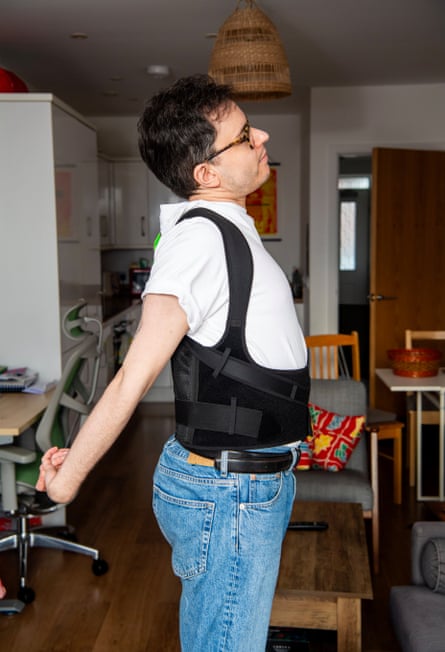
When I sat at my desk this morning, I couldn’t slouch over the keyboard like I usually do. As much as I tried to hunch over, my back was held straight, shoulders pulled back. My trick? I was wearing a corset-like device with straps over my shoulders that forced me into an upright position.
Posture correctors claim to provide instant improvement in posture and relieve the back, shoulder and chest pain often associated with poor posture, if worn long term. The one I have on, Vicorrect (£29.99), is one of many on the market – Lidl’s budget posture trainer (£7.99) is now sold out; Taylor Swift has been spotted wearing a sports-bra version by Forme (£140).
I have a history of bad posture. I usually spend more than eight hours a day working on a laptop – sometimes at my home desk with an adjustable office chair and external monitors, but also on the sofa, at the dining table or even in bed. By the end of a typical workday, my shoulders, neck and back are painfully stiff, despite weekly trips to the gym and swimming pool to try to loosen them up. I recently visited a massage therapist, who gasped at how tight my shoulders were and told me, with a look of alarm, that I must improve my posture. An instant fix in the form of a wearable item is very appealing.
But can you really “correct” your posture with a harness? David Harris, a clinical director and clinical specialist physiotherapist at Oxford Circus Physiotherapy, says they are “definitely not something I’d recommend as a standalone solution for someone with poor posture, but if they asked whether they could wear one, I would say yes – for short periods.” Traditionally, he says, good posture “is having a straight line running through your body”, where your ears are directly over your shoulders and your shoulders are directly over your hips. “But we’re busy human beings and we can’t sit in the perfect posture all day. The key is changing positions regularly. You don’t want to become reliant on a brace to stay upright.”
Harris says occasionally wearing a posture corrector may benefit your proprioception – “improving your ability to sense where you are in space and getting your muscles to hold you in that position”. The corrector pulls the shoulders back, which he says could be useful “to learn the right position for your body to be in”. However, long-term, “we really want the muscles to work to hold that position, too”. And for that, muscle strengthening is essential.
The Vicorrect comes with a user manual that recommends wearing the device for 30 minutes a day, building up to a maximum of three hours to “improve your alignment over time”, warning that it may cause discomfort or even pain to those not used to it. On first look, it resembles a mix between a Victorian corset and a bondage harness. It includes a back brace that sits snugly around the waist, with two hard plastic rods to ensure the back is kept straight, and when I tug on the arm straps, my shoulders are forced back. My bones click worryingly. Vicorrect doesn’t specify how long the corrector should be worn for in total – but it says at least three weeks. During my first 30 minutes, I notice a significant difference in my posture while I work, mainly because I can’t round my shoulders like I usually would. But after I take the corrector off, my posture slowly returns to its usual state.
The scale of poor posture is difficult to measure. It is tough to quantify something not everyone agrees on – ideas of “good” and “bad” posture vary between cultures and time periods, and one study of 295 European physiotherapists even shows some disagreement between countries. A research paper published in 2019 argued for a re-evaluation, stating that “despite common posture beliefs, there is no strong evidence that one optimal posture exists”, and that variations in posture are more reflective of beliefs and moods than health.
The impact of poor posture is also hotly debated: while there is some evidence that a forward head posture (known as “tech neck”) can cause neck pain, an umbrella review of evidence suggests that poor posture does not cause back pain. Alison McGregor, a professor of musculoskeletal biodynamics at Imperial College London, tells me that “the direct link between poor posture and back pain is actually quite tenuous”. Sitting with poor posture can be uncomfortable, she says, but it’s not usually the cause of back pain: “If anything, poor posture is a sign of weak muscles, which can also cause back issues.”
Over the next few days I follow the posture corrector’s manual and increase my wearing time to 45 minutes a day. I typically throw the corrector on as soon as I start work and wear it in the privacy of my own home, but one day I forget until the evening, when I am heading out to a friend’s dinner party. The product listing states it can be worn for sitting, walking or exercising, so I put it on and head out to catch the tube.

I quickly discover that wearing a posture corrector on a hot rush-hour train is a special kind of discomfort. As I’m squeezed into the back of a carriage, the back brace becomes increasingly claustrophobic. By the time I arrive at my stop, I’m covered in a thin sheen of sweat and tumble out on to the platform like a fish gasping for air. The humiliation is doubled when I show my friends the corrector and one of them says it looks like the harness she puts on her dog.
The next day, I ask McGregor about the possible benefits of wearing a corrector. “It can sometimes be useful to remind people they’re slouching,” she says, “but strong muscles to support your spine are the biggest part of maintaining good posture.” She notes that this includes back muscles as well as hip, pelvis and core muscles – but warns that these “won’t develop by wearing a brace that does the work for you – they’ll just get lazier and weaker.”
Spurred on by this warning, the next day I head to the gym and do reverse flies, an exercise recommended by Harris to help my rounded shoulders. I wear the corrector, as its listing claims it can be worn during workouts, but it slides uncomfortably over the fabric of my gymwear and quickly bunches up under my chest, so I take it off. Harris advises that the kind of exercise an individual should do to improve their posture varies: “It’s usually very specific, depending on what their muscle imbalance is, and it has to go hand in hand with changing environmental factors and examining any joint stiffness.” He was able to provide some tailored advice after I told him about my particular areas of pain, but recommended that anyone seeking their own workout routine should speak to a physiotherapist first.
However, there are some things many people can do to improve their posture that don’t have to include a regular gym routine. “A lot of our posture is related to our behaviour – we are what we do repeatedly,” McGregor says, “so improving it can just be about restarting the body to work again.” This could include going for short walking breaks, or reminding yourself to sit upright and engage your core muscles. McGregor adds: “It’s important to break up long periods of sedentary behaviour with movement and be mindful of how you’re sitting.”
The downside of behavioural changes like these is that seeing the results takes time, which could be why people are turning to devices that promise a quick fix. “Humans will inherently find the easiest way to do something, and it’s easy to slouch or sit in a comfortable chair all day,” McGregor says. For a lot of us, “the thought of having to work at our health is sometimes quite hard.” It can take six to eight weeks for exercise to start having an impact on our posture, she continues, and “human attention span often isn’t that good. We just want to take a tablet to get better.”
As the fortnight draws to a close, wearing the posture corrector feels increasingly like a chore, with minimal impact on how I sit, and I’m convinced the brace around my stomach is giving me acid reflux. My posture has improved – my shoulders are more relaxed, my back is straighter – but it’s impossible to say whether it’s because the corrector has forced me into shape and made me more aware of my body, or because I went to the gym and worked on my back and core.
I will keep the posture corrector for occasional use, but I’m wary of letting a device that works in place of my muscles become a new bad habit. I don’t want my back to weaken further, making me reliant on a brace to sit upright, and the lack of research linking poor posture and back pain is striking when a primary selling point of many correctors is their ability to relieve it. Perhaps regular exercise, bodily awareness and frequent movement are better than buying something that promises to do the hard work for you, no matter how tempting it may be.

















