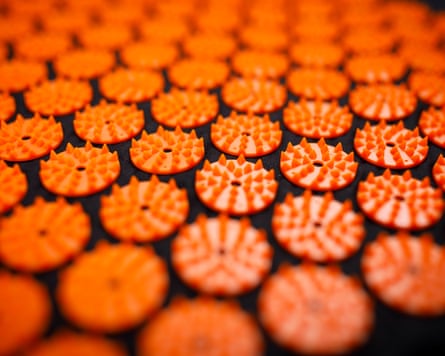
Ever since Keith, 39, from Kansas, was in a car accident in 2023, he has lived with “pretty much constant mid-back and shoulder pain”. Over-the-counter treatments didn’t touch the sides and he didn’t want to resort to opiates. “Having exhausted everything there was solid science for with no satisfaction, I delved into acupressure,” he says. He bought an acupressure mat made of lightly padded fabric, studded all over with tiny plastic spikes, to lay his back on, and was surprised to find that it actually helped.
Acupressure mats, also known as Shakti mats, are inspired by the beds of nails that Indian gurus used for meditation and healing more than 1,000 years ago. While today’s mats have the nonthreatening sheen of a luxury wellbeing product, the spikes are no joke. In fact, the internet serves up a plethora of images of flaming, dented backs after their use – although you’re unlikely to seriously injure yourself using them. While the mats have been widely available for more than a decade, there has been a recent surge in mainstream interest. You may have seen them heavily advertised on your social media feed, the most prominent brand being Shakti Mat, made in India and costing up to £99 for the premium model. But Amazon is full of acupressure mats and pillows – Lidl recently stocked a mat and pillow combo for a tenner. Yet there is still no compelling evidence that they relieve stress, pain and sleep problems, or help with any other unmet health needs.
Keith reclines on his mat and pillow for about 45 minutes at a time. “It’s not a cure-all, and I’ve got no science-based explanation for it, but I find relief when I use the mat,” he says. Out of curiosity, he took his blood pressure before and after sessions (he even did control tests, before and after resting without the mat) and, he says, “My blood pressure trends lower after using it.” As someone with diabetes and high blood pressure, this has been a valuable bonus benefit for him – not that he would recommend it or claim it would necessarily work for anyone else. “In no way is this anything but anecdotal,” he says.
But many other people report that acupressure mats work for them, as many posters to the IsItBullshit subreddit attest. One says that it makes them “relaxed AF” and their sleep metrics improve after using it. Another, a contractor, says he uses it three times a week if his back and neck are stiff, writing: “It’s a magic wand at times.” Another user says that they often end up falling asleep on their mat. Most acknowledge that there’s little but anecdotal evidence about the benefits, and aren’t interested in the ancient philosophy behind the practice of acupressure – they say it just works for them.
Sahar Hooti, an acupuncturist and author of The Pocket Guide to Perimenopause, has never used an acupressure mat, but she says that the sheer number of tiny spikes on the mats mean that some of them will inevitably end up touching on an acupuncture – which is also an acupressure – point. Indian Ayurvedic medicine focuses on similar (though not identical) points to traditional Chinese medicine, the type of acupuncture and acupressure that Hooti practices, and the most widely used in the UK. “Acupuncture points are strategically placed on our nerve pathways, so [the mat] is stimulating these points, but also other points that are in between – just stimulating the surface of the skin for relaxation, like giving yourself a massage.”
Three thousand years ago, she says, fish bones were used as the first Chinese acupuncture needles. “Then they became stones, etc. Every culture has its own way of acupuncture. It’s like when you have a massage, the hands of the therapist are stimulating all of the nerve endings in your back. The ‘nails’ on the mats are just another road to that healing, but with added extra strategic, pinpointed benefit – pun intended – when it hits an actual acupuncture point, which is a nerve ending that sends a particular message to your brain to carry out a specific function.” In Chinese acupuncture, she says, the points on the back are “beneficial for direct organ rejuvenation, and so I use a lot of [these] when people have a lot of systemic issues”.
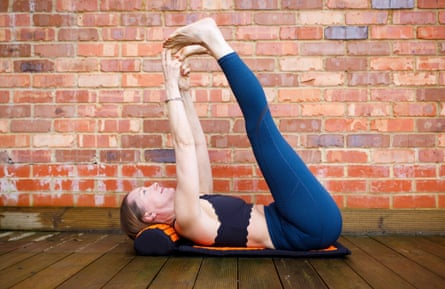
I’ve heard that lying on the mat hurts at first and then you relax into it, a bit like a cold plunge. So I borrow a friend’s mat and neck pillow to try. Both are covered in plastic discs with 4mm-deep spikes around the outside, and shallower 3mm ones on the inside. They look like an ouch waiting to happen, yet, on initial impact, as I recline, I am almost disappointed by how little it hurts. Relaxing on to it is a damn sight easier than plunging into freezing water. There’s a slight prickle, followed by warmth and a continued mild prickle. The small of my back naturally curves away from the floor or mat, so when I raise or hug my legs, forcing my back to flatten, the intensity heightens and I feel a stronger sense of tension and release. I’ll admit that it does feel as if I’m doing more than merely lying down and relaxing on a mattress, which is illustrated by the angrily red, deeply dimpled skin I have afterwards, and the lingering itchy, stingy sensation. But it’s hard to tell whether or not it’s more beneficial.
Some claim that the discomfort the mats induce also stimulates the release of endorphins, although this too remains unproven. It will certainly, says Hooti, create an injury response: “The brain thinks, ‘Oh my God, something’s happening. Let’s rush blood to the area, to heal whatever’s going on.’ Temporarily, I would say that’s a really good thing. It rejuvenates you.” She advises using the mats for no more than five minutes at a time. “Imagine prolonging that injury response in your brain. I would be very cautious, because if you’re pregnant, for example, it could be stimulating points that shouldn’t be stimulated.”
Humans are often tempted to indulge in too much of a good thing, on the basis that, if it’s doing us good, the longer we do it, the more good it will do us. Hooti says of the use of acupressure mats that, in her professional opinion, “If you don’t have any severe health conditions, it’s safe, it’s really good short term, but everything in moderation.”
Learning to do “selective, strategic acupressure” on yourself – applying pressure on points on your body, such as the webbing between the thumb and forefinger, to relieve stress – would be even more effective, she says. “But my conclusion is: anything is better than nothing. We need stimulation. We’re in a day and age where stagnation occurs, as we call it in Chinese medicine – blood circulation becomes sluggish through excess cortisol, which is the stress response. We’re a nation of wired and tired, right? So I feel that bringing a little blood to the surface doesn’t do us any harm.”
There isn’t much empirical evidence for the benefits of lying on spiky mats, but one attempt to measure their effects was undertaken in 2023 by Benjamin Schöne, associate professor of psychology at the Norwegian University of Science and Technology. “It was a student project,” he says, “and we did it basically for fun. I thought it was a good learning opportunity for students, and I was a bit personally invested, because I used one of those mats to relax, falling asleep.”
The idea was to test the mats daily for three weeks on perceived stress levels and physiological markers such as heart rate, blood pressure and pain tolerance (the standard endurance measure of putting your hand in cold water). Like Keith’s private experiment, there was a control group who relaxed on a mat without needles.
Elevate Your Health for Just $29.99/Month
Join the Precision Wellness Subscription at My Healing 365 and get discounted services, priority coaching access, virtual care, and exclusive wellness resources to support your physical, emotional, and hormonal health.
Join for $29.99/Month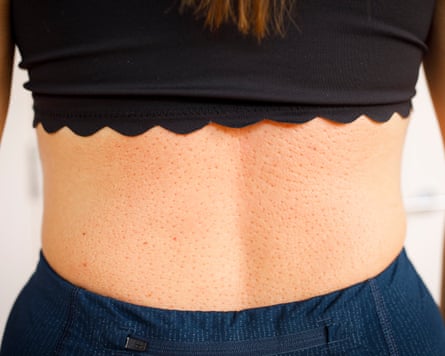
The researchers’ hypothesis was, says Schöne, that “if you lie on needles every day for some time, your pain tolerance should improve, because that goes along with the claims of these mats, that they help neck pain or back pain or whatever. So they facilitate relaxation and the pain really goes away, but maybe also pain tolerance increases generally.” The researchers also checked if participants felt and slept better.
Unfortunately, he says, “We found nothing.” By which he means nothing significant enough to warrant funding for further studies for his particular group. Participants’ blood pressure, heart rate and pain threshold and tolerance did not change significantly over the course of the experiment, but subjective stress decreased (as did subjective wellbeing, oddly), and sleep quality and concentration endurance increased. No significant differences were found between the group using acupressure mats and those using regular mats. Both had some positive effects on participants, but the experiment showed that using the acupressure mats was no better than “just lying down, relaxing a bit”, says Schöne.
He also notes that while subjective wellbeing actually decreased a little for both groups, he doesn’t think this means that the mats had a negative effect. “We tested students during the term, and at the end of the term, when they are more stressed. So this could be one effect, but it could also be, if I asked you, how is your wellbeing, you start noticing that your wellbeing might not be so good.”
The other limitation he points out is that they only used healthy participants – not people who sought out mats because they were stressed or experiencing chronic pain, so Schöne suggests that further studies working with specific health complaints such as tension pain would be useful. For instance, “if you have high blood pressure, the mats could bring it down. Our study does not exclude that.”
And at least the study showed that resting, either with or without an acupressure mat, reduces perceived stress. “The stress reduction was about 7%, which is, I would say, substantial for three weeks, and it’s just due to lying down and relaxing. From a very personal point of view, these mats are an interesting way to facilitate relaxation, to establish an evening ritual, maybe before you go to bed. And I think there should be more research on that. It’s a more complicated topic than you would think.”
As a scientist, however, he decided to fade out his own mat use due to the current lack of strong evidence, although, he says, “It did help me a little bit falling asleep during a stressful period.” I can well imagine that, in these always-on times, it may feel easier to submit to rest if there’s a sense that you’re still actively achieving something, participating in a self-improvement activity that challenges and stimulates you. The mats certainly offer a subtle, massage-like sensation – although it feels to me fairly surface level. And, while mercifully I’m not seeking relief from any injury at the moment, I’d rather do a bit of yoga and then lie on my back and drift into rest on a nice, smooth mat.























