
Until pretty recently, the conventional wisdom about building muscle was that it worked via a system you might think of as “tear and repair” – the idea being that working out causes microtears in the muscle fibres, which trigger the body’s repair processes, encouraging the muscles to come back bigger and stronger.
That’s why many old-school trainers will tell you that there’s no gain without pain, and why a lot of bodybuilding advice includes increasingly byzantine ways of pushing your biceps and triceps to the point where you can’t do another repetition: the more trauma you can cause, the thinking goes, the more “swole” you can become.
To be clear, this has worked for plenty of lifters – especially ones aided by under-the-counter performance enhancers, which can help recovery from even the most arduous workouts. But the current science suggests that there’s a better way to think about things.
“The best evidence now suggests that the primary driver of muscle hypertrophy – the technical term for an increase in size of the muscle cells – is mechanical tension,” says Dr Anne Brady, a kinesiology professor who specialises in muscle quality, physical function and body composition. “Muscle damage certainly contributes, but it’s not the main factor. Typically, it’s more of a side-effect.”
To explain this a bit more: when you lift a weight that’s heavy enough (or you perform enough repetitions of a movement to reach near-failure, which you’ll recognise from the fact that your reps slow down and feel more “grindy”), the resulting physical tension stretches the membrane that encases your muscle cells. From there, specialised sensors called mechanoreceptors detect that stretch and turn on what’s known as the mTOR pathway, a sort of master regulator that listens to various signals and “decides” whether your body should be building new tissue or breaking down old parts for energy. From there, the mTOR pathway signals to the cell to start muscle protein synthesis (MPS) – the process of adding new protein to the muscle fibres to make them thicker and stronger.
“A third factor is metabolic stress, which leads to the ‘burn’ that you might feel while lifting,” says Brady. “You can think of that as an amplifier to mechanical tension – it’s a form of cellular signalling which creates a favourable environment for muscle growth.” In other words, feeling your muscles start to ache might mean that you’ve pushed them enough to grow, but it also might not – you can get a burn from doing enough biceps curls with a pencil in your hand; you won’t grow much because there isn’t enough physical tension to strain your muscle fibres.
Elevate Your Health for Just $29.99/Month
Join the Precision Wellness Subscription at My Healing 365 and get discounted services, priority coaching access, virtual care, and exclusive wellness resources to support your physical, emotional, and hormonal health.
Join for $29.99/MonthThe second key thing to understand about muscle is that you can build a fair amount of it without adding much extra strength – or, if you’d prefer, get quite a lot stronger without actually getting any larger. “There are two main types of muscle hypertrophy: myofibrillar and sarcoplasmic,” says Brady. “Myofibrillar hypertrophy is an increase in the number of myofibrils – the bundles of tiny filaments that actually contract to lift weights – resulting in increased strength. Sarcoplasmic hypertrophy is an expansion of the volume of fluid inside the muscle – this results in a larger muscle size without additional strength.”

This is how Olympic weightlifters can move enormous weights without jumping up a bodyweight category, and why gymnasts can be stronger in certain movements than bodybuilders who train entirely for aesthetics. Science now suggests that one form of hypertrophy rarely happens without the other, but different types of workout can certainly lead to one style getting priority: in a study from 2019, young men who worked out for six weeks on a high-volume weightlifting programme seemed to see the largest results from sarcoplasmic hypertrophy: in other words, they got bigger without necessarily getting much stronger. The most effective growth seems to happen when you combine the two types of hypertrophy: using a weight heavy enough to create high tension, but performed for enough repetitions to generate significant metabolic stress.
What does all this mean for you? First, it means that whether something hurts – either during your workout or in the days afterwards – isn’t necessarily a good marker of its effectiveness. “It has been noted that muscles can grow with minimal soreness, and on the flip side there can be lots of muscle damage with little muscle growth – for example in downhill running,” says Brady. “At the same time, muscle damage can reduce growth if it negatively impacts an individual’s performance when training or training frequency.”
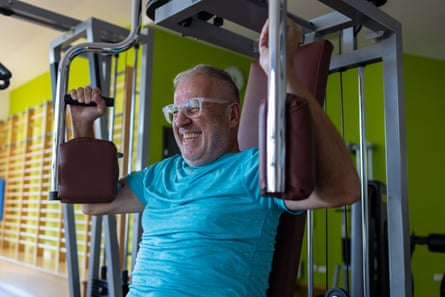
It also means that you don’t need to worry too much about pushing yourself to the limit, or even close to it. “I coach women in midlife, and always tell them not to major in the minor,” says Brady: in other words, don’t obsess over trivial details. “During resistance training, I’d suggest working to near failure. This can be accomplished across a wide range of repetitions as long as the final few reps are challenging.”
What coaches call progressive overload – making the muscles do more work – is still key, but there are lots of ways to come at it: doing more repetitions in each set, using heavier weights, reducing the amount of time you spend resting between sets, and so on. Gradually up the amount you’re doing over weeks or months, and you’ll get both stronger and probably slightly bigger – but please note that you’re unlikely to outgrow your T-shirts unless you’re investing in serious pharmaceutical help. Plenty of people are trying to do it in every gym in the world, and they don’t all succeed.























