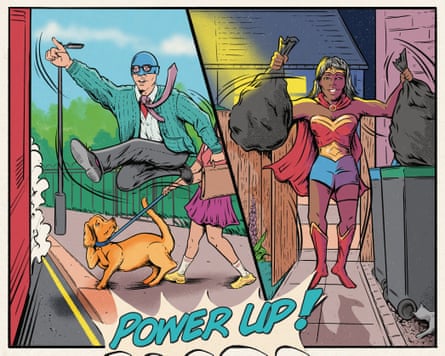
Chasing after your dog, catching yourself before you fall, jumping over a big puddle. These activities all have something in common, and it’s not just that they’re the makings of a very bad day. They rely on power: the ability to generate force quickly. It’s an often overlooked part of the fitness menu that experts think deserves more attention.
Mobility, cardio and strength all help us stay active and healthy as we get older. Strength training in particular has boomed in recent years, as the importance of building muscle mass to keep us strong, protect our bones and help us stay mobile as we age becomes more widely recognised. But when it comes to activities such as pushing yourself up from a chair or moving your arms quickly to break a fall, the size of your muscles will only get you so far. You also need power.
Imagine throwing a shot put, says Oly Perkin, a researcher at the University of Bath specialising in exercise to improve health at all stages of life. “You might have the strength to move the shot put from a start position to the top position. That’s largely down to your muscle mass. But to do that super quickly, to produce the force needed to propel the shot into the air, a different kind of strength is required.”
That explosive force depends on how quickly the nervous system can activate those muscles – the speed and efficiency of the brain-muscle connection.
For younger, active people, improving power can help prevent injuries. It can also help people who lift weights break through a training plateau. Where power training may matter most, though, is in reducing some of the effects of ageing.
“As you get older your muscles shrink and that is inescapable, irrespective of how active you are,” Perkin says. “If you make sure that the neural element is maintained alongside the muscle, your ability to maintain physical function across your life is much better. Even if you inevitably lose muscle mass, there’s good evidence that you can make better use of the muscle you have.”
The challenge is that power tends to decline faster than strength. After the age of 40 people typically lose about 1-2% of muscle mass each year. Alarmingly, muscle power can decline earlier and much more rapidly. The encouraging news is that power can be trained.
You build muscle by moving heavy weights a few times a week and increasing the load as it becomes manageable. The tension that the exercise places on the muscle fibres triggers a remodelling process that leaves the muscles better able to handle the stress next time.
Elevate Your Health for Just $29.99/Month
Join the Precision Wellness Subscription at My Healing 365 and get discounted services, priority coaching access, virtual care, and exclusive wellness resources to support your physical, emotional, and hormonal health.
Join for $29.99/MonthPower is built differently. Instead of lifting heavy weights you move lighter weights, or your own body weight, but as quickly as possible. This could mean plyometric exercises such as box jumps. It could also include weighted movements such as throwing and catching a medicine ball, weighted jumps, snatches (where you grab a dumbbell from the ground and pull it towards the ceiling) and kettle bell swings. Weight-wise, you want something at about a six-out-of-10 difficulty level.
For older or less mobile people, power training can start with very simple movements. Try wall push-offs: lean diagonally with your hands against a wall, arms bent, and push yourself away at speed.
Perkin adds that, although everyone can benefit from training power, it may be especially valuable for older adults who have already experienced a significant decline in muscle mass. When muscle loss reaches the point of immobility, rebuilding it becomes very difficult. But improving the nervous system’s ability to activate the muscle that remains is still possible. “Growing muscle when you’re old is hard. There are physiological limits,” he says. “But for most older adults the capacity to improve neural function is still quite good. Within three or four weeks you can start to see improvements in key markers.”
If you’re thinking of stepping into your power, Perkin, alongside Alex Dinsdale, senior lecturer in sport and exercise biomechanics at Leeds Beckett University, and Leigh Breen, a leading expert in the field of skeletal muscle physiology and metabolism from the University of Leicester, share their tips.
Table of Contents
Find your benchmark
A good way to test whether you could benefit from power training is if you can hold a squat but can’t squat jump more than a couple of inches off the ground, says Perkin. But jumps are also useful for measuring progress for those who have already built some power. Dinsdale says that when he works with athletes they regularly test power by incorporating jumps into sessions and measuring the heights or distances achieved. This may include static jumps on to boxes or broad jumps where you jump forward from a standing start.
For older or less active adults, the sit-to-stand test is useful. Sit in a chair with no armrests, cross your arms over your chest with your hands on your shoulders and keep your feet flat on the floor. How many times can you move from sitting to standing in 30 seconds? Over-65s should aim for at least 11 repetitions.
Perkin recommends using the same exercise to improve your power by doing three sets of 12 to 15 sit-to-stands while wearing a weighted vest.
Train with a goal in mind
“Obviously the main goal should be good general health and longevity,” says Breen. “But beyond that, everybody has something specific they want to achieve.” It’s useful to keep that end goal in mind as a motivator, as you’re less likely to see visible results than you are with strength training. It doesn’t have to involve training for a marathon or doing a Hyrox competition. It could simply mean restoring a functional ability that has been lost, such as being able to throw the bin bags into the outside bin or chasing the grandchildren around. “I think it’s always important to keep the purpose in mind when we undertake a training regime,” says Breen.
Get the timing right
All our experts say power training should come after you’ve warmed up, but early in your workout. It’s harder to develop neuromuscular speed when your muscles are fatigued; and it’s easier to injure yourself doing rapid movements when you’re exhausted.
Keep sessions short, adds Dinsdale. The focus is on how quickly you can move something, which means working at your maximum possible speed. You can only sustain that for short bursts. If you’re using weights, choose a light or moderate load and move it five or six times. Do three sets of three exercises, resting between them. You’ll want two to five minutes between sets so your systems can recover fully.
You don’t need a separate session
Doing a couple of power exercises a few times a week is more effective than doing many of them once a week. A simple approach is to add a 10-minute power block to the beginning of any regular strength workout. That could be three rounds of 10 kettlebell swings (which help with the posterior power chain), medicine ball throws and slams (to improve upper body speed) and weighted squat jumps (lower body).
Runs can also be tweaked to include power work. “You could do short periods of sprinting, maybe five or 10 strides as quickly as you can,” says Perkin. “Or stop briefly and do a few vertical jumps.”For those who aren’t confident with weights or jumping, Breen recommends doing medicine ball throws while seated (they’re still effective).
Take it steady
On first trying power training, it’s tempting to reach for heavier weights than necessary, says Dinsdale. Instead start lighter. “Use about 50 to 60% of whatever your maximum is for that movement [your maximum is the weight you can only lift once], and then build up,” he says. He adds that there’s very little benefit to going very heavy with these kinds of exercises if your focus is building mind-muscle connection.
Because you’re moving quickly, safety matters. As well as lighter weights, it’s important to focus on maintaining good form. If you’re unsure, Dinsdale recommends working with a trainer or taking gym classes while you build confidence.
Don’t be fooled by the name of workouts
Confusingly, powerlifting – lifting heavy weights without a time limit – doesn’t actually train power. Olympic weightlifting – with moves like the clean-and-jerk, where a barbell must be moved quickly off the floor and then into the air – does. For most people, power walking doesn’t train power either.
Use power to break through a plateau
Power training can also help people who feel stuck in their strength training. “When you lift weights you can reach a plateau where it becomes difficult to increase muscle size further,” says Perkin.
Adding lighter power work for a few weeks can sometimes unlock further gains. It forces your body to adapt by increasing the efficiency of the neuromuscular system. This enhances your ability to move heavy weights when you go back to them. “Then you have the opportunity to grow more muscle again. There’s a crossover effect,” adds Perkin.
Try a sport
If gyms feel intimidating and you’re right at the start of a power journey, playing sport can be another way to develop a beginner level of power. Activities such as tennis, padel, football or netball involve short bursts of acceleration that engage the mind-muscle connection, with the added social benefits. Contact sports, such as rugby and boxing, require explosive power too. The most important thing is finding a varied routine you enjoy.

























