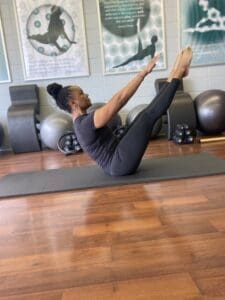
Pilates is often framed as a measured, discipline-heavy practice living inside boutique studios and a narrow slice of the wellness world. Yet the method has always had a deeper story, one that includes Black pioneers and a long tradition of movement and healing.
Today, Black-owned Pilates studios are carrying that history forward. They are creating spaces where Black people can strengthen their bodies, regulate stress, and feel seen in a practice that hasn’t always reflected them in popular media.
Table of Contents
The Pilates Method
Pilates is a method of controlled, intentional movement that builds strength, mobility, and alignment. It can be practiced on a mat or on specialized equipment such as the reformer. Most approaches center breath, precision, and mindful engagement of the core and stabilizing muscles.
History That Includes Us
Pilates began with Joseph Pilates in the early twentieth century, but the method evolved because of the people who carried it forward. One of the most influential figures was Kathleen Stanford Grant, a Black dancer from Boston who trained directly under Pilates after a knee injury. She completed more than two thousand hours of instruction and became one of only two people personally certified by him to teach his method.
Her legacy lives on through the Black instructors she mentored and inspired. Sonja R. Price Herbert, founder of Black Girl Pilates and an instructor at Ctrl Pilates in Mableton, Georgia, grounds her work in that lineage.
She explains, “I am fortunate to know Kathleen Stanford Grant’s very first assistants who are Black women. They were key in making sure I knew our Black history which began with Ms. Grant. Knowledge is power and freedom.”
Grant’s approach centered the individual body rather than a single rigid sequence. Many of the adaptive techniques used in studios today can be traced back to her teaching. Her influence is a reminder that Black movement artists have shaped Pilates in ways that are rarely acknowledged.
Pilates Matters for Black Communities
Black Americans experience some of the highest rates of chronic pain and mobility limitations in the country. A National Health Interview Survey analysis found that 36.4 percent of Black adults with arthritis report severe joint pain, a significantly higher rate than white adults.
Pilates offers a form of movement that supports the nervous system, strengthens the core, improves posture, and increases mobility. It is low impact and adaptable, which makes it accessible for people managing chronic pain, postpartum recovery, or long-term stress.
For many Black clients, the emotional benefits are just as significant as the physical ones. Najmah, cofounder of Pilates X Three in Union, New Jersey, explains, “Pilates offers a unique balance of strength and restoration. For Black clients in particular, the practice can serve as both a physical and emotional release.”
Herbert echoes this, noting that “racism through microaggressions, institutional, and structural affects us daily.” She adds that being in a space where you see yourself “allows us to release, trust and move without restriction or judgement.”
Elevate Your Health for Just $29.99/Month
Join the Precision Wellness Subscription at My Healing 365 and get discounted services, priority coaching access, virtual care, and exclusive wellness resources to support your physical, emotional, and hormonal health.
Join for $29.99/MonthBarriers to Access
Even with its benefits, Pilates has not always been accessible to Black communities. Several barriers continue to shape who feels welcome in the practice.
Cost
Reformer equipment is expensive, and many traditional studios charge premium prices. This can make Pilates feel out of reach for clients who want to try it but cannot commit to high monthly costs.
Representation
Herbert has seen how isolating it can feel for Black people to be the only person of color in a studio. She describes the difference when representation is present. Speaking about the Black-owned studio where she teaches, she says, “It’s like having our own Wakanda but in Pilates space.”
Location
Studios are often concentrated in higher-income neighborhoods, creating access barriers for people who rely on public transportation or live outside those areas.
Certification Barriers
Instructor training is costly and often lacks Black mentors. This can make the process isolating for aspiring Black instructors.
Ife Obi, founder of The Fit In in Bedford-Stuyvesant, works to change this through intentional hiring and training. She explains, “We prioritize hiring and training highly skilled instructors from within the community. Representation matters.” She adds that their teacher trainings prepare instructors “to teach diverse communities with confidence and care.”
What Instructors Are Seeing in Their Studios
Across the country, Black-owned studios are creating environments where clients can move without judgment and feel supported from the moment they walk in.
Pilates X Three founders Deanna and Najmah built their studio around that intention. As Deanna explains, “Pilates X Three was born from both a love of the practice and a desire to reimagine the environment it lives in.” She adds that the studio is designed as “a vibrant, inclusive space where movement feels expansive rather than restrictive.”
Tabatha Russell, NCPT, founder of Tab Pilates in Chicago and a member of the National Pilates Certification Program board, brings more than thirty years of teaching experience to her work. She describes Pilates as grounding for Black clients because it offers “time to slow down, to listen, and to be supported in our bodies without judgment.” She adds that Pilates becomes “a place where the nervous system can settle.”
At The Fit In, Ife focuses on building strength and confidence through intentional movement. She explains that clients are encouraged to be present and to shift their attention back to themselves. “For many, that hour becomes one of the few moments in their day where they can step away from external stressors.”
Herbert emphasizes the importance of acknowledging each client’s identity. “I want them to know that I acknowledge their unique Blackness. I welcome their body types, movement experiences and perspectives.”
Corrective Movement and Cultural Awareness
Pilates can be deeply corrective for chronic pain, posture, and nervous system regulation. Yet, Herbert notes that some traditional cueing can be harmful when it is based on stereotypes of Black bodies. She explains that “some cues are based upon stereotypes of Black bodies and can eventually injure or re-injure.” She offers the example of instructors assuming an anterior pelvic tilt in Black women without proper assessment. “Our spines are not flat,” she says, and she no longer uses cues that force that shape.
Russell sees the impact of consistent practice in her clients’ daily lives. She notes that people often tell her they are “turning to check blind spots more easily” or “sitting taller.” She believes Pilates becomes foundational and “supports how you live, not just how you look.”
Movement With Deep Purpose
Black-owned Pilates studios are expanding access to healing and offering a practice that supports strength, mobility, and emotional grounding.
Herbert offers a reminder of the legacy behind this work. “I let them know that we are and still continue to be Black Pilates history. Kathleen Stanford Grant ran real hard so we could walk.”
Studios to Explore
These studios reflect some of the Black-owned Pilates spaces highlighted through this reporting. If there is not one near you, consider searching locally for instructors and studios in your area.
- Pilates X Three
Union, New Jersey - Brooklyn’s Pilates, Strength, Barre, Yoga & Wellness Hub— The Fit In
Bedford-Stuyvesant, Brooklyn, New York - Tab Pilates
Chicago, Illinois - Prevailing Pilates
Durham, North Carolina - GRND Pilates
Atlanta, Georgia - Embody Pilates LA
Los Angeles, California - Ctrl Pilates
Mableton, Georgia - The Pilates Table
Cincinnati, Ohio
Resources:
Brooklyn’s Pilates, Strength, Barre, Yoga & Wellness Hub— The Fit In

























