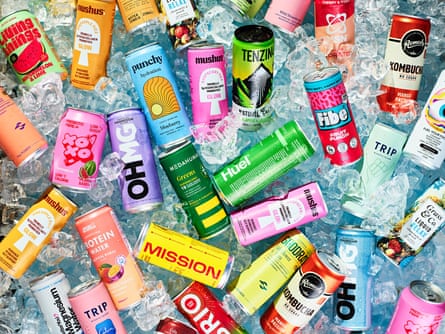
Show yourself some love. Fuel your focus. Life’s too good for bad energy. Find your calm in the everyday chaos. Live fit. No, not new-age slogans or something you’d find scribbled in neon on the wall of a cocktail bar, but marketing taglines slapped across cans of functional soft drinks. Walk into any supermarket or newsagent and there they are, bright and cheerful, right next to the Tango, promising everything from improved mental clarity and zen-like calm, to a blast of highly caffeinated energy as part of your sandwich-and-a-snack lunchtime meal deal. Influencers love them. Your favourite podcasters are sponsored by them. Even Gillian Anderson has a functional drinks brand (brilliantly, she’s called it G Spot).
If you have not yet swigged an electrolyte-loaded lemonade or opened a can of probiotic fizzy pop, you might be wondering what functional drinks even are. Because they are marketed as having one or more of many possible physiological and cognitive benefits, it’s a big category. There are functional drinks for focus, productivity, relaxation, calm, protein, energy, gut health and perhaps most confusingly, for hydration – which is, after all, the core function of most potable liquids.
Unsurprisingly, the branding of today’s functional drinks says a lot about each one’s intended market: high-caffeine products like Tenzing and Neutonic look as if they’re trying to lure club kids and gamers away from the Red Bull, while XOXO prebiotic drinks and Living Things probiotic drinks come in bright pink or lime green cans which could easily contain a hoppy lager microbrewed under a railway arch. Others are more pared back – Goodrays, Mushus, Mission and Water Junkie go for slim cans in a single colour – while Cadence Core Hydration and Celsius fruit-flavoured energy drinks come in minimal white, black and silver cans that look as if they’ve been designed to slot neatly into bro culture. (Celsius contains 200mg of caffeine per can, about three espressos’ worth, and is particularly popular with bankers, traders and hedge funders).
At £2-3 per bottle or can, functional drinks are readily available and often very sweet way into wellness – and the market is booming. Globally, functional drinks are now worth about £115bn a year and predicted to be worth twice that by 2030. In the UK, the market is generating £100m a year in sales, with a quarter of consumers now saying that they want functional benefits from the drinks they buy, up from 13% in 2024. Functionality isn’t just limited to drinks: according to Mintel, one out of every four new food and drink launches now makes a functional benefit claim.
Most functional drinks go hard on the idea that they can meaningfully improve not just your diet, but also your life. They offer everything from “multivitamin support” and “natural energy” to “the power of calm” and “beauty from within”. But can a canned drink really do all – or any – of this?
Some functional drinks are made with added vitamins such as A, B12 or D, or minerals such as magnesium, chromium or molybdenum. Others contain so-called adaptogenic and nootropic botanical ingredients, such as ashwagandha, ginseng and reishi, chaga and lion’s mane mushrooms, or contain green tea, yerba mate, matcha, L-theanine, caffeine or CBD (the non-psychoactive ingredient in cannabis). Still more are enriched with collagen, protein, fibre or probiotics. And some contain a dizzying – and not always palatable – mixture of many of the above.
Having taste-tested a bunch of them alongside drinks writer Aleesha Hansel, I cannot recommend Huel’s Daily Greens, a sparkling soft drink with 45 ingredients, including mushrooms and four green vegetables, and unexpected top notes of cooked broccoli and extremely well-boiled peas. And while many gym-goers swear by protein shakes, I’m going to give a hard pass to protein waters, which tasted not unlike cordial mixed with bone broth.
Functional drinks can serve a useful purpose, says consultant dietitian Sophie Medlin, who works at City Dietitians. “They do offer more than other regular soft drinks do. But would I encourage people to start drinking them? No. When I’m working with patients, sometimes functional drinks can help get them off less healthy things they already drink, like colas.” She says three different groups of people consume functional drinks: people who drink a lot of soft drinks and want to swap to something less unhealthy; people looking for something to drink instead of alcohol; and people who previously didn’t buy soft drinks, but who think functional drinks are a worthwhile addition to their diets.
Health claims on foods, drinks and supplements are tightly controlled in the UK, and some brands have already got into trouble with the Advertising Standards Authority. A 2025 complaint against Trip was upheld after its ads suggested that the drink could reduce levels of the stress hormone cortisol and promote calm, while also in 2025, Myota was censured for illegally suggesting a food product could have medicinal effects when promoting its metabolic booster drink.
While you might assume that the health claims a brand makes refer to the sum total of all the ingredients in a product and their effects, food and drink producers can only legally make health and nutrition claims about certain ingredients, so vitamins C, D or B12 often do a lot of heavy lifting on the labels. For instance, as long as a product contains 15% of an adult’s recommended daily allowance (RDA) of B12 per 100ml (which costs manufacturers very little to add) a brand can say its drink reduces tiredness and fatigue, supports neurological functioning and helps the immune system. Whether it contains lion’s mane, ginseng or ashwagandha is irrelevant, because the health claim is only being made about the B12.
In some cases, the added vitamins aren’t doing much. “Some functional drinks add a long list of vitamins and minerals in small amounts to create a health perception, even when those nutrients make little difference to overall intake,” says Gopi Chandratheva, a registered nutritionist who works in the NHS and privately.
Huel’s Daily Greens drink is marketed as containing 41 vitamins, minerals and superfoods and although it has high levels of vitamins D and B9, each serving provides less than 20% of your daily phosphorus, iron, zinc, molybdenum and chromium requirements. Celsius, however, contains nearly 300% of the RDA for vitamin B7 and well over 100% of the adult RDA for B2, B3, B5, B6 and B12 – all of which we just wee out if taken to excess (although excess B6 can sometimes build up in the body and cause nerve damage). So it’s worth reading the label carefully, especially if you’re already taking other supplements. (Children’s requirements for vitamins and minerals are lower than adults: functional drinks are not designed for them. “ You can easily overdose a child on vitamins if they drink a lot of them,” says Medlin. Many cans do say they’re not suitable for children, or for pregnant or breastfeeding women.)
While vitamins and minerals are listed with an RDA or nutrient reference level (NRV) on the label, it’s not always clear whether a functional drink contains clinically or nutritionally significant amounts of adaptogenic and nootropic ingredients, such as lion’s mane or reishi, because in most cases we don’t know what that amount would be. “Products often group together ingredients with very different mechanisms of action and levels of evidence,” says Chandratheva. Adaptogens are plant-based ingredients which are supposed to affect the way your body responds to stressors; nootropics are said to enhance mental functions like memory or function (some substances are both).
“‘Clinically significant’ suggests that a product contains a dose which research has shown has a benefit,” says Medlin. “But there’s nowhere near enough research on that, and we don’t have long-term studies about people taking these products every day yet, either. It’s a growing area of research, but the problem with adaptogens and other ‘natural’ products is that things will be a bit different depending on where or how each ingredient, like a mushroom, is grown, so that also makes it difficult to be sure about what would cause a meaningful effect.”
Chandratheva says mixing multiple adaptogens or nootropics whose effects we don’t totally understand with vitamins, minerals and stimulants, such as caffeine, or relaxants, such as CBD, might not be wise. “These drinks should be taken with caution, as they contain bioactive compounds and may interact with other medications. Often other ingredients are added to these drinks which can outweigh the benefits.” Some people find that rhodiola isn’t a good match with caffeine, say, and can make them feel jittery or restless.
“It could be quite confusing, physiologically,” adds Medlin. “And if you do feel a benefit, it’s likely to be from ingredients like caffeine, rather than from the ingredients you’re paying a lot of money for.”
But plenty of people love functional drinks and find them effective. “For me, it’s having them in specific moments of my day,” says Cem Yildiz, a business strategist. “Do I want an afternoon pickup or an evening wind-down; is it post-gym or pre-gym, or after a heavy night or a stressful day? They also taste so good that it’s a double whammy of feeling like you’re doing something good for yourself, but they’re also refreshing and tasty.”
Today’s brightly packaged functional drinks feel novel, but they are not exactly new. Teas, coffee and alcohol are arguably the original functional drinks; probiotic fermented drinks, such as kefir, also have a long history. (It’s actually quite hard to think of any drink that doesn’t have some sort of function.) Coca Cola was marketed in the late 19th century as a medicinal temperance drink to rival alcoholic tonic wines, and was supposed to cure everything from addiction to indigestion. Energy drinks containing taurine and caffeine emerged in the 1960s, before Red Bull took them global in the 1990s. Sports drinks such as Lucozade and Gatorade are also functional drinks. But the new breed of mushroom-laden, herb-infused self-optimisation-obsessed functional drink really took off during the pandemic.
The biggest of the new brands is Trip, which launched in 2019 but is now so widely available that it’s often part of the meal deal at my local Co-op. The wellness industry flourished in the aftermath of the pandemic, when many of us started to pay attention to our health in ways we never did before; functional drinks are a less expensive part of a larger trend that includes complex skincare regimes, red-light masks, health trackers and sleep monitors.
Plus, as Laura Willoughby, alcohol-free drinks expert and founder of the Club Soda mindful drinking movement, says, “The number of people who don’t drink at all has plateaued in recent years, but the number of people who want to drink less is still rising.” She sees functional drinks as a great stand-in for alcohol, and so does Sian Fellowes (not her real name), who works in hospitality. “I haven’t drunk alcohol for six months and I lean very heavily on functional drinks as replacements.” (Not everyone who is sober agrees: “I gave up drink and drugs because I didn’t want to take anything mind-altering any more,” says my friend Tom. “Functional drinks have zero appeal to me.”)
The Food Standards Agency in 2023 lowered its recommended daily intake limit for CBD, and some brands have since reformulated. It is now 10mg (down from 70mg) after new evidence emerged that long-term use might be connected to liver damage and thyroid disease.
“CBD does have specific medical uses, and there is some evidence for anxiety reduction,” says Chandratheva. “But most consumer drinks contain relatively small doses and the evidence for meaningful effects from low doses remains limited.” Most human trials looking at CBD for anxiety have used doses from 150-600mg. A single can of a Goodrays CBD drink contains 10mg, as do Trip’s CBD drinks. Medahuman’s CBD drinks contain 20mg and a can of Hip Pop’s CBD kombucha has 15mg, so if you’re a regular consumer it wouldn’t be hard to take too much without necessarily getting any benefits.
Some people find they don’t react well to CBD on its own. Ceri Jones is a chef and food educator: “I’ve tried a CBD drink a few times and always feel incredibly weird for an hour afterwards. A kind of calm-but-spaced-out confusion. I had one on a train a few weeks back, then couldn’t find my way out of the station. So they definitely do something!”
But for others, CBD is a gamechanger. “I use CBD drinks, often in the evening because they calm my brain,” says Dan Farr, a copywriter. “They work particularly well at the end of the week, or if I’ve been drinking the night before, and help my nervous system settle back into a ‘normal’ rhythm and calm my anxiety.”
Electrolyte drinks are huge on social media (blame #watertok and heatwaves), and many wellness influencers sell or promote them. Historically, you probably only drank electrolytes if you’d had a stomach upset, and most electrolyte drinks contain a mixture of minerals, such as sodium, potassium, calcium and magnesium, and perhaps sugar. Modern electrolyte drinks are marketed on the basis that none of us drinks enough water and that water alone isn’t fully hydrating. (Not true, says Medlin. “If you’re drinking enough water and you’re eating a normal diet, you don’t need electrolytes.”)
The popularity of electrolyte drinks (and powders) may mean a lot of us are suddenly consuming too much salt. “Dietitians and public-health professionals have worked for decades to get people to reduce their salt intake, which has had a really positive impact on stroke incidents and cardiac problems,” says Medlin. “Now everybody’s taking electrolytes and potentially getting excess sodium. If it’s very hot, or you’re doing a lot of exercise and sweating a lot, if you’ve had diarrhoea or if you’ve got a medical condition that requires it, electrolytes are useful. But the rest of the time, nobody needs them.” (Electrolytes are handy if you have a hangover, a drinks writer friend tells me. “I do drinks trips where I feel woozy and generally dehydrated no matter how much water I drink, and electrolytes really save me,” she says.) The UK guidance states that adults should have no more than 6g of salt per day (the WHO says 5g). Cadence contains 1.25g of salt per 330ml can, as does a can of Na11.
Medlin doesn’t think magnesium waters are particularly helpful, either. “ If you’ve got symptoms of magnesium deficiency, such as muscle cramps, or if you are struggling with sleep or mental energy levels or brain fog, it’s worth experimenting with a magnesium capsule,” she says. “It’s difficult to get enough magnesium into anything apart from a capsule, because you need quite a big dose for it to make a difference, which might mean drinking multiple of these drinks a day.” OHMG’s blackcurrant sparkling water contains 100mg of magnesium per can, about a quarter of a UK adult’s NRV; BetterYou’s citrus and botanical magnesium water contains about half the NRV per can.
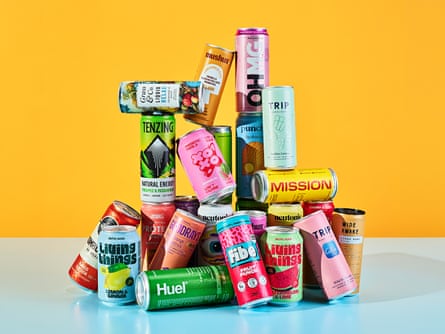
What about protein or collagen water? Many people may benefit from more protein in their diet, says Medlin. “But if you feel you need a bit more protein, eat a bit more protein rather than having a drink that has loads of additives in it. Ultimately, these drinks are all ultra-processed foods, and we need to see them in that light rather than as something beneficial.”
There is still quite a large gap between what the makers of collagen products claim and what the research says – there is little high-quality, large-scale research to suggest that consuming extra collagen positively impacts joints, skin, hair or nails. When we eat collagen (or any protein or peptide) our bodies decide what to break it down into and where to use it – we can’t direct it specifically at our wrinkles or aching knees. Many people don’t realise that bovine collagen is industrially extracted from the skin, connective tissue and bones leftover after cows are slaughtered for meat, or that marine collagen is made from fish bones and viscera. (Vegan collagen is in fact a selection of plant-based peptides mimicking those found in animal-based collagen.)
Few functional drinks, such as Tenzing, contain sugar; most use artificial sweeteners, usually steviol glycosides or sucralose, acesulfame potassium, or erythritol. Steviol glycosides are 200-400 times sweeter than sugar and sucralose is about 600 times sweeter. “Most sweeteners are ultra-sweet,” says Medlin. “And that can make us more likely to look for sugary and sweet things elsewhere,” training our palates to want sweet flavours. “As a gut-health dietitian, I’m very careful with sweeteners, because we know they’re detrimental to gut bacteria.”
Even caffeine, ubiquitous in modern life, needs a health warning. A cup of tea contains 30-50mg of caffeine and a cup of coffee 60-100mg, depending on size and strength, but some energy drinks contain 200mg per can. “Too much caffeine can affect our health negatively. It acts as a stimulant and can cause anxiety and poor sleep,” says Chandratheva. In rare cases, fatal heart arrhythmia can result from drinking well above the NRV of 400mg a day or a large amount very quickly. The American Academy of Pediatrics advises that children under 12 do not drink caffeine, and children aged 12-18 should have no more than 100mg a day. In the UK, the NHS says babies and young children should not drink it; the government is consulting on whether to ban the sale of caffeinated drinks to under 16s in England.
Functional drinks with added fibre or live probiotics are perhaps the least problematic – and in some cases the least processed, too. “I don’t think adding fibre or probiotics to our diets is unreasonable,” says Medlin. “But I do worry about people who are doing it if they already have irritable bowel syndrome (IBS). Most of the added-fibre drinks contain inulin, the most common source of which is chicory root, and that can trigger IBS symptoms.”
Dr Daniel Lamport is a psychologist at the University of Reading who studies the impact of nutrition on cognition and mental health. He has researched probiotics, polyphenols and flavonoids (both beneficial chemicals found in fruits and vegetables) to see if they boost our brain power or our mood. “ There is a place for functional foods, but I’m not convinced there is currently a robust evidence base for many of the claims being made for wellbeing and cognition,” he tells me. “Ultimately, there is no substitute for a fibre-rich, fruit-and-vegetable-rich, whole-foods diet; on that front, the evidence is clear and compelling on the benefits for cognitive health.” So show yourself some love: “It’s just always better to eat the whole food.”
Table of Contents
‘If you love Red Bull, you’ll love this’: functional drinks, rated
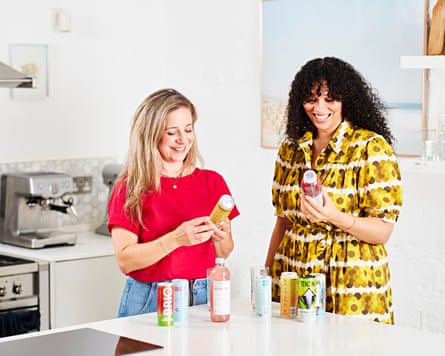
Knowing that a tasting would involve a weird and wonderful range of flavours and ingredients, I recruited drinks writer and editor of Slake magazine, Aleesha Hansel (pictured on right) to help. This wasn’t a blind tasting, as we wanted to know what the product was intended to do ahead of trying them, so looked at the ingredients before we began, and listed the key ones here. Though we both have good palates, picking out notes of yerba mate over those of chaga mushroom or broccoli juice is a challenge.
Mission Lime + Yuzu Natural Energy + Hydration
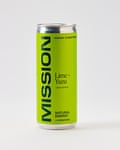
What it costs £2/250ml
What it promises “Functional, light energy and nothing else” and “science-led ingredients to fuel your extraordinary”.
What it contains* Sparkling water, yerba mate extract, magnesium, natural flavourings, ginkgo biloba extract, Himalayan pink salt electrolytes, vitamins C, B3, B6, B7, B12 and D3, natural caffeine.
How it tastes “You can really smell the citrus flavours just from opening the can,” says Hansel. “ It’s all in the front, though. You get the yuzu and lime on the front palate but then it goes to an almost sherbety, synthetic taste. There’s an earthy note underneath, probably the yerba mate. I think they’ve had to make the other flavours so intense to cover up that. Not for me, I’m afraid.”
G Spot Protect
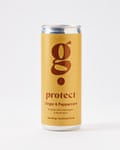
What it costs £2/250ml
What it promises “Daily defence for resilience and wellness” and “ this is where pleasure meets protection”.
What it contains Sparkling water, ginger juice, apple juice, lemon juice, erythritol, kombucha, meadowsweet, turmeric, peppercorn, chaga, natural flavours, vitamin C.
Elevate Your Health for Just $29.99/Month
Join the Precision Wellness Subscription at My Healing 365 and get discounted services, priority coaching access, virtual care, and exclusive wellness resources to support your physical, emotional, and hormonal health.
Join for $29.99/MonthHow it tastes G Spot is actor Gillian Anderson’s functional drinks brand. “Oh Gillian, I wanted to love this,” says Hansel. Sadly, we don’t. “ It smells like baked-bean sauce – that’s not getting anyone in the mood. I was expecting ginger and peppercorn, but those flavours are not there.” Given that it’s made with apple and lemon juice plus kombucha, there isn’t much acidity, either. “It feels very limp, which is the opposite of what she’s trying to do.”
Fibe Fruit Punch
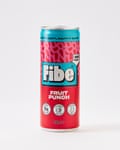
What it costs £1.99/250ml
What it promises “Happy gut, happy days” and 5g fibre per can.
What it contains Water, chicory root inulin, calcium lactate, vitamin C, fructose, natural fruit flavours, citric acid, fruit colour extracts, steviol glycosides.
How it tastes “On the can, it says it has pure party vibes, so I’m expecting a lot,” says Hansel. “The colour and the smell are definitely fruit punch, so they get a tick for that. It’s very nostalgic and it tastes exactly how I want a fruit punch to taste, and the sweetness is good. It’s not sophisticated, but it quite literally does what it says on the tin. I’m happy with that. Well done, Fibe.”
Water Junkie Feel Alive, Chaga mushrooms, Coconut and Lychee
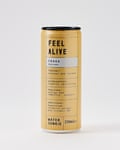
What it costs £2.49/250ml
What it promises “Energy and immunity support”.
What it contains Carbonated water, grape juice, lychee juice, ginger extracts, chaga, turmeric, magnesium lactate, natural lychee and coconut flavourings, steviol glycosides, B6.
How it tastes “ I don’t want this to taste of mushrooms,” says Hansel – and it doesn’t. “The coconut and lychee are giving suncream and pina colada, with a little bit of ginger and turmeric.” But not in a good way.
Vieve Strawberry & Rhubarb Protein Water
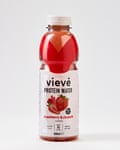
What it costs £2.59/250ml
What it promises 20g of protein, “a tasty, hydrating protein top-up.”
What it contains Water, bovine collagen hydrolysate, phosphoric acid, carrot concentrate, natural strawberry and rhubarb flavouring, citric acid, sucralose.
How it tastes At first, the scent reminds us of strawberry bubble bath. “But there’s also a weird smell of animal hair and … animal’s feet?” says Hansel. The bovine collagen means it tastes as though someone has stirred beef stock into a glass of squash. “It’s excessively sweet. They’re trying to override the meatiness with the sweetness, trying to pretend it doesn’t exist. But it does exist. Oh, that’s horrible.”
Trip Sicilian Lemon Mindful Blend
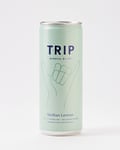
What it costs £2/250ml
What it promises “A drink that actually does something”.
What it contains Carbonated water, grape and lemon juices from concentrate, magnesium, citric acid, extracts of lion’s mane, lemon balm and chamomile, ascorbic acid, steviol glycosides.
How it tastes “I like how this one tastes,” says Hansel. “It’s got a very nice level of acidity, a nice zestiness – all the flavours feel integrated.” It doesn’t feel as if we are drinking something designed to include ingredients just because they are functional – it’s easy to see why Trip is such a successful brand.
Neutonic Natural Energy Orange Sunrise Productivity Drink
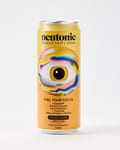
What it costs £2.75/330ml
What it promises “Fuel your focus”, “research-backed nootropic ingredients” from the “world’s first productivity drink”.
What it contains Carbonated water, green tea extract containing L-theanine, natural flavourings, Cognizin (citicoline), rhodiola rosea, panax ginseng, natural caffeine, sucralose, acesulfame potassium, B vitamins.
How it tastes We agree that coffee can probably make a better claim to be the world’s first productivity drink. It smells a little like Calpol. “This is so sweet, it’s almost syrupy,” says Hansel. “Wow, that’s intense – the orange flavour isn’t real oranges, it’s just like Berocca. If you love Red Bull, you’ll love this.”
Goodrays Raspberry & Guava CBD 30mg
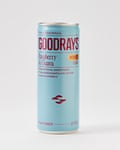
What it costs £7.50/4 x 250ml cans
What it promises “A moment of calm for the curious, the creative, the bold and the brave”.
What it contains Carbonated water, grape juice, raspberry juice, natural flavourings including guava, natural colourings, malic acid, lactic acid, acidity regulator, CBD isolate, vitamin D.
How it tastes “I’m expecting this to be very zesty with lots of red fruit flavours and a bit of tartness from the guava.” The liquid is very pink “and it smells like squash,” says Hansel. “There’s a lavender or Parma Violet flavour to this, which I don’t like. It’s like I’ve eaten my grandmother’s pot-pourri – it’s so perfumed.”
Grass & Co, Peach, Chamomile & Reishi Liquid Relax
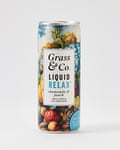
What it costs £2.49 /250ml
What it promises “Mental clarity, relaxation and natural energy”.
What it contains Water, apple concentrate, magnesium, reishi extract, ashwagandha extract, citric acid, peach flavouring, chamomile flavouring, B vitamins.
What it tastes like “There’s white-fruit fleshiness to the nose, from the apple and peach,” says Hansel. “ The flavours are muddy, whereas I want to be able to pick out what’s in this, so that’s disappointing. There’s a slightly savoury note, which I think would come from the mushroom and ashwagandha. It’s not the worst we’ve tasted, but I’m not in love. It’s very middling.”