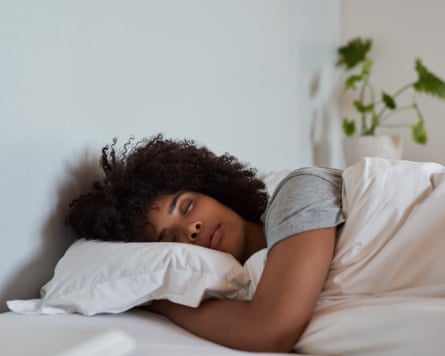
‘Once, after I did a presentation, someone came up to me and said, ‘I don’t get eight hours of sleep a night. Am I going to die?’” says Prof Russell Foster, head of the Sleep and Circadian Neuroscience Institute at the University of Oxford. “And I said, ‘Well, yes, you’re going to die. But, you know, we all die eventually.’”
This exchange is, hopefully, comforting, but it also shouldn’t be too surprising. Over the past decade or so, we’ve been repeatedly told that sleep is everything from a legal performance-enhancer to an actual superpower – and, conversely, that if we don’t get enough shuteye we’re risking an early start to our eternal slumber. But how bad is a lack of sleep, really? And if we seem to be coping fine on six hours a night, is there a chance we’re still setting ourselves up for problems further down the line?
To start with the bad news: yes, being chronically sleep deprived is pretty bad for us. One sobering and relatively recent discovery is the glymphatic system, a waste-clearance mechanism that flushes “misfolded” proteins like beta-amyloids (found in the brains of people with Alzheimer’s disease) from the brain during rest. Foster points to data showing that poor sleep during the middle years is a risk factor for dementia in later years, because the brain loses its ability to effectively clear these toxins. “There’s increasing evidence surrounding a lack of sleep’s association with cognitive decline later in life,” says Prof Guy Leschziner, a consultant neurologist who specialises in sleep disorders. “But it’s also associated with increased risk of cardiovascular disease and stroke. We also know that it impacts a range of other physiological processes, like your immune system, your respiratory system and so on. It even influences how your brain processes pain signals, and makes you more vulnerable to them. Every single system is influenced by sleep in some way.”
The good news? Just because you aren’t getting the commonly recommended seven to eight hours doesn’t necessarily mean you’re at risk. Those numbers are typically based on studies from the UK Biobank, a long-term biomedical database that follows the lives of half a million volunteers to investigate how genetics, lifestyle and environment intersect to cause disease – but that doesn’t mean they’re perfect. “I’m a huge fan of the Biobank, but sometimes it’s difficult to unpick sleep from other causes – like the fatigue caused by other illnesses,” says Foster. “With something like sleep, you can’t just slap an average on it and say that’s what everyone should get.”
So how do you know if you’re getting enough sleep for your health? Perhaps surprisingly, the best marker is whether you feel OK on the amount you get. “There are some people who need shorter sleep than others in order to maintain the same level of cognitive, psychological and physiological health, and then there are others who are genetically long sleepers who need much more,” says Leschziner. “If someone’s only sleeping for six hours a night but they’re not tired, they don’t have any cognitive symptoms, and, when given the opportunity to sleep more, they don’t, then that’s a good indicator that you have an underlying genetic short sleep time.”
A bad indicator is that you’re irritable, feeling flat, or overreliant on caffeine, says Foster. “There’s some really beautiful data on the fact that the tired brain has a tendency to remember negative experiences, but forget positive ones,” he says. “So if you find that you’re depressed and you’re taking a sort of a negative view of the world, that might be an indication you’re not getting one of the most important things for your health. It’s also important to listen to friends, family and colleagues about the way you’re behaving – and of course, if you’re tired and irritable, you’re going to be less inclined to do that. If you’re drinking excess caffeine to fuel the day, that’s really important – especially if you’re delaying sleep onset by drinking it into the afternoon and then using alcohol as a sedative, because sedation isn’t as restorative as real sleep.”
This might be a good time to clarify that insomnia, or being unable to sleep despite wanting to, is a different physiological condition from chronic sleep deprivation, or what happens when you’re burning the candle at both ends.
“The easiest way to see the difference is that if you take somebody who is sleep deprived and you give them a bed during the day, they will fall asleep, whereas people with insomnia won’t,” says Leschziner. “We also know that insomnia and being sleep deprived can have very different impacts on general health. Chronic sleep deprivation is not very good for a range of aspects of your health, whereas for most people with insomnia, a lot of the long-term health effects we associate it with are not necessarily applicable.”
One reason for this is that when researchers track the sleep of people with insomnia, their sleep typically isn’t as short as they think – this is because of a phenomenon called sleep state misperception, where people perceive themselves to have been awake when they’ve actually been asleep. “For the majority of individuals who complain of insomnia, their total sleep time, when we measure it based on their brainwaves, is not that much shorter than the average person,” says Leschziner. “And so while these individuals feel sleep deprived, in most cases they’re not at that much risk of some of the harms that are associated with sleep deprivation.”
This brings us to the shorter term. Here, the news is slightly better – though you should still aim to get to bed early rather than burn the midnight oil. “The current thinking is that memory consolidation seems to happen during slow-wave, or NREM sleep, which dominates the early part of the night – REM sleep is much more about emotional processing,” says Foster. It’s also a good idea to focus on sleep if you’re working on a difficult problem: in a landmark study published in the journal Nature, volunteers working on a complex mathematical task were able to solve it about 60% of the time after a good night’s sleep – compared with groups that remained awake during the day or were sleep deprived at night, who saw a 20% success rate. “Those results tell you that sleep is enormously important for coming up with novel solutions to difficult problems,” says Foster. “It’s really not an indulgence.”

“To have a single bad night’s sleep is something that we’ve evolved to do every so often, and the brain has an enormous capacity to compensate for it,” says Leschziner. “Now, obviously, our vigilance declines, and it is a physiologically stressful experience. You might be stressed and more irritable, but in the greater scheme of things, it’s not going to make a huge amount of difference to our health.”
Can you catch up over the weekend? “If you’re oversleeping when you don’t set an alarm, that’s a key sign that you need more sleep, and catch-up sleep is certainly helpful – there’s no question about that,” says Foster. “But it has the downside that if you sleep through the morning light, you’ve lost a key signal that is stabilising your internal clock, which means you’re likely to drift into later sleep patterns.”
Apart from making it more difficult to get up on Monday morning, this tends to destabilise your circadian rhythms. In the short term, it doesn’t really matter what time you get up – but if you do it repeatedly over a long period of time it can come with health consequences. In shift workers, the problem gets worse – if sleep gets destabilised then activating the body’s stress response can be the best way to stay awake, but that can come at the expense of the body’s other systems. “It’s a bit like the gears of an engine,” says Foster. “First gear can be fantastic – it gives you that acceleration you need – but if you keep your engine there you’ll ruin it. In the same way, constantly elevating the stress response means you’re going to have a suppressed immune system.”
One clear takeaway is to try not to overstress about a single night’s bad sleep: even if it leads to a couple more nights of tossing and turning, it’s unlikely to do you much lasting damage. But what about when we’re being deprived of sleep for the slightly longer term – like in the months after we welcome a baby into the house?
“This is a question I’m often asked,” says Leschziner. “And the honest answer is we don’t know, but what we do know is that parenthood is associated with longevity and with better cognitive health later on in life – so it seems that if there is a neurological harm attributable to the sleep deprivation of parenthood, then it’s typically offset by other benefits that parenthood provides. One of the theories as to why that might be the case is because having children enriches our cognitive world and increases our cognitive reserve: and so parenthood might actually be protective of brain health.”

Really, the best advice is to prioritise sleep: recognise that it’s important, make sure you’re setting enough time aside to get as much as you need to feel well rested, and make the most adjustments you can to your current sleep environment. “If I only did one thing, it would be invest in proper blackout curtains,” says Leschziner. “And if you live in a noisy environment, then consider comfortable earplugs that are designed for sleeping in.”
Finally, there’s at least one good reason to stay up late, even if you shouldn’t make a habit of it. “What some people find is that they can access their executive mode network – which is the set of brain regions that keep us laser-focused – by working late at night, and just ploughing through a project,” says Foster. “So the occasional all-nighter, if you’re doing something that’s highly task-oriented, can be helpful. But don’t do it if you’ve got a difficult social interaction to deal with or you’re driving the next day.”

















