Claire was in bad shape. She had been brought to the ward on a stretcher and hoisted on to a bed where she lay curled up in a ball. She was unable to speak, her eyes flat and face expressionless. While she could move her right arm a little, her left arm and both legs were immobile.
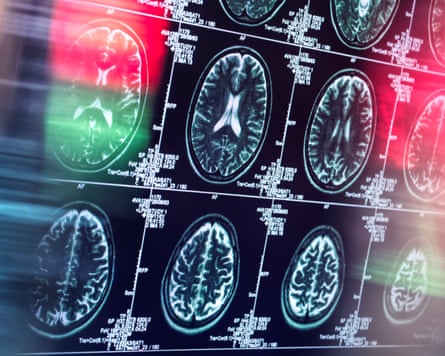
Life had changed dramatically for Claire, a mother of three in her late 30s, many months earlier, when she collapsed while on a night out with friends. A weakness in an artery at the base of her brain had ruptured, spilling blood around her frontal lobe. She was taken to hospital, where surgeons removed two side plate-sized pieces of bone from her skull to relieve the pressure on her brain. She spent months in intensive care.
Can a patient with such profound impairment improve in any meaningful way, especially so long after the event? That was the question for Orlando Swayne, a consultant neurologist and co-lead of the pioneering neurorehabilitation unit at the National hospital for Neurology and Neurosurgery, a Victorian redbrick building in Queen Square, central London.
It was a few years before the pandemic when Swayne first met Claire on the ward. She made eye contact but showed no other response. He knew from the referring hospital that she could write single-word answers to queries, but these revealed characteristic signs of the brain damage she had sustained. Before leaving her bedside to tend to other patients, Swayne asked if she had any questions. With a pencil clenched in her right hand, she wrote: “Questions, questions, questions,” and then tailed off into a wiggly line. The pathological repetition comes from a failure in the frontal lobe to keep actions moving along in sequence.
“There are some patients who start off, when we first work with them, severely impaired – and I mean very severely impaired,” says Swayne. Claire (not her real name) was one such patient.
If he had trusted only his lectures at medical school, Swayne might have considered Claire beyond help. Dogma held that broken brains didn’t mend. A brief flirtation with neurosurgery did nothing to dispel the view. “You see patients in a really terrible state and you think that’s them for life,” he says, “but you don’t see them for very long.”
Swayne quickly decided against a career in neurosurgery, perhaps for the best. “I’m a bit clumsy,” he says, though this wasn’t the only reason. “Neurosurgery is all about the craft, and I’m not really a craft person. I like the people. I like the relationships and the human aspects, which you don’t get so much in neurosurgery.”
He moved into general medicine, then into neurology and stroke medicine, and over the next 20 years or so started to see patients long after their original admission. “I began to realise that some of these patients were improving. And the ones who were improving were the ones working with therapists,” he says. “I thought: ‘OK, I didn’t realise that was a thing. How does it work?’”
The answer, it seems, is to be found in the brain’s capacity for neuroplasticity, its ability to make new connections and reorganise in the face of changed circumstances. In his new book, How to Use a Fork: Stories of Mending the Broken Brain, Swayne argues that recent discoveries in this area have “profound implications” for patients and the therapy and care we owe them.
Swayne is at the piano murdering Chopin – his words, not mine – when I arrive at his north London home. Our chat clashes with his daughter leaving for gap year travels, a milestone I’d assumed would be infused with chaos, but a calmness prevails. A small black dog bounds over and then scoots away, before finding a spot on the kitchen sofa.
My copy of his book is a mess of folded corners, underlined passages and notes in the margin, but I confess, unfairly in retrospect, that I hadn’t relished reading it. For there is history here. Doctors have written books on neuroplasticity before and some made me deeply uncomfortable. To my mind, they peddled false hope through portrayals of miraculous recoveries. At worst, they seemed to imply that patients with severe brain injuries could rise up from their wheelchairs, speak fluently once again and overcome deep cognitive impairment if only they put their mind to it. I feared more of the same: show me a publisher that wants stories of patients whose lives are destroyed and remain so.

Swayne, it turns out, has read the same books and shares the concern. To be clear, he is not suggesting that everyone who suffers a huge stroke or brain injury can recover. His argument is that early, targeted and intense therapy can bring about life-changing improvements, and that we have a moral obligation, not to mention an economic one, to provide such care. “The perception of brain injury is that it is irreversible and irrecoverable from, and this is a corrective to that view,” he says. “There is hope, but clearly you have to balance that. Some people just don’t recover.”
Stroke is a leading cause of adult disability in the UK. It happens when a blood vessel, typically an artery, becomes blocked or bursts, and starves the brain of oxygen and nutrients. Within minutes, brain cells in the affected region begin to die. Depending on the location, a stroke can cause paralysis, loss of speech, blindness and other vision problems, impaired thinking, memory loss, personality changes, an inability to swallow, and more. Of the 12 million or so people globally who suffer a stroke each year, one in five dies within 30 days.
Many stroke patients show small improvements in the first few weeks, as swelling and inflammation subside. According to old-school thinking, that was as much as you could hope for. But it’s not the full story. The damage caused by stroke or brain injury drives chemical changes in the brain. These trigger neuronal growth processes that were last active in the developing brain. Surviving neurons are spurred into making new connections and to work around the dead tissue.
Of course, the brain constantly demonstrates some level of neuroplasticity. To learn a foreign language, or how to play a new instrument or fly a helicopter, your brain must forge new connections. The process redraws the functional maps in the brain, the neural territory called upon to perform particular tasks. So it is that black-cab drivers in London have more grey matter in the hippocampus after learning the Knowledge. Likewise, the amount of brain dedicated to using the index finger expands when people learn to read braille with it. But the process is sluggish in adults compared with children and those who have suffered recent stroke or brain injury.
After such events, neuroplasticity ramps up for several months. This is when intense, targeted therapy can have the most impact. “Even though the capacity for plasticity is greatest in the first few months, it doesn’t just switch off,” Swayne says. In one study, intensive therapy improved upper limb movement in patients 18 months after their strokes.
Elevate Your Health for Just $29.99/Month
Join the Precision Wellness Subscription at My Healing 365 and get discounted services, priority coaching access, virtual care, and exclusive wellness resources to support your physical, emotional, and hormonal health.
Join for $29.99/MonthClaire’s early therapy sessions focused on positioning and stretching – to enable her to sit comfortably – and mouth, tongue and voice box exercises. But they were tough, and she quickly became too tired to continue. In time, though, her stamina improved and she engaged more with the therapists. Her gaze began to follow people walking past and she would sometimes move her mouth to speak in response to questions.

Her improvement gathered pace with music therapy. In those sessions, Claire used her stronger right hand to pluck guitar strings and shake maracas. Her therapists noticed more spontaneous facial expressions and she began to point to instruments, choosing, being proactive. Session after session, for four months, she was drilled to make choices, identify objects, to engage her mouth and tongue.
Swayne hadn’t caught up with the therapists in a while, but one day as he headed past Claire’s bay and said hello, she looked up and said: “What happened to your hair?” Swayne stopped dead. “That was an amazing moment,” he says. “If you work with a patient who’s not spoken for a year, and you do an intervention and they start speaking, it’s got to be a response to the therapy.”
Swayne confided in Claire about his disastrous encounter with a barber and later learned from the speech therapist that her language had been coming for a week or so. First it was single words, then phrases and short sentences. She had made progress with her right hand, too. Before long, she was playing Connect 4 with her boys and fellow patients on the ward, though her left side and right leg remained lifeless.
“She started communicating with her kids and with us, and that was enormous,” Swayne says. “Her left side will always remain weak because it’s very badly damaged, but she started using her right arm to do things, like use a phone and use a power chair. We had her cooking, and that was huge. She will always need help, but for quality of life it was transformational.”
There’s plenty still to learn about the brain’s ability to work around dead tissue, but details of some mechanisms are emerging. Delve into the motor cortex in the brain’s frontal lobe and you’ll find specialised neurons that drive limb movement. These are arranged vertically to send their messages to the spinal cord. But they are also linked by a mesh of horizontal connections. Normally, these horizontal connections are suppressed, but in the event of brain damage, the inhibition is relaxed and the connections activate. Surviving neurons can now recruit neighbours to their cause, though they need time and training to learn the new job.
There’s more to neuroplasticity than this, but the mechanism explains some of the stark limitations that doctors and their patients witness. When neural connections are completely lost, it seems no amount of therapy can bring them back. And while the brain can reorganise to some extent, there’s no evidence that a specialised region of the cortex can take on an entirely different role. If a stroke leaves your right arm limp, your visual cortex cannot take control of it any more than your kettle can make the morning toast. That said, movement, language, sensation and vision are not confined to small brain regions: they are distributed across networks that provide for some flexibility. For example, most people do the bulk of their language processing in the left side of the brain, but if it is damaged, there’s evidence that parts of the language network on the right side can take on some of the work.

Much of the immediate work with new stroke patients is to identify their impairments and the causes. If they are unable to use a fork, what is stopping them? Can they feel it? Are they too weak on that side? Can they coordinate their movements?
Therapists take impairments and break them down into steps that patients can be drilled on. There is, so far, no shortcut to the gruelling hours put in by the patients described in Swayne’s book. Thomas, a vicar who couldn’t speak after a stroke at the pulpit, had intensive speech therapy to retrain his swallowing and tongue movements. Christian, a mixologist at a swanky London hotel, relearned how to brush his teeth: turn the tap on, get the toothbrush, add the toothpaste. Vikas, a roofer who fell from three storeys up, had sessions in the kitchen to learn how to pay attention and multitask again.
It’s not just the direct damage that therapists have to contend with. The brain can create its own problems. Patricia, a catering assistant, had lost the use of her right arm. When asked to point to it, she would move it out of the way and keep searching among the bedclothes. She later believed the arm was a baby and became inconsolable when she thought it had died.
The therapy a patient receives after stroke is the most important determinant of how well they recover: will they be dependent on others or able to fend for themselves? Yet what most patients receive is grossly inadequate, Swayne says. Every working day, patients at stroke units in the UK should receive 45 minutes each of physio, occupational therapy and speech therapy. In 2020, an audit found that most patients received only 14, 13 and seven minutes per day, respectively. “It’s shocking,” says Swayne.
It is even worse when people leave hospital. Stroke units used to pass patients on to the community therapy team in their local area, but those networks were demolished by austerity economics. “It’s a real postcode lottery. There are some boroughs where you’re relieved you’re discharging the patient to that borough because they’ve actually got a speech therapist, whereas another borough is a desert,” Swayne says. “It’s frustrating, having worked with these patients for months, to then send them into the wilderness.” It’s common for patients to return a year or two later with complications, having had no therapy since leaving hospital.
The argument that proper rehabilitation is a luxury we cannot afford does not add up, Swayne adds. Early intensive therapy pays for itself by reducing the cost of long-term care. This will become ever more important as first-time strokes rise in the coming years. Today, strokes cost the UK economy an estimated £27bn a year, but only £3bn of that is driven by direct hospital care. The rest is lost economic productivity and the invisible costs of care. By 2035, the cost is predicted to more than triple to £75bn.
“People talk about the cost of these interventions, but if you do the maths, an admission might cost something like £40,000,” Swayne says. “That sounds like a lot of money, but if you look at the change in care costs, it isn’t, because it pays itself back pretty quickly.” Swayne did the sums for one patient: during his time in the rehabilitation unit, his care costs fell to £2,640 per week, meaning the cost was offset within four months of him going home, and would save tens or hundreds of thousands of pounds in the longer term.
It’s not just stroke rehabilitation that’s in trouble. Care for traumatic brain injury is also badly neglected. Each year, more than 1 million people in England and Wales attend emergency departments for head injuries. Of the 200,000 or so who are admitted to hospital, about 40,000 have evidence of traumatic brain injury.
Many such patients are discharged within a couple of weeks. Superficially, they seem better: they can walk and talk. But often, important problems are simply not spotted. “What we now realise is that a majority of those patients have got cognitive changes that haven’t been picked up,” Swayne says. “You can see them walking down the street and they look fine, but they cannot function normally. There’s an invisible disability. It affects their relationships, their employment and they get into trouble with the police.”
And so, the hidden damage left by brain trauma can lead to lives falling apart. In one 2025 study, researchers found that nearly 90% of adult men in Scottish prisons had experienced severe head injury. That doesn’t mean that brain injury triggered their crimes: violent men experience more violence. But damage to specific brain regions might contribute to criminal behaviour, by making it harder for people to control their impulses, feel empathy and anticipate the consequences of their actions.
Researchers are looking at ways to make therapy more effective and – the holy grail – to reopen the window of enhanced neuroplasticity. New drugs, brain stimulation and virtual reality are all in the mix. If they succeed, patients could receive more beneficial therapy to boost their recovery. But for now, perhaps the best we can do is keep our brain healthy and protected.
“We all know what to do for brain health,” says Swayne. “We should exercise. We should be in a stimulating environment and have social interactions. We shouldn’t smoke or drink too much alcohol. There’s really strong evidence that all these things help with brain maintenance. By looking after your brain you’re giving yourself the best chance of recovery should you need it.”
How to Use a Fork: Stories of Mending the Broken Brain is published by Pan Macmillan on 4 June (£20). To support the Guardian, order a copy from guardianbookshop. Delivery charges may apply

























