Table of Contents
You’re in a boom and bust cycle
We’ve all done it. Launched ourselves head first into a new regime – perhaps as the result of a new year resolution, recent breakup or aggressively unflattering photo. “You go all in and train five days a week,” says Elizabeth Davies, personal trainer and author of Training for Your Old Lady Body. “Then life happens. You miss a few sessions, then stop completely. You feel deflated that you couldn’t stick to it. Then some time later, motivation strikes again and the cycle repeats itself.”
A better approach is to devise a realistic training schedule that actually aligns with your lifestyle. “When getting started, lower the bar,” she suggests. “Aim for two weekly strength sessions done consistently. If you manage that, and have the time, energy and inclination to do more, you can always add in a third. It’s much easier to build on something you’re doing consistently than repeatedly start over with something that’s unsustainable.”
You’re changing your programme too often
“There’s an outdated belief that you must ‘keep the body guessing’ in order for it to adapt, by continually switching up your workouts,” says Nick Finney, who has trained Robbie Williams and Jennifer Lopez. “I understand that people want to avoid boredom by changing what they do each workout, but it ends up hindering their progress. You need to practise your technique, become more proficient and give your body time to improve and get stronger. If you keep changing things up, then it’s impossible to measure progress by comparing what you achieved in previous workouts.”
Instead, he suggests adopting the principle of “progressive overload”. Simply put, this means gradually increasing the reps or weight of your lift, in order to stimulate your body to react by growing stronger. “There is a very simple formula: you might be able to lift 60kg on a bench press for five reps. If over time you are able to increase this to eight reps you can then increase the load to 64kg, which may then put your maximum reps back down to five. So you keep practising until you can get to eight reps at 64kg, before increasing the load again.”
You’re too focused on cardio
“For decades, people have associated getting fit with running, cycling or other forms of cardiovascular exercise,” says David Vaux, an osteopath and author of Stronger: 10 Exercises for a Longer, Healthier Life. “These activities are excellent for heart health, weight management, joint health and mental wellbeing – but focusing exclusively on cardio means you may be neglecting one of your body’s most valuable ageing assets: your fast-twitch muscle fibres. We lose these at a faster rate as we age, which is one of the major contributors to frailty, falls, reduced mobility and loss of independence later in life. For most people, the healthiest approach is to combine regular movement with resistance training two or three times each week.”
You’re adding ‘junk volume’
Victorian poet Robert Browning coined the phrase “less is more”. He wasn’t writing about Bulgarian split squats, but he might as well have been. “People often assume more is better: more weekly sessions, more exercises within each session, more sets,” says Davies. “But you don’t need to cram 10 different movements into a session. This can actually just add fatigue without much benefit.” If muscle growth is your goal, you need to be training “close to failure” – the point at which you could not manage another good rep.
“If you’re stopping each set when you’re reaching an arbitrary number rather than because the set has become genuinely challenging, you may not be providing your body with enough stimulus to adapt,” she says. “And don’t confuse ‘feeling the burn’ with being close to failure. That burning sensation is largely associated with the buildup of metabolites during exercise, especially very high-rep sets, which are popular in some classes. It can be very uncomfortable, but discomfort isn’t necessarily the same thing as your muscles reaching the point where they could not do another good rep.”
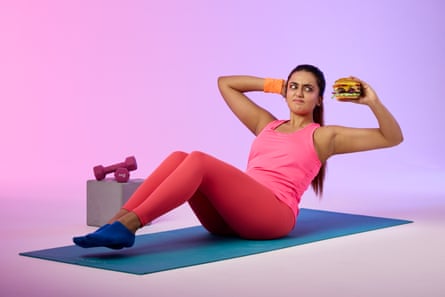
You’re trying to out-train a bad diet …
Finney warns that bad nutrition is “by far” the most common factor holding gym-goers back from reaching their goals: “Working out hard all week can be completely negated simply by eating whatever you want. People believe workouts burn tons of calories, but most barely even burn off a balanced meal. You must tackle your nutrition if you are serious about any physical change.”
If your goal is weight loss, you need to be working in a calorie deficit. If you want to build muscle, you need to be eating a surplus of the right kind of calories, including about 2g of protein for every kilo of body weight. And don’t fall into the trap of thinking that a frenzied hour-long workout is the best way to burn off a burger. “Blitzing a bootcamp-style workout that leaves you feeling like you’re dying may only burn about 150 more calories than doing a calmer, focused weights workout. That’s about the same amount of calories as one and a half apples. And yet the difference in effort and fatigue and potential for injury is huge.” If your goal is weight loss, he suggests finding a type of exercise you enjoy, and focusing on training at a sustainable pace while eating a deficit of about 500 calories a day.
… and you’re drinking your calories
According to trainer and women’s wellness coach Aimee Victoria Long, “People often focus on what they’re eating and forget about what they’re drinking. Coffees, juices, smoothies, soft drinks and alcohol contain a surprising amount of sugar and calories – they add up incredibly quickly.” Long is a proponent of everything in moderation, but cautions: “If your goal is fat loss and you’re not seeing results, it’s worth looking at what’s in your favourite drinks.”
You’re training too hard
Forget “go hard or go home”. In practice, this can mean “go hard and tear a ligament”. “I often see people in my clinic who have thrown themselves into high-intensity workouts six or seven days a week, believing more intensity – longer, faster, heavier – must mean better,” says Vaux. “Unfortunately, our bodies don’t work like that. Fitness is built through consistency, not punishment. The body needs time to adapt to exercise, especially if you’ve been inactive for a while. In particular, our connective tissues, such as tendons and ligaments, need time to adapt to training and increase their strength.”
Elevate Your Health for Just $29.99/Month
Join the Precision Wellness Subscription at My Healing 365 and get discounted services, priority coaching access, virtual care, and exclusive wellness resources to support your physical, emotional, and hormonal health.
Join for $29.99/MonthYou also need to allow time between sessions for the body to recover. “If we have not fully recovered before our next training session, the risk of injuries such as tendinitis increases,” says Vaux. “This can leave us weaker and less fit than we were before. Think of exercise as a long-term investment rather than a short-term fix. Start with a programme you can realistically sustain and gradually build from there.”
You have unrealistic expectations
Not content with rotting our brains and destroying democracy, it seems social media is also giving us skewed expectations of what we can hope to achieve in the gym. “A big problem, especially for young people, is that they see fitness influencers with visible veins and rippling six-packs, and feel despondent about their own lack of progress by comparison,” says Finney. “The reality is that many influencers have been training for years, edit their pictures and even use performance-enhancing drugs. It’s often not a realistic or healthy goal to emulate.” Progress takes time, and attempting a quick fix is likely to leave you disappointed.
“Some people want to lose weight very quickly and restrict calories too severely,” Finney says. “Crash dieting often means losing muscle alongside fat, resulting in a ‘skinny fat’ appearance. Creating a steady calorie deficit allows you to slowly chip away at fat stores, while maintaining strength and energy. A solid and realistic weight loss result is to lose 1lb a week. If your strength in the gym is significantly diminished, that’s a sure sign your calorie deficit is too severe. As a very generalised guide, people can healthily gain 1lb-2lb of muscle a month. This will taper off after the first year of training.”
You’re wasting time
Is there anything more annoying than someone hogging a machine while scrolling on TikTok? Take satisfaction from the fact they aren’t just robbing you of precious minutes atop the Booty Builder – they’re also short-changing themselves. “Something I see all the time is people saying they train for an hour, but spending half of that chatting to friends, checking their phone or taking far too much rest between sets,” says Long. “Suddenly that hour-long workout is only 30 minutes of meaningful training.”
Instead, she suggests “putting your phone away, having a plan before you start, and being intentional with your rest periods. If you’re training to build muscle, rest for 60-90 seconds between sets, or 90-120 seconds if you’re training to increase strength.” How long should a typical session last? “If you’re being efficient, you can get a solid workout done in 45 minutes, but there is nothing wrong with doing 60-90 minutes, depending on your training plan.”
Models: Parsha and Tom Trossero at Street Cast Models. Styling assistant: Tasha Patrick. Hair and makeup by Sarah Cherry using Estee Lauder